
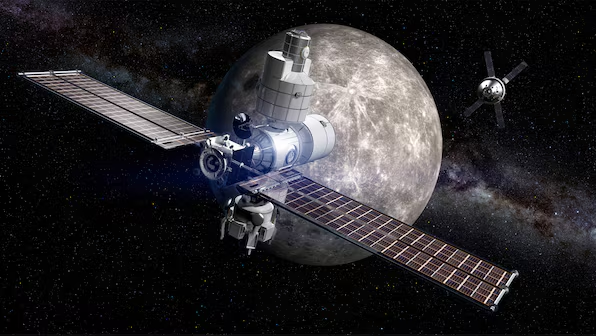
Exciting news is coming from space agencies! NASA and the United Arab Emirates (UAE) announced that they will work together to build a new space station that will orbit the Moon. This is a big step in human space exploration and shows how countries are teaming up to explore our closest neighbor in space.
The project is expected to open new opportunities for science, research, and future missions to the Moon and even farther to Mars. It’s a sign that space exploration is becoming more global, with different countries sharing knowledge, technology, and goals.
What Is This New Space Station?
The new space station will circle the Moon, meaning it will orbit around the Moon instead of Earth. Scientists and engineers are calling it a “gateway” for future missions. This station will serve as a base for astronauts, where they can live and work while studying the Moon and preparing for even bigger space missions.
The station will be smaller than the International Space Station (ISS) that orbits Earth, but it will still have laboratories, living quarters, and science equipment. Astronauts will be able to stay there for weeks or months, instead of just visiting the Moon for a few days.
Why NASA and UAE Are Collaborating
NASA has a long history of space missions, including sending humans to the Moon in the 1960s and 1970s. The UAE is newer in space exploration but has made impressive achievements, like launching the Hope Probe to Mars in 2020.
By working together:
-
NASA brings experience and technology
-
UAE brings new funding, research ideas, and regional expertise
-
Both can share astronaut training, science experiments, and data
This partnership shows that space exploration is no longer just for one country—it’s becoming a global effort.
Where Will the Station Orbit?
The station will orbit the Moon in a path called a lunar orbit. This means it will move around the Moon in a circular or slightly oval path. From this position, astronauts and scientists can:
-
Observe the Moon’s surface
-
Study craters, mountains, and possible water ice
-
Prepare for landings on the Moon itself
Being in lunar orbit makes it easier and safer for astronauts to reach the Moon’s surface and return to the station.
What Is the Purpose of the Moon Space Station?
The main goals of the space station are:
-
Scientific Research: Study the Moon’s geology, water, and atmosphere (yes, the Moon has a very thin layer of gases).
-
Astronaut Training: Prepare astronauts for longer missions to the Moon or Mars.
-
Technology Testing: Try new spacesuits, vehicles, and tools for lunar exploration.
-
International Cooperation: Build strong partnerships between countries for future space projects.
It will also help NASA plan the Artemis missions, which aim to send humans back to the Moon in the coming years.
How Will the Space Station Be Built?
Building a space station around the Moon is not easy. It will likely happen in phases:
-
Step 1: Launch modules into space from Earth
-
Step 2: Assemble them in orbit around the Moon
-
Step 3: Test systems for life support, energy, and communication
-
Step 4: Send astronauts and scientists to live and work there
Robots and spacecraft will help assemble parts before humans arrive. Some modules may even be pre-positioned to make construction faster and safer.
What Will Astronauts Do There?
Astronauts living on the lunar station will have many tasks:
-
Conduct experiments to learn more about space and the Moon
-
Test new technology for survival on other planets
-
Monitor the Moon’s surface for changes, such as dust storms or possible ice deposits
-
Prepare for landings on the Moon’s surface for exploration missions
Living in lunar orbit will also help scientists understand how long-term space travel affects the human body.
How Is This Station Different from the ISS?
The International Space Station (ISS) orbits Earth, while this new station will orbit the Moon. The Moon is farther away from Earth, which brings new challenges:
-
Communications take longer
-
Supplies need careful planning
-
Astronauts need more advanced systems to live safely
The station will also focus more on lunar science instead of general space experiments like on the ISS.
How the UAE Contributes
The UAE has been investing in space science for years. Their contributions may include:
-
Advanced satellite technology for observing the Moon
-
Research funding to support experiments
-
Expertise in space robotics to help assemble the station
The UAE’s involvement shows how emerging space nations are becoming key partners in major projects.
Why the Moon Is Important
The Moon is not just a bright object in the night sky. It is a strategic stepping stone for space exploration:
-
Provides a base to study Mars and beyond
-
Has potential water ice, which can be turned into oxygen and fuel
-
Helps test technology for long-term space living
Understanding the Moon also helps us learn about Earth’s history because both planets formed together billions of years ago.
What This Means for International Space Cooperation
This collaboration is a sign that the future of space exploration is global. NASA, UAE, and possibly other countries may work together on:
-
Lunar research stations
-
Space resource exploration
-
Deep-space missions to Mars or asteroids
Working together allows countries to share costs, technology, and knowledge—making space exploration faster and safer.
Challenges of Building a Moon Station
Of course, building a station around the Moon is not simple. Some challenges include:
-
Harsh space environment with radiation and temperature extremes
-
Distance from Earth makes resupply difficult
-
Technical challenges in assembling large structures in orbit
-
Ensuring astronaut health and safety for long periods
Scientists and engineers are already working on solutions to make this station a reality.
Timeline for the Moon Station
NASA and UAE have not released a fixed timeline, but experts estimate:
-
Next few years: Planning and designing modules
-
5–7 years: Launch initial parts of the station
-
7–10 years: Begin sending astronauts for long-term stays
This timeline may change depending on funding, technology, and testing results.
How This Helps Future Missions
The Moon station is more than just a place to orbit—it is a training ground for exploring the rest of the solar system. Astronauts can:
-
Learn to live in space longer
-
Test new equipment for Mars missions
-
Study how humans adapt to low gravity
It’s like a space school where scientists and astronauts learn before going farther into space.
Public Interest and Excitement
News of this collaboration has captured attention worldwide. People are excited because:
-
The Moon has always fascinated humans
-
Seeing multiple countries work together is inspiring
-
The idea of humans living in space is exciting
Social media and news outlets are sharing updates, photos, and graphics showing how the station might look.
Final Thoughts
The NASA-UAE collaboration to build a Moon-orbiting space station is a historic step in space exploration. It shows how countries can work together to achieve big goals in science and technology.
This station will help astronauts live in space longer, study the Moon in detail, and prepare for missions to Mars and beyond. It’s a symbol of global cooperation and a reminder that space exploration is entering a new era—one where the Moon is not just a distant object in the sky, but a base for humanity’s future in space.
As scientists and engineers work together, the dream of living and working near the Moon is becoming closer to reality. And for the world, it’s a moment to look up at the Moon with excitement and wonder.
Read Also: Keep your face towards the sunshine and shadows will fall behind you
Watch Also: https://www.youtube.com/@TravelsofTheWorld24










Leave a Reply