
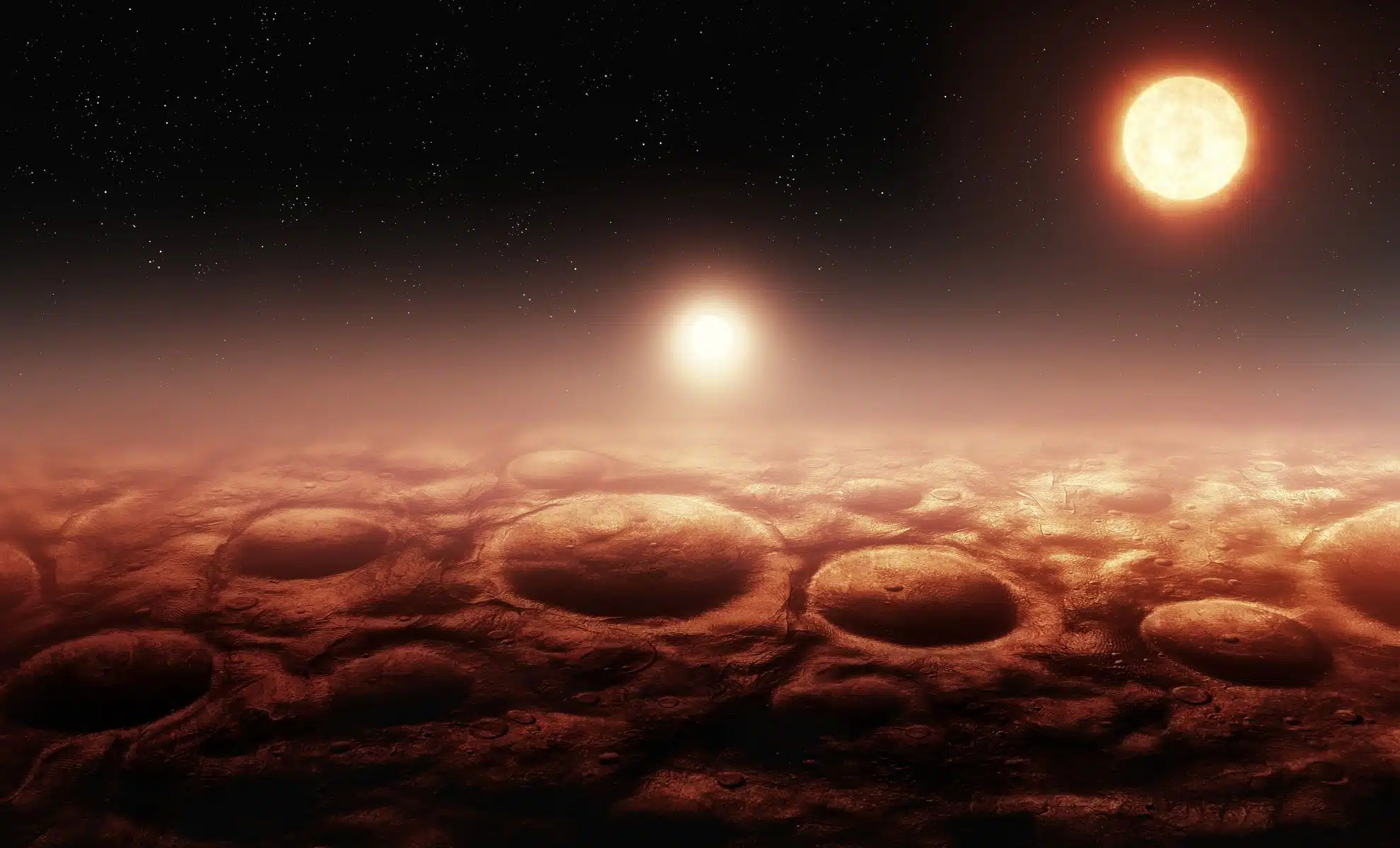
For many years, scientists believed that planets orbiting two suns—called “two-sun planets” or circumbinary planets—might be very common in the galaxy. Since there are billions of stars in the universe, and many stars exist in pairs, astronomers expected to find hundreds or even thousands of such planets.
But the surprising reality is very different. So far, only about 14 confirmed two-sun planets have been discovered. This huge gap between expectation and reality has confused scientists for a long time.
Now, a new idea based on Einstein’s theory of gravity may help explain why these planets are so rare.
What are two-sun planets?
Two-sun planets are planets that orbit around two stars instead of one.
In a normal solar system like ours:
- One star (the Sun)
- Planets orbit around it
But in a two-sun system:
- Two stars orbit each other
- A planet orbits both of them together
This creates a very complex gravitational environment.
You may remember the fictional planet Tatooine from Star Wars, where two suns rise in the sky. That idea is based on real science.
Why scientists expected more of them
Astronomers expected many two-sun planets because:
- Binary star systems are very common in the galaxy
- Planets form from gas and dust around stars
- So if stars form in pairs, planets should also form around them
With billions of stars in the Milky Way, scientists thought two-sun planets should be everywhere.
But observations did not match this expectation.
The surprising discovery: only 14 planets
Despite powerful telescopes and long years of research, only a small number of two-sun planets have been confirmed.
This includes planets found by space missions like Kepler and ground-based telescopes.
So the big question became:
Why are they so rare if the universe is full of binary stars?
The role of gravity in binary star systems
The main reason lies in gravity.
In a system with two stars:
- Gravity is not stable
- The forces constantly change direction
- Planetary orbits become chaotic
Instead of a smooth orbit, planets experience:
- Pull from one star
- Then the other star
- Then a changing balance between both
This makes it very difficult for planets to stay in stable orbits.
Einstein’s theory may explain it
Albert Einstein’s theory of general relativity changed how we understand gravity. Instead of being a simple force, gravity is described as a curvature of space and time.
In strong and complex systems like binary stars, this curvature becomes very complicated.
According to modern studies based on Einstein’s ideas:
- The gravitational field in binary systems is highly unstable
- Small changes in position can lead to large orbital shifts
- Planets can be thrown out of the system entirely
This may explain why so few stable two-sun planets exist.
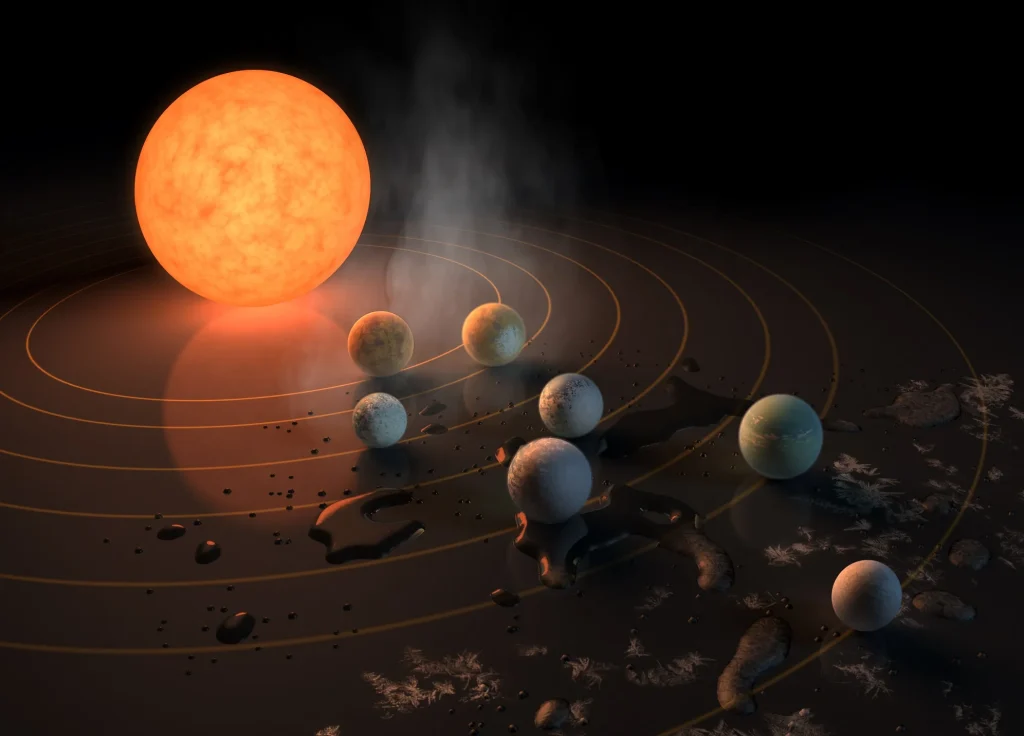
The Mystery of Two-Sun Planets and What Einstein Discovered
How planets get destroyed or ejected
In many binary systems, planets may:
1. Fall into one of the stars
Strong gravitational pulls can drag planets inward.
2. Get thrown into deep space
Unstable orbits can eject planets completely out of the system.
3. Never form properly
The early chaotic environment may prevent planets from forming at all.
Where do the 14 known planets survive?
The few known two-sun planets exist in very special conditions.
They are usually:
- Far enough from the stars to avoid strong gravitational chaos
- In stable orbital zones
- Carefully balanced between both stars
These “safe zones” are rare, which explains why such planets are uncommon.
How astronomers detect them
Scientists cannot directly see these planets easily. Instead, they use methods like:
- Watching stars dim when a planet passes in front
- Measuring small gravitational effects on stars
- Tracking unusual light patterns
Space telescopes like Kepler Space Telescope played a major role in finding them.
Why this discovery is important
Understanding two-sun planets helps scientists:
- Learn how planets form in extreme conditions
- Study the role of gravity in complex systems
- Improve models of planetary systems
- Understand how rare or common Earth-like systems might be
It also helps us understand whether stable life-supporting planets can exist in binary star systems.
What this tells us about the universe
This discovery teaches us something important:
Just because something is possible does not mean it is common.
Even though the universe is full of stars, the conditions for stable planet formation can be very specific.
The universe is not only vast, but also very selective in how things form and survive.
Connection to Einstein’s ideas
Einstein’s theory helps scientists understand:
- How gravity behaves in extreme systems
- How space-time is curved by massive objects
- Why orbits become unstable in binary stars
Without these ideas, it would be very hard to explain why two-sun planets are so rare.
Future research
Astronomers are still searching for more two-sun planets. Future telescopes will help:
- Detect smaller planets
- Study more binary star systems
- Understand orbital stability better
- Improve models of planet formation
There may still be many undiscovered worlds waiting to be found.
Final thoughts
Scientists once expected hundreds of two-sun planets, but only a few have been found. This surprising result shows how complex the universe really is.
In simple words:
Two-sun planets are rare because the gravitational environment in binary star systems is extremely unstable, and Einstein’s theory helps explain why.
This discovery reminds us that space is full of surprises, and even our best predictions can be challenged by reality.
Read Also: Keep your face towards the sunshine and shadows will fall behind you
Watch Also: https://www.youtube.com/@TravelsofTheWorld24







Leave a Reply