
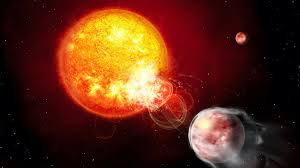
Astronomers have made a fascinating discovery that is helping us understand how planets are born. A giant “baby planet,” often called a Baby Jupiter, has been spotted forming around a young star located about 500 light-years away from Earth. This is one of the clearest glimpses we’ve ever had of a planet being born in real time.
The discovery is not just exciting—it also gives strong clues about how our own solar system may have formed billions of years ago.
What Is This “Baby Jupiter”?
The object discovered is not a fully formed planet yet. Instead, it is a growing planet in its early stage, known as a protoplanet.
Scientists believe it will eventually become similar to Jupiter, which is the biggest planet in our solar system.
At this stage, it is still collecting gas, dust, and material from the space around it. Think of it like a snowball rolling down a hill, getting bigger as it gathers more snow. In space, this “snow” is made of gas and dust.
Where Was It Found?
This baby planet was found orbiting a young star surrounded by a thick disk of material.
The star is located about 500 light-years away, which is extremely far. Even light, which is the fastest thing in the universe, takes 500 years to reach us from there.
The discovery was made using advanced telescopes that can look deep into space and see through clouds of dust.
The Star and Its Planet-Building Ring
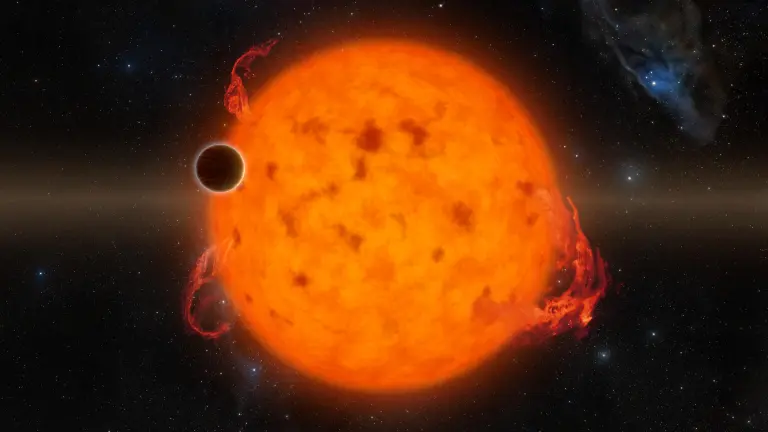
The young star is surrounded by a huge spinning disk made of gas and dust. This is called a protoplanetary disk.
Inside this disk:
- Dust particles collide and stick together
- Gas slowly gathers into large clumps
- Gravity pulls material together
- Slowly, planets begin to form
This is exactly where the “Baby Jupiter” is forming.
How Scientists Saw It
Normally, planets forming inside dust disks are very hard to see. The dust hides them from direct view.
But in this case, scientists used very powerful telescopes and special imaging techniques to detect the planet.
One of the main tools used was the Very Large Telescope (VLT).
They also used infrared light, which can pass through dust better than normal visible light.
This allowed them to see a faint object shaping a gap inside the disk—strong evidence of a forming planet.
Why This Discovery Is So Important
This discovery is important because it gives us a rare chance to watch planet formation happening right now.
Before this, scientists mostly relied on computer models and indirect clues. Now, they have actual visual evidence.
This helps confirm long-standing ideas about how planets are born.
How Planets Like Jupiter Are Born
To understand this discovery, it helps to know how giant planets form.
Here’s a simple explanation:
- A young star forms from a cloud of gas and dust
- Leftover material forms a spinning disk around the star
- Dust particles begin to stick together
- Small clumps grow into bigger cores
- Once the core becomes large enough, it pulls in gas quickly
- A giant planet is formed
This process can take millions of years.
The Baby Jupiter is currently somewhere in step 4 or 5.
What Makes Jupiter Special?
Jupiter is a gas giant, meaning it is mostly made of hydrogen and helium. It does not have a solid surface like Earth.
It also has:
- A strong magnetic field
- Over 90 moons
- Giant storms like the Great Red Spot
- A very fast rotation (about 10 hours per day)
Seeing a planet like Jupiter forming helps scientists understand how such massive worlds come into existence.
What the Baby Planet Looks Like
The baby planet itself cannot be seen clearly like a solid object. Instead, scientists detect it through its effects on the surrounding disk.
They noticed:
- A gap forming in the disk
- Changes in light patterns
- Material being pulled inward
- Signs of a growing gravitational object
These clues all point to a forming giant planet.
Why It’s Called a “Baby”
The term “baby planet” is not official science language. It is used to help people understand that the object is still growing.
In scientific terms, it is called a:
- Protoplanet
- Forming planet
- Planetary embryo
It is still changing and has not cleared its orbit yet.
The Role of Gravity
Gravity is the main force behind planet formation.
In the disk around the star:
- Tiny particles attract each other
- Bigger objects grow stronger gravity
- They pull in more material
- Over time, a planet is formed
In the case of Baby Jupiter, gravity is already strong enough to start shaping its surroundings.
How Rare This Discovery Is
Seeing a planet at this stage is extremely rare.
Why?
- These systems are very far away
- The process is hidden inside thick dust
- It happens over millions of years
- Only a few systems are close enough to observe in detail
That’s why this discovery is considered a major milestone in astronomy.
What This Means for Our Solar System
This discovery also helps scientists understand our own origins.
Our solar system likely formed in a similar way about 4.6 billion years ago.
Earth and other planets probably started as small dust particles in a disk around the young Sun.
Over time, those particles came together and formed planets, moons, and asteroids.
So, this Baby Jupiter is like a window into our own past.
Tools That Made This Possible
Modern astronomy uses very advanced technology. Some key tools include:
- Large ground-based telescopes
- Space-based observatories
- Infrared cameras
- Computer simulations
Without these, we would not be able to see such distant and faint objects.
What Scientists Want to Learn Next
This discovery opens many new questions:
- How fast does a planet like Jupiter grow?
- Why do some planets become giants while others stay small?
- How common are systems like this in the galaxy?
- Can we find more baby planets forming nearby?
Future missions will try to answer these questions.
The Bigger Picture
The universe is full of star systems forming new planets all the time.
Every star you see in the night sky could have its own system of planets forming around it.
This discovery shows that planet formation is not rare—it is happening everywhere.
Final Thoughts
The discovery of a Baby Jupiter forming 500 light-years away is one of the most exciting moments in modern space science.
For the first time, we are not just imagining how giant planets are born—we are actually seeing it happen.
It brings us closer to answering one of the biggest questions in science:
How did worlds like ours come to exist?
And with new technology coming in the future, we may soon witness even more amazing discoveries like this.






Leave a Reply