
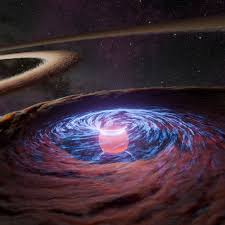
A major breakthrough in space science has shocked and excited astronomers around the world. For the first time ever, scientists have captured a direct image of a “baby” planet forming inside a ring of dust and gas around a young star. This discovery gives strong proof of how planets are born and how solar systems like ours may have formed billions of years ago.
This event is being called one of the most important discoveries in modern astronomy. It helps us see, almost like a real-life picture, how planets begin their journey from tiny dust particles to full-grown worlds.
Let’s break it down in a simple way.
What Was Discovered?
Astronomers observed a young star surrounded by a large disk of gas and dust. Inside that disk, they found a forming planet—often called a protoplanet or “baby planet.”
This baby planet is still in its early stage of development. It is not fully formed like Earth or Jupiter. Instead, it is slowly collecting material from the disk around it.
The most surprising part is that scientists were able to actually see it directly. This is very rare because planets forming inside dusty disks are usually hidden from view.
Where Was It Found?
The discovery was made using advanced telescopes that can observe deep space in high detail. One of the key tools used was the Very Large Telescope (VLT), which is one of the most powerful ground-based telescopes in the world.
The baby planet was found orbiting a young star surrounded by a glowing ring of material. This ring is called a protoplanetary disk.
These disks are like cosmic “birthplaces” of planets. They contain gas, dust, ice, and rocks that slowly come together over millions of years.
What Makes This Discovery So Special?
In the past, scientists could only guess how planets form. They had theories, computer models, and indirect signals—but no clear pictures.
Now, for the first time, they have actually seen a planet forming inside its birth environment.
This is important because:
- It confirms long-standing theories about planet formation
- It shows planets form inside rings of dust and gas
- It gives real images instead of just simulations
- It helps us understand how Earth may have formed
It is like finally seeing a baby being born instead of just imagining it.
What Is a “Baby Planet”?
A baby planet is not like a fully developed planet. It is still growing and changing.
At this stage:
- It is gathering dust and gas
- It is forming a solid core
- It may still be very hot
- It is shaping its orbit around the star
Over time, this object may grow into a gas giant like Jupiter or become a rocky planet like Earth.
Scientists call this early stage a protoplanet.
The Star and Its Ring System
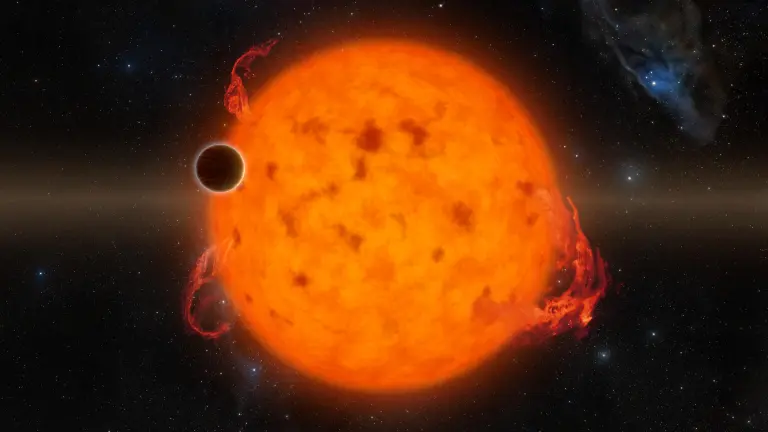
The star where this discovery happened is very young in cosmic terms. Around it is a huge spinning disk of material.
This disk is made of:
- Dust particles
- Gas clouds
- Ice fragments
- Rocky debris
These materials slowly move and collide. Over millions of years, they start sticking together.
This process eventually forms planets, moons, and sometimes even asteroid belts.
How Planets Are Born (Simple Explanation)
Planet formation is a slow process. Here’s how it works in simple steps:
- A star is born from a cloud of gas and dust
- Leftover material forms a spinning disk around the star
- Dust particles begin to stick together
- Small clumps grow into larger bodies
- These bodies become baby planets
- Over time, they clear their path around the star
This process can take millions or even billions of years.
The new discovery shows step 4 and 5 happening in real time.
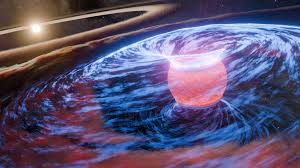
Huge Space Breakthrough: Baby Planet Spotted Inside Dust Ring 🔭
How Scientists Took the Image
Capturing this baby planet was not easy.
The disk around the star is very bright and dusty. It blocks direct light from the forming planet.
To solve this, scientists used special imaging techniques that filter out the star’s brightness and highlight faint objects nearby.
They also used infrared light, which can pass through dust better than visible light.
This allowed them to spot the planet forming inside the ring.
Why It Took So Long to See This
Even though planets form in many places across the universe, we rarely see them directly.
There are three main reasons:
- They are too far away
- They are hidden by dust
- They are too faint compared to the star
Because of this, scientists usually rely on indirect signs, like gaps in dust rings or changes in light patterns.
This new discovery is special because it breaks that barrier and shows a real image.
What This Tells Us About Our Own Solar System
This discovery is not just about a distant star. It also tells us about our own past.
Scientists believe our solar system formed in a similar way about 4.6 billion years ago.
Earth, Mars, Jupiter, and other planets likely formed from a similar dusty disk around the young Sun.
So, this baby planet is like a glimpse into our own history.
It helps answer big questions like:
- How did Earth form?
- Why are planets different from each other?
- How common are solar systems like ours?
Role of Modern Technology
This discovery was only possible because of modern space technology and powerful instruments like:
- Advanced space telescopes
- High-resolution imaging systems
- Infrared sensors
- Powerful data processing computers
Without these tools, the baby planet would still be invisible to us.
What Scientists Expect Next
Now that we have seen a baby planet forming, scientists want to:
- Find more examples like this
- Study how fast planets grow
- Understand why some planets become gas giants and others become rocky
- Learn how planetary systems evolve over time
Future telescopes will make these studies even better.
One of the upcoming tools is the James Webb Space Telescope, which is already helping scientists study deep space in more detail than ever before.
Why This Discovery Is Exciting for Everyone
Even if you are not into space science, this discovery is important because it answers one of humanity’s biggest questions:
How did planets like Earth come to exist?
It also shows that the universe is not static—it is always changing, forming, and evolving.
Every star might have its own story of planet formation, just like this one.
Final Thoughts
Seeing a baby planet forming inside a ring around a star is a huge step in understanding the universe.
For the first time, we are not just guessing—we are actually watching planet formation happen.
This discovery opens the door to many more exciting findings in the future.
And it reminds us of something simple but powerful:
We are all part of a much bigger cosmic story.






Leave a Reply