
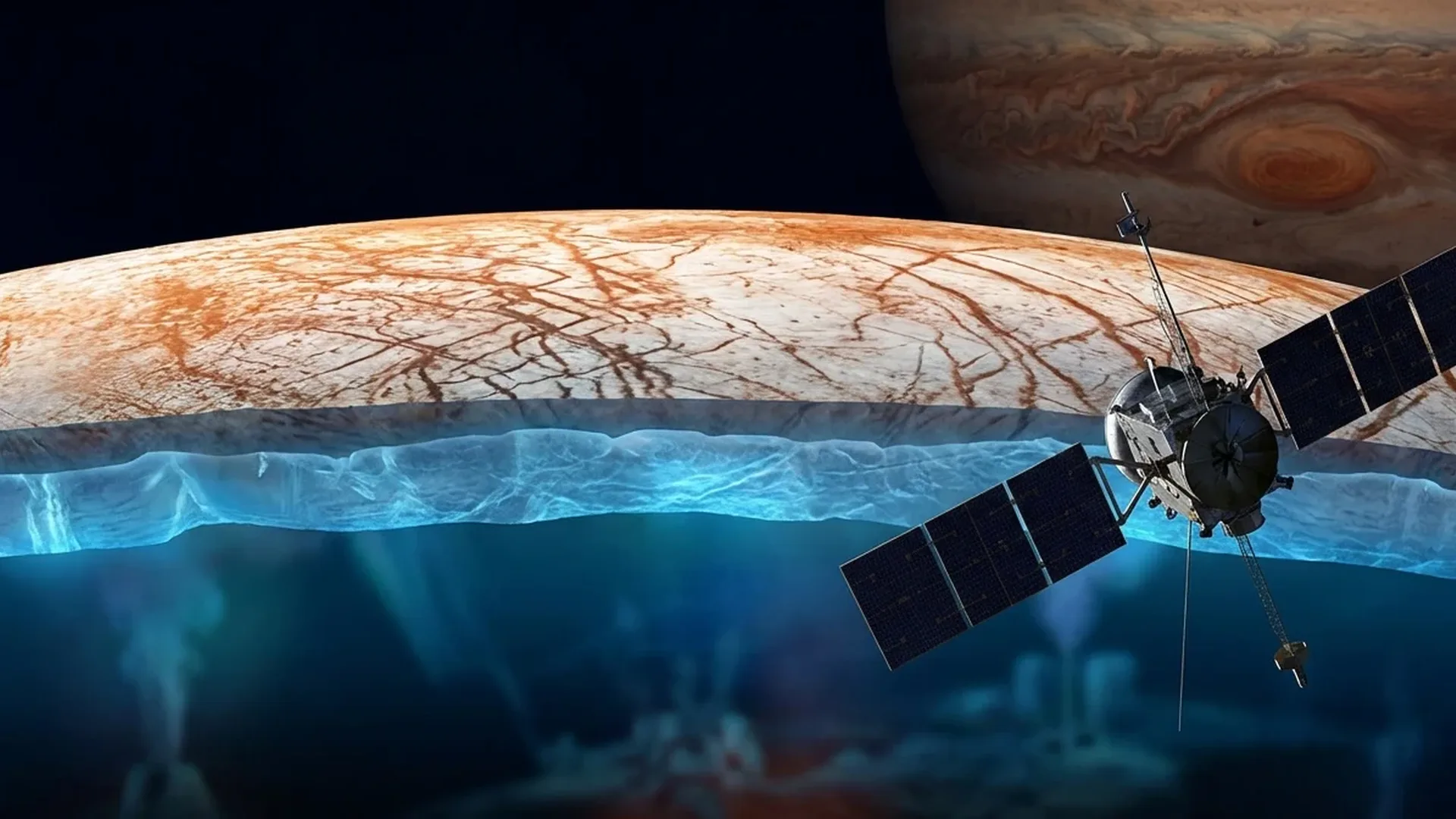
Among the many moons of Jupiter, one stands out as a fascinating world that might host life: Europa. Scientists believe Europa hides a vast ocean beneath its icy surface, making it one of the most promising places to search for extraterrestrial life in our solar system.
Let’s explore why Europa is so interesting, what we know about it, and what missions are planned to study this mysterious moon.
What Makes Europa Special
Europa is one of Jupiter’s largest moons, slightly smaller than Earth’s Moon. It is covered by a thick layer of ice, but beneath that ice lies a liquid water ocean. Scientists think this ocean could be twice the volume of all Earth’s oceans combined.
Key Features of Europa:
- Icy surface with cracks and ridges
- Hidden subsurface ocean
- Evidence of water plumes shooting into space
- Potential chemical energy sources for life
These features make Europa one of the most exciting targets in the search for life beyond Earth.
Evidence of Water
Europa’s icy surface shows signs of a dynamic world. Observations from telescopes and spacecraft reveal:
- Cracks and ridges in the ice, suggesting the surface shifts over time
- Possible geysers of water vapor erupting into space
- Magnetic measurements indicating a salty subsurface ocean
Water is essential for life as we know it, so finding it on Europa increases the chances of habitability.
Could Life Exist on Europa?
Scientists consider three main ingredients necessary for life:
- Liquid Water – Europa’s ocean is a prime candidate
- Energy Source – Could come from chemical reactions in the ocean
- Chemical Ingredients – Elements like carbon, hydrogen, nitrogen, oxygen, phosphorus, and sulfur may be present
If all these exist under Europa’s ice, microbial life could potentially survive there. Some researchers even speculate that life might thrive near hydrothermal vents on the ocean floor.
The Role of Jupiter’s Gravity
Jupiter’s strong gravity plays a crucial role in Europa’s ocean:
- It causes tidal heating, which keeps the ocean from freezing completely
- Tidal forces flex the ice crust, creating cracks and possibly allowing water to reach the surface
- This heating could also drive chemical reactions, providing energy for life
Without Jupiter’s influence, Europa’s ocean might be frozen solid and lifeless.
Observations from Spacecraft
Several missions have helped scientists study Europa:
- Voyager 1 & 2 (1979) – First close images of Europa’s surface
- Galileo Orbiter (1995–2003) – Detected magnetic field and evidence of a subsurface ocean
- Hubble Space Telescope – Observed potential water vapor plumes
These observations provide clues about Europa’s composition and potential habitability.
Jupiter’s Europa: An Ocean World That May Harbor Life
Upcoming Missions to Explore Europa
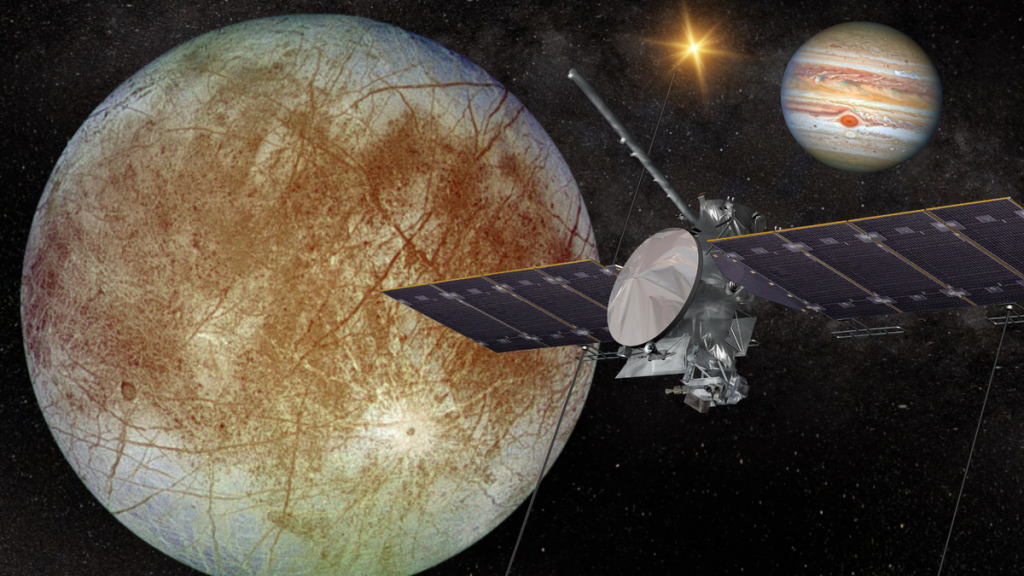
NASA and the European Space Agency (ESA) are planning missions to study Europa more closely:
- Europa Clipper (NASA) – Launching in the 2020s, it will orbit Jupiter and make multiple flybys of Europa
- Study ice thickness
- Analyze surface composition
- Detect potential plumes
- JUICE (ESA) – Will study Jupiter’s moons, including Europa, focusing on its oceans and ice
These missions will provide more detailed data than ever before.
Surface Features of Europa
Europa’s surface is covered with interesting features:
- Linear cracks and ridges – Caused by ice shifting
- Chaos terrain – Areas of broken ice blocks suggesting the surface melted and refroze
- Impact craters – Fewer than on other moons, indicating a young and active surface
Studying these features helps scientists understand Europa’s history and potential for life.
The Subsurface Ocean
The ocean beneath Europa’s ice is thought to be deep and global. Scientists believe it could have:
- Salty water, similar to Earth’s oceans
- Hydrothermal vents on the ocean floor, providing heat and nutrients
- Chemical interactions between water and rock, offering energy for life
This makes Europa’s ocean one of the most intriguing places to look for extraterrestrial life.
Jupiter’s Europa: An Ocean World That May Harbor Life
Water Plumes and Exploration
Some observations suggest water plumes erupt from Europa’s surface into space.
- Hubble Space Telescope detected hints of these plumes
- They may allow spacecraft to sample the ocean without drilling through ice
- Analyzing plume material could reveal organic molecules or signs of life
This could make Europa easier to study than other icy worlds.
Challenges of Exploring Europa
Exploring Europa is not easy:
- Thick Ice Crust – Could be miles deep, making direct access to the ocean difficult
- Radiation from Jupiter – High-energy particles make the surface hazardous for spacecraft
- Distance – Europa is hundreds of millions of miles from Earth
- Technical Limits – Designing instruments to withstand harsh conditions is challenging
Despite these obstacles, missions like Europa Clipper are designed to gather data safely.
Scientific Importance
Studying Europa helps scientists:
- Understand how oceans form on icy worlds
- Explore habitability beyond Earth
- Test theories about life in extreme environments
- Prepare for future human exploration of icy moons
Europa is a natural laboratory for understanding life and planetary science.
Comparisons to Earth
Europa’s ocean may be similar to Earth’s deep oceans:
- Dark and cold, with no sunlight
- Hydrothermal vents provide energy, like Earth’s deep-sea vents
- Microbes on Earth survive extreme conditions, suggesting life could exist on Europa
Studying Europa could teach us how life begins and survives in harsh environments.
Public Interest and Cultural Impact
Europa has captured the imagination of the public:
- Featured in science fiction books and movies
- Inspires students to study astronomy and space science
- NASA uses it as an example to engage the public in planetary exploration
Public excitement helps support funding and interest in space missions.
Future Possibilities
If life is discovered on Europa, it would be one of the most significant findings in human history:
- Confirms life exists beyond Earth
- Provides clues about life’s adaptability
- Encourages more exploration of other moons and planets
- Could inspire new technology for studying extreme environments
Even if life is not found, Europa offers valuable lessons about oceans, ice, and planetary systems.
How to Follow Europa Missions
You can stay updated on Europa exploration:
- NASA’s Europa Clipper updates and press releases
- ESA JUICE mission news
- Educational websites and space news outlets
- Social media updates from space agencies
Following missions can bring you closer to understanding this mysterious world.
Conclusion
Europa, Jupiter’s icy moon, is more than just a frozen satellite. Beneath its surface lies a vast ocean, potentially capable of supporting life. With upcoming missions like Europa Clipper and JUICE, scientists hope to study this ocean, analyze plumes, and search for the building blocks of life.
Europa represents the possibility of life beyond Earth and is a key target in our quest to understand the universe. From its cracked ice surface to hidden oceans, this moon continues to inspire scientists, students, and the public alike. Exploring Europa is a reminder of the endless curiosity that drives humanity and the exciting mysteries that await in the solar system.
Read Also: Keep your face towards the sunshine and shadows will fall behind you
Watch Also: https://www.youtube.com/@TravelsofTheWorld24








Leave a Reply