
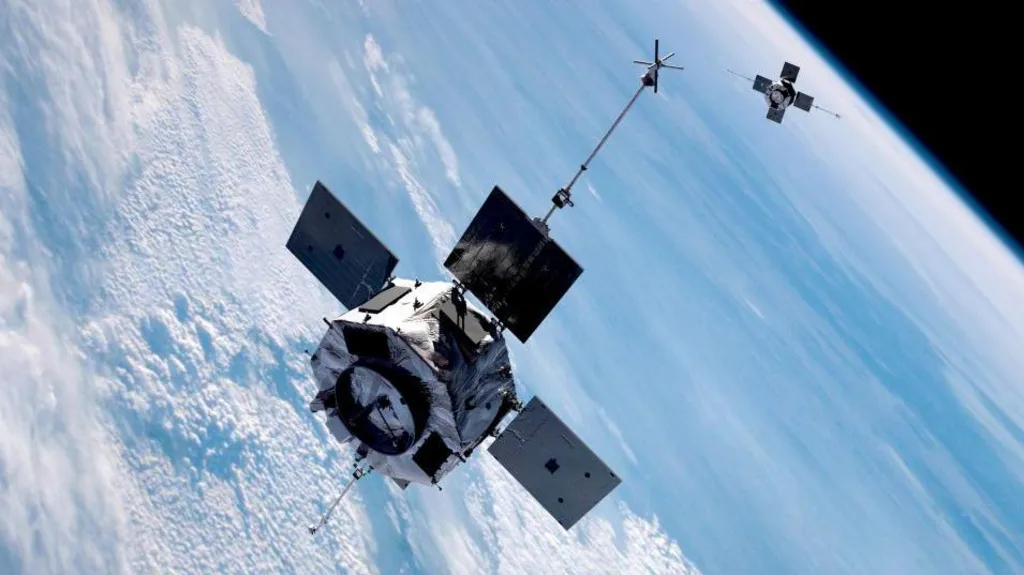
Late in March 2026, something unusual happened in Earth’s skies. A NASA spacecraft weighing about 1,300 pounds (around 600 kg) began a long, fiery fall back toward our planet after almost 14 years in space. The spacecraft is called Van Allen Probe A, and its return was watched by space scientists, sky watchers, and news outlets around the world.
This event got a lot of attention because it’s not every day that large objects from space fall back to Earth — and people wondered if it could be dangerous or visible from the ground. In this article, we’ll explain:
-
What the Van Allen Probe A is
-
Why it is falling back to Earth
-
What happened during re‑entry
-
Whether it was dangerous
-
And what this tells us about space debris
Everything here is written simply so anyone can understand, even if you don’t follow space news regularly.
1. What Is the Van Allen Probe A?
The spacecraft that came back to Earth is known as Van Allen Probe A. It was launched by NASA way back in August 2012 along with a twin spacecraft called Van Allen Probe B. Their job was to study something called the Van Allen radiation belts, which are two donut‑shaped regions of energetic charged particles around Earth. These belts are formed by Earth’s magnetic field and can affect satellites and astronauts if they are not understood well.
Originally, the probes were expected to operate for just two years, but they were so well built that they continued sending useful data until 2019. After that, they were retired and left in orbit.
Van Allen Probe A weighed about 1,323 pounds (600 kg) — roughly the same as a small car. It spent nearly 14 years circling Earth before gravity and the upper atmosphere finally pulled it back down.
2. Why Did the Spacecraft Come Down Early?
Objects in space are not always in perfect orbits forever. Over time, the very thin upper atmosphere around Earth can slow down satellites and spacecraft. This slowing effect — called atmospheric drag — gradually pulls them down closer and closer until they re‑enter the atmosphere. This happens more quickly when the upper atmosphere expands, which can be caused by increased solar activity (more charged particles and heat coming from the Sun).
In this case, scientists originally thought the Van Allen Probes would stay in orbit until around 2034, but stronger solar activity in recent years heated Earth’s upper atmosphere. That made the air molecules rise higher and increased drag on Probe A, slowly pulling it down sooner than expected.
Probe B, its twin, still remains in orbit and is not expected to fall back until later, probably around 2030 or after.
3. What Happens During Re‑entry?
When an object like Van Allen Probe A falls back toward Earth, it encounters thicker air as it comes lower. The friction between the spacecraft and air molecules at high speed causes the object to heat up and begin to burn. This creates bright fireballs that may be seen from the ground if timing and location are right.
Most of the spacecraft’s body burns up during this fiery descent, turning it into glowing streaks in the sky. Smaller pieces of metal or stronger parts sometimes survive the heat and reach closer to Earth’s surface before falling into the ocean or onto land. But by the time the object reaches the lower atmosphere, most of it is gone.
For Van Allen Probe A, NASA and the U.S. Space Force estimated that the spacecraft would re‑enter Earth’s atmosphere around 7:45 p.m. ET on March 10, 2026, with a margin of plus or minus a day because it is hard to predict the exact moment when drag finally pulls it in.
Later updates confirmed that the spacecraft did blaze through the atmosphere and fall back to Earth, mostly burning up in the process. Some small pieces may have survived, but there were no major reports of damage or injury on the ground.
4. Was It Dangerous for People on Earth?
A fall of a 1,300‑pound object from space might sound scary, especially when dramatic words like “crash” and “plummet” are used in some news headlines. But the reality is that the risk to people on Earth was very low.
According to estimates, the odds of any part of the spacecraft hitting and injuring someone were about 1 in 4,200 — that’s less than 0.025%. Scientists consider this a very small risk. Most of the surviving pieces, if any, would likely fall into the ocean, which makes up about 70 % of Earth’s surface.
Space agencies around the world track falling satellites and warn people when their re‑entry is predicted, not to scare them but to keep them informed. In most cases — like this one — these events end without harm.
5. Why Does Earth Get Left With Old Spacecraft?
When satellites or probes finish their missions, they either stay in orbit, move into a special “graveyard” orbit far away, or eventually come back into the atmosphere. Many old objects burn up completely, but some parts can survive.
This happens because Earth has no atmosphere at very high altitudes. Up there, there is nothing to slow objects down. Eventually, drag in the thin air causes them to lose altitude and re‑enter. This is normal and has happened many times throughout the history of space flight, with most returning spacecraft burning up safely as they hit the atmosphere.
Agencies track these events so they can warn people and try to understand if any debris might land on land. Because of how much ocean and unpopulated land there is, the chance of hitting someone is very small — much smaller than many everyday risks people take on Earth.
6. What Did the Van Allen Probes Teach Us?
The Van Allen Probes mission was one of the most successful scientific missions NASA has run to study Earth’s radiation belts. These belts are invisible zones of charged particles that can damage satellites and affect astronauts if not understood well.
Thanks to Probe A and its twin Probe B, scientists learned:
-
How the radiation belts change during solar storms
-
The speed and energy of particles in those belts
-
How the belts affect space weather and conditions around Earth
This information helps scientists protect other spacecraft and plan better for future missions. Even after the probes stopped working, the data they collected continues to support research years later.
7. What Happens Next With Space Debris?
As space activity increases — with more satellites, rockets, and missions — the number of objects orbiting Earth also increases. Many countries and companies are now working together to track these objects and plan for safe re‑entries. Because uncontrolled re‑entries could pose risks if they grow more common, space agencies and researchers study how to reduce the risks and even design spacecraft that burn up more completely or land in safer places.
International efforts aim to manage space debris so Earth’s orbit stays usable for future science, communication satellites, and even space tourism.
8. Final Thoughts
The re‑entry of NASA’s 1,300‑pound spacecraft was a rare and dramatic reminder that Earth is part of a busy space environment. Objects we send to space don’t stay there forever — eventually, gravity brings them back, mostly in spectacular fireballs that disappear in the sky.
For people on the ground, the event was mostly safe and uneventful. For scientists, it marked the end of a long and valuable mission that advanced our understanding of the space environment around our planet.
As humans send more and more objects into space, knowing how to manage and track old satellites will continue to be important. But for now, events like this continue to remind us of the amazing journey of human exploration — and how even quiet, defunct satellites can come back home in a fiery way that catches the eye and the imagination.
In Summary
-
Van Allen Probe A, a NASA spacecraft weighing about 1,300 lb, re‑entered Earth’s atmosphere after nearly 14 years in orbit.
-
It was originally launched in 2012 to study Earth’s radiation belts and continued contributing science long past its planned mission.
-
The spacecraft’s orbit decayed earlier than expected due to solar‑driven atmospheric expansion.
-
Most of it burned up during re‑entry, and the chance of any harm on the ground was very low.
-
The event highlights the need to track space debris as more missions fill Earth’s orbit.
Read Also: Keep your face towards the sunshine and shadows will fall behind you
Watch Also: https://www.youtube.com/@TravelsofTheWorld24






Leave a Reply