
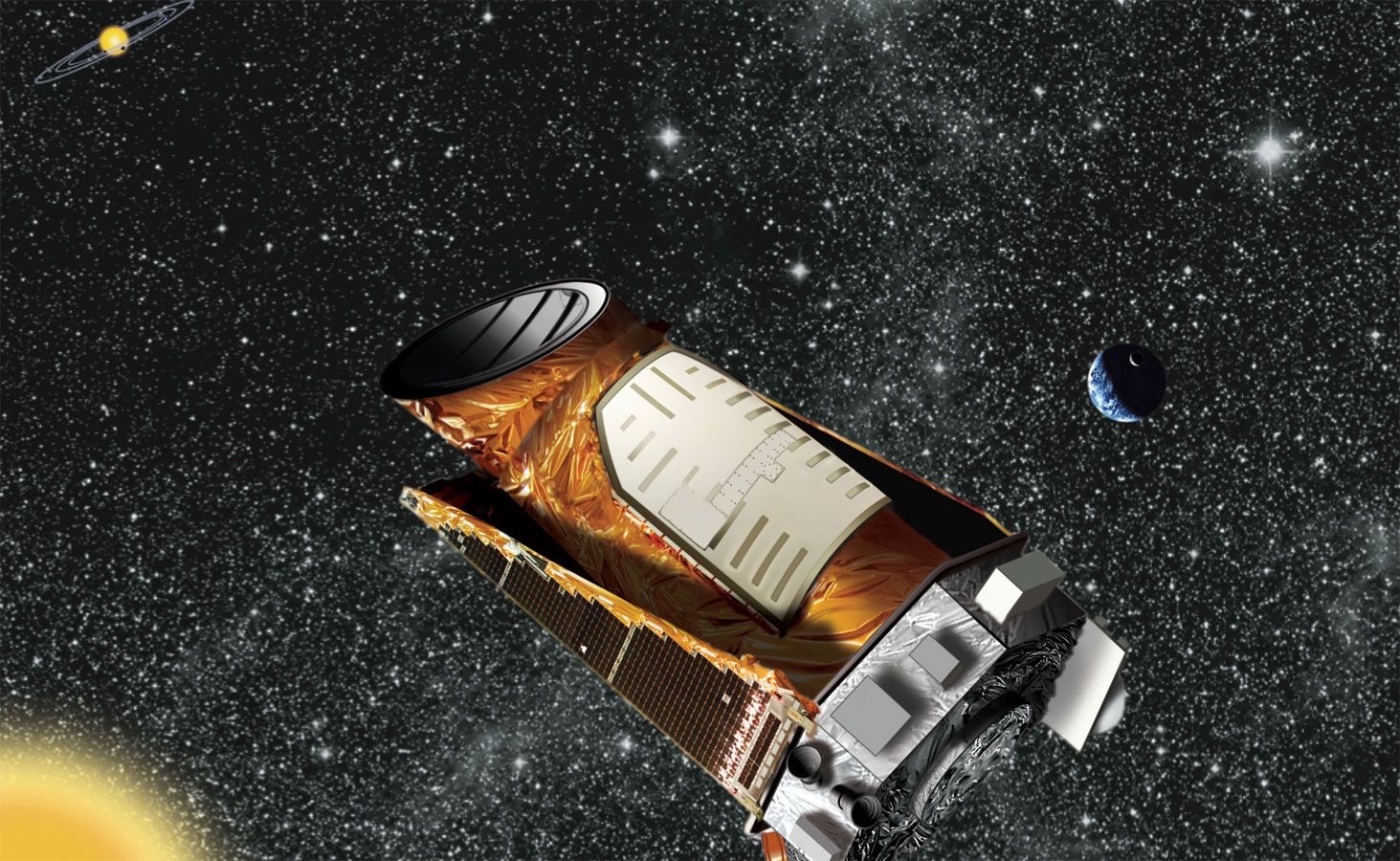
Space missions are never easy. They require advanced technology, years of planning, and sometimes a little bit of luck. One of the most successful planet-hunting missions ever launched faced a serious problem a few years after it began. Yet instead of ending the mission, scientists found a clever solution that gave the spacecraft a second life.
The spacecraft is the Kepler Space Telescope. Even after suffering a major technical issue, the mission was revived and continued to make important discoveries about planets beyond our solar system.
The Original Mission
The Kepler spacecraft was launched by NASA in 2009 with one clear goal: find planets orbiting other stars.
Before Kepler, scientists knew that some planets existed outside our solar system, but they were not sure how common they were. The mission aimed to answer this big question.
Kepler looked at a large patch of the sky and carefully watched the brightness of more than 150,000 stars. Whenever a planet passed in front of one of those stars, the star’s light would dim slightly. By measuring these tiny dips in brightness, scientists could identify new planets.
This method turned out to be extremely successful.
Discovering Thousands of New Worlds
During its early years, Kepler made an incredible number of discoveries. It confirmed thousands of exoplanets, which are planets that orbit stars outside our solar system.
These discoveries completely changed our understanding of the universe.
Scientists learned that planets are very common. Many stars have planetary systems, and some even have several planets orbiting them. Some of these planets are large gas giants, while others are rocky worlds similar to Earth.
Kepler even discovered planets located in the habitable zone, where temperatures might allow liquid water to exist.
A Serious Technical Problem
Despite its success, Kepler faced a major problem in 2013.
The spacecraft used special devices called reaction wheels to keep itself stable and precisely pointed at its target stars. These wheels allowed the telescope to stay focused on the same region of space for long periods.
Unfortunately, two of these reaction wheels failed. Without enough working wheels, Kepler could no longer maintain the steady position needed for its original mission.
At first, it seemed like the mission might have to end.
Many people feared that one of the greatest space telescopes ever built would stop working years earlier than expected.
A Creative Solution
Instead of giving up, engineers and scientists looked for a way to save the spacecraft.
They realized that sunlight pressure could help stabilize Kepler. By carefully balancing the force from the Sun, the spacecraft could still maintain a stable position.
This new method allowed the telescope to continue observing space, although in a slightly different way.
The revived mission was called K2.
The K2 Mission Begins
With the new K2 mission, Kepler no longer observed a single region of space for years. Instead, it studied different areas of the sky for shorter periods of time.
Every few months, the spacecraft would shift its view and focus on a new part of the sky.
This change actually created new opportunities. Instead of observing only one group of stars, Kepler could now explore many different regions of the galaxy.
The spacecraft continued to discover new planets and provide valuable data to astronomers.
Important Discoveries Continue
Even after its technical problems, Kepler continued to make important discoveries.
Scientists found planets that were:
-
Similar in size to Earth
-
Orbiting close to their stars
-
Located in systems with multiple planets
Some planetary systems discovered by Kepler looked very different from our own solar system. In some cases, several planets were packed very close together around their stars.
These discoveries helped scientists better understand how planetary systems form and evolve.
Searching for Earth-Like Worlds
One of Kepler’s biggest goals was finding Earth-sized planets.
Before the mission, scientists did not know whether small rocky planets like Earth were common or rare.
Kepler’s discoveries showed that Earth-sized planets are actually quite common. Many stars appear to have small rocky planets orbiting them.
Some of these planets exist in the habitable zone, which means they might have the right conditions for liquid water.
This finding has greatly increased the chances that life could exist somewhere else in the universe.
Inspiring New Missions
Kepler’s success has inspired new space missions designed to continue the search for exoplanets.
One of the most important follow-up missions is the Transiting Exoplanet Survey Satellite.
While Kepler focused on distant stars, this newer mission looks for planets around stars that are closer to Earth. These nearby planets are easier to study with powerful telescopes.
The discoveries made by Kepler helped guide the design and goals of these future missions.
Studying Planet Atmospheres
Finding a planet is only the first step. Scientists also want to learn what those planets are like.
Modern telescopes can analyze the atmospheres of some exoplanets.
For example, the James Webb Space Telescope can examine the light passing through a planet’s atmosphere when it crosses in front of its star.
This method allows scientists to detect gases such as water vapor, methane, and carbon dioxide.
These gases may provide clues about whether the planet could support life.
The Importance of Kepler’s Legacy
Even though the Kepler spacecraft faced serious technical challenges, its mission changed astronomy forever.
Before Kepler, scientists were still debating whether planets around other stars were rare. After Kepler, it became clear that planets are everywhere.
The mission also helped scientists estimate how many potentially habitable planets might exist in our galaxy.
Some researchers believe that billions of Earth-sized planets could exist in the Milky Way alone.
Public Interest and Inspiration
Kepler’s discoveries have captured the imagination of people around the world.
The idea that thousands of planets exist beyond our solar system has made many people think differently about our place in the universe.
These discoveries also inspire young students to study science and explore careers in astronomy, engineering, and space exploration.
Space missions like Kepler remind humanity that there are still many mysteries waiting to be solved.
A Mission That Refused to End
The story of Kepler is not just about technology or science. It is also about creativity and determination.
When the spacecraft lost its reaction wheels, many believed the mission was over. But engineers and scientists refused to give up.
By using the pressure of sunlight as a stabilizing force, they found a way to keep the spacecraft operating.
This clever solution allowed Kepler to continue exploring the universe for several more years.
Conclusion
The Kepler Space Telescope started as a mission to answer a simple question: Are planets common in the universe?
The answer turned out to be yes.
Despite suffering serious technical problems, the spacecraft was given a second life through the K2 mission. It continued discovering new planets and expanding our knowledge of the cosmos.
Today, Kepler’s legacy lives on in the thousands of exoplanets it discovered and the new missions it inspired.
The universe is filled with countless worlds, and thanks to Kepler, humanity now knows that our solar system is just one small part of a vast cosmic neighborhood.
The search for new planets—and perhaps even life beyond Earth—continues.
Read Also: Keep your face towards the sunshine and shadows will fall behind you
Watch Also: https://www.youtube.com/@TravelsofTheWorld24










Leave a Reply