
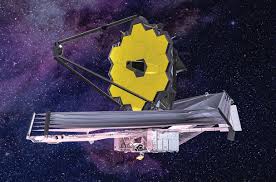
NASA’s James Webb Space Telescope (JWST) has done something amazing. For the first time, it has captured the Pillars of Creation in incredible detail. These are huge clouds of gas and dust where new stars are born, located in the Eagle Nebula about 7,000 light-years away. The images show these famous pillars more clearly than ever before and give scientists a better understanding of star formation.
What Are the Pillars of Creation?
The Pillars of Creation are giant columns of gas and dust. They are called “pillars” because of their long, column-like shape. These regions are stellar nurseries, meaning new stars are forming inside them.
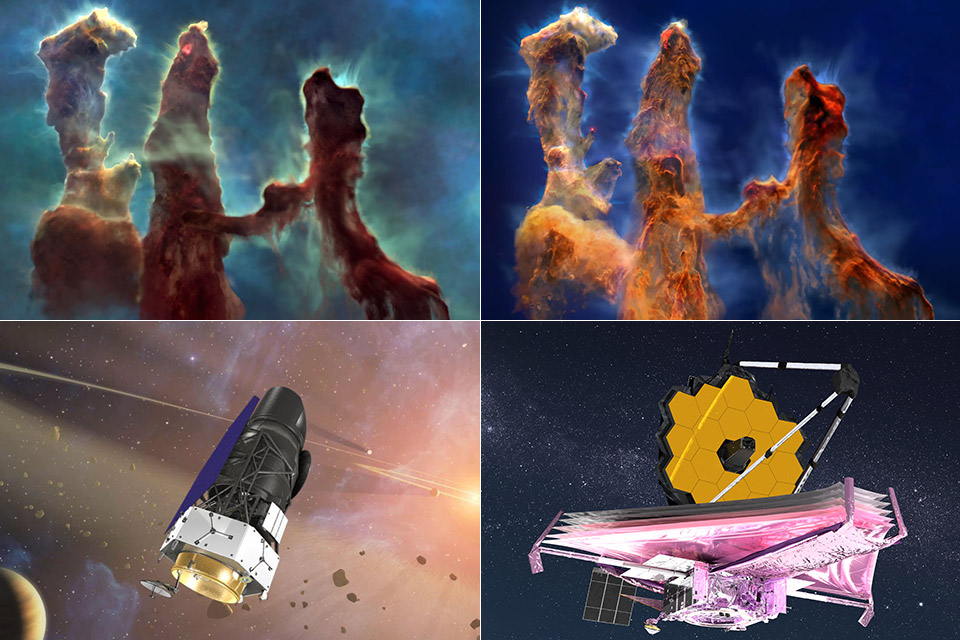
The pillars were first made famous by the Hubble Space Telescope in 1995, which gave the world a stunning view of these cosmic structures. JWST now provides a sharper, infrared view, letting us see inside the dust clouds that Hubble could not fully penetrate.
Why James Webb Is Different
James Webb is special because it sees in infrared light, unlike Hubble, which mostly observes visible and ultraviolet light. Infrared light can:
-
Pass through dense clouds of dust
-
Reveal hidden stars forming inside
-
Show temperature and chemical composition of the gas
This means JWST can see the pillars from the inside, uncovering details scientists could only imagine before.
The Science Behind the Image
The new JWST image shows:
-
Stars forming inside the pillars
-
Complex gas structures shaped by stellar winds
-
Hot young stars illuminating the surrounding clouds
Scientists are excited because these details help us understand:
-
How stars form in clusters
-
The life cycle of gas and dust in galaxies
-
The influence of massive stars on their surroundings
How JWST Captures Such Detail
JWST uses advanced instruments and a giant sunshield:
-
Infrared cameras detect heat from stars and dust
-
The sunshield blocks sunlight to keep the telescope cold
-
Long exposures allow JWST to capture faint and distant light
These tools allow astronomers to see new stars and cosmic structures hidden from previous telescopes.
Discovering Hidden Stars
Inside the pillars, JWST reveals hundreds of new stars forming. Many of them are young and very hot, illuminating the gas around them. Observing these stars helps scientists:
-
Learn how stellar nurseries evolve
-
Understand the interaction between stars and surrounding gas
-
Predict the future of star clusters
This is a rare chance to see the earliest stages of star formation in high detail.
Understanding Star Formation
The pillars show how gas and dust collapse under gravity to form stars. JWST observations allow scientists to:
-
Study temperature and density inside the pillars
-
See how radiation from nearby stars shapes the clouds
-
Determine which areas will form stars next
This helps us understand the process of star formation across the universe.
The Role of Infrared Light
Infrared light is key because:
-
Dust blocks visible light but infrared passes through
-
JWST can see hot and cold regions in the same image
-
It can detect chemicals like carbon and oxygen
Infrared observations are revolutionizing our view of the universe.
Comparing to Hubble
Hubble showed the pillars in stunning visible light, highlighting:
-
The shape and texture of gas columns
-
The overall structure of the Eagle Nebula
JWST now adds:
-
Infrared detail of hidden stars
-
Chemical composition of the gas
-
Temperature differences inside the pillars
Together, the two telescopes give a complete picture of star formation.
What Scientists Learn
JWST’s observations teach scientists:
-
How stellar winds shape gas clouds
-
How clusters of stars form and evolve
-
The influence of massive stars on their surroundings
This helps answer fundamental questions like:
-
How do stars like our Sun form?
-
How do nebulae evolve over millions of years?
-
How does the birth of stars affect future planetary systems?
Exploring the Eagle Nebula
The Eagle Nebula is a massive star-forming region in the Milky Way. JWST images show:
-
Hot young stars lighting up the pillars
-
Areas where gas is being eroded by radiation
-
Dust lanes and filaments unseen before
This gives a dynamic view of how star nurseries change over time.
Role in Understanding Galaxies
Studying the Pillars of Creation helps scientists understand:
-
Star formation rates in galaxies
-
How galaxies recycle gas and dust
-
How new stars influence galactic structure
JWST’s infrared capabilities are helping us study similar processes in distant galaxies.
Revealing Hidden Features
JWST reveals features hidden from Hubble, such as:
-
Stars forming inside dense dust clouds
-
Shadows and cavities carved by radiation
-
Gas streams being pushed away by stellar winds
These features show that star formation is messy, dynamic, and beautiful.
Why This Image Matters
This new image is more than just a picture. It:
-
Inspires public interest in astronomy
-
Provides scientific data for years of research
-
Helps us understand how stars like our Sun are born
-
Prepares scientists for future telescope observations
It’s a perfect example of how technology and curiosity combine to expand our knowledge.
Collaboration and Technology
JWST is a global project, with contributions from:
-
NASA
-
European Space Agency (ESA)
-
Canadian Space Agency (CSA)
International collaboration ensures:
-
Advanced technology and instruments
-
Expertise from scientists worldwide
-
Shared data for research
This teamwork makes discoveries faster and more accurate.
Challenges in Capturing the Image
Capturing the pillars in infrared light was difficult because:
-
JWST must be kept ultra-cold
-
The telescope is 1.5 million kilometers from Earth
-
Data must be transmitted back to Earth carefully
Despite these challenges, JWST delivered unprecedented clarity and detail.
Inspiring Future Generations
This image inspires:
-
Students interested in space and science
-
Engineers and scientists working on future telescopes
-
The public to look up and wonder about the universe
Images like this show the beauty and mystery of space, encouraging curiosity.
Future Observations
JWST will continue observing:
-
Other star-forming regions in the Milky Way
-
Distant galaxies and early universe structures
-
Exoplanets and their atmospheres
The Pillars of Creation image is just the beginning of many discoveries.
Summary of Key Findings
JWST reveals:
-
Hundreds of new stars forming inside the pillars
-
Gas and dust being shaped by stellar radiation
-
Chemical composition and temperature of star-forming regions
-
A dynamic, detailed view of stellar nurseries
These findings expand our understanding of star formation and the life cycle of galaxies.
Public Engagement
NASA has shared the images publicly, allowing everyone to:
-
See the beauty of the Pillars of Creation
-
Learn about how stars are born
-
Follow the progress of James Webb Space Telescope missions
This promotes science education and curiosity worldwide.
Conclusion
The James Webb Space Telescope has transformed our view of the Pillars of Creation. For the first time, we can see stars forming inside the gas clouds in stunning detail. This image:
-
Provides scientific insight into star formation
-
Demonstrates the power of infrared observations
-
Inspires students, scientists, and the public
JWST’s observation of the Pillars of Creation shows that space is full of beauty, mystery, and discovery. It’s a reminder that with technology, collaboration, and curiosity, humanity can explore the universe like never before.
The Pillars of Creation are now more alive than ever, showing us the birthplaces of stars and the forces shaping our galaxy. Thanks to JWST, we’re witnessing the unseen heart of the cosmos.
Read Also: Keep your face towards the sunshine and shadows will fall behind you
Watch Also: https://www.youtube.com/@TravelsofTheWorld24







Leave a Reply