

NASA and international astronomers have uncovered remarkable insights into the nature of rocky planets subjected to extreme cosmic conditions, revealing new details about their composition, structure, and resilience. Using data from cutting-edge space telescopes and spectroscopic instruments, researchers have observed planets experiencing intense radiation, gravitational stress, and atmospheric erosion—providing a rare window into the extreme environments that can shape planetary evolution.
These findings are particularly significant as they expand our understanding of rocky exoplanets, which are similar in composition to Earth, and offer clues about their potential habitability, formation history, and ultimate survival in hostile stellar neighborhoods.
Extreme Conditions and Rocky Planets
Rocky planets, composed primarily of iron, silicates, and other refractory materials, are often thought of as stable, solid worlds. However, many of these planets exist in extreme conditions that challenge traditional notions of planetary geology and atmosphere.
Planets orbiting close to their parent stars, for example, endure high-energy radiation, strong stellar winds, and tidal forces that can reshape their surfaces, strip away atmospheres, and influence internal geology. Similarly, planets in multi-star systems or those orbiting young, active stars experience violent radiation bursts and gravitational interactions that leave lasting imprints on their physical and chemical structure.
“These extreme environments act like natural laboratories,” explained Dr. Elena Martinez, lead researcher on the study. “By studying rocky planets under cosmic stress, we can learn how they form, evolve, and survive—or fail—in ways that simpler models never predicted.”
Observing Rocky Planets in Harsh Environments
Advances in space-based observation have made it possible to study rocky planets in unprecedented detail. Instruments such as the James Webb Space Telescope (JWST), the Transiting Exoplanet Survey Satellite (TESS), and ground-based observatories equipped with high-resolution spectrographs allow astronomers to measure chemical compositions, surface temperatures, and atmospheric changes.
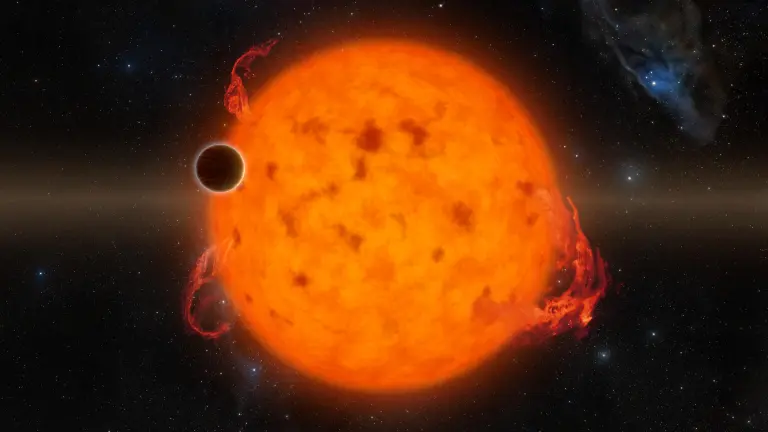
One particularly revealing method involves observing transits, when a planet passes in front of its host star. During a transit, starlight filters through the planet’s atmosphere, imprinting spectral signatures that reveal the presence of elements, molecules, and potential atmospheric loss. For planets exposed to intense stellar activity, these measurements can show the ongoing effects of radiation-driven atmospheric escape.
Surprising Discoveries
The research team has identified several rocky exoplanets exhibiting unexpected properties under extreme cosmic stress:
-
Resilient Cores: Some planets maintain dense, iron-rich cores despite significant atmospheric erosion and surface heating. This suggests that internal structures may provide stability even as outer layers are stripped away.
-
Exotic Surface Chemistry: Infrared spectroscopy has revealed unusual mineral compositions, including high concentrations of magnesium silicates, titanium oxides, and trace metals. These findings indicate that intense stellar radiation can trigger chemical reactions and alter surface mineralogy.
-
Dynamic Atmospheres: Rocky planets exposed to stellar flares and extreme ultraviolet radiation show evidence of atmospheric expansion, high-altitude escape, and complex interactions with stellar winds. Some atmospheres are partially ionized, producing unique signatures detectable from space.
“These planets are far more dynamic than we imagined,” said Dr. Martinez. “Their surfaces and atmospheres are in constant flux, reshaped by forces that far exceed what we experience on Earth.”
Implications for Planetary Formation
Studying rocky planets in extreme conditions also informs models of planetary formation. Traditional theories suggest that rocky planets form from protoplanetary disks of gas and dust and remain largely stable once fully formed. However, observations of planets in harsh stellar environments indicate that planetary evolution is far more complex.
High-energy radiation and tidal forces can erode planetary atmospheres, strip lighter elements, and expose rocky interiors. These processes may explain the diversity of rocky exoplanets observed, including “super-Earths” with dense compositions and planets with anomalously thin or missing atmospheres.
By comparing planets in different stellar environments, astronomers can map how external factors influence planetary size, density, composition, and long-term survival.
The Role of Stellar Activity
A critical factor in shaping rocky planets is the activity of their host stars. Young, active stars emit frequent flares, strong ultraviolet radiation, and stellar winds, all of which can heat and strip planetary atmospheres. Close-in planets, sometimes orbiting within a few stellar radii, experience tidal forces that can induce internal heating and surface volcanism.
Spectroscopic measurements reveal that planets exposed to extreme stellar activity often show high-altitude metal vapors, evidence of atmospheric escape, and surface modifications caused by radiation. These observations help astronomers understand how planets evolve over millions to billions of years, particularly in systems unlike our own solar system.
Lessons for Habitability
Understanding rocky planets in extreme conditions also informs the search for habitable worlds. While many rocky exoplanets orbit in the so-called “habitable zone,” the presence of intense stellar radiation, flares, and strong tidal forces can make surface conditions hostile to life.
However, some planets demonstrate resilience. Dense atmospheres, magnetic fields, and protective mineral compositions can help preserve conditions favorable for habitability despite harsh stellar environments.
“These extreme planets teach us about the boundaries of habitability,” explained Dr. Martinez. “By studying them, we refine our criteria for worlds that could sustain life, even in the face of extreme cosmic forces.”
Technological Advances Enabling Discovery
Recent discoveries of rocky planets in cosmic extremes are made possible by cutting-edge instruments:
-
JWST: Its infrared sensitivity allows the detection of heat signatures, atmospheric compositions, and surface mineralogy.
-
TESS: Detects transits of exoplanets, providing orbital parameters and size measurements.
-
Ground-Based Spectrographs: Instruments like HARPS and ESPRESSO measure radial velocities and chemical compositions with extreme precision.
Combining data from multiple platforms allows astronomers to construct detailed models of planetary interiors, atmospheres, and orbital dynamics, even for planets many light-years away.
Insights into Planetary Diversity
The study of rocky planets in extreme environments highlights the diversity of planetary systems. While our solar system’s rocky planets—Mercury, Venus, Earth, and Mars—exist in relatively stable orbits with mild stellar activity, other systems produce planets with highly elliptical orbits, intense radiation exposure, and dramatic tidal heating.
These extremes contribute to the wide range of planetary densities, atmospheres, and surface compositions observed. Understanding this diversity is essential for building a comprehensive theory of planet formation and evolution across the galaxy.
Future Research Directions
Astronomers plan to continue monitoring rocky planets in extreme environments using both JWST and upcoming missions like the European Space Agency’s Ariel telescope. Key objectives include:
-
Mapping atmospheric escape processes in real-time.
-
Measuring the impact of stellar flares on surface and atmospheric chemistry.
-
Identifying mineralogical changes on planetary surfaces due to radiation.
-
Assessing magnetic field strengths and their protective effects.
These studies will improve predictions about the long-term survival and evolution of rocky planets under extreme conditions.
Broader Implications
The research has implications beyond exoplanet studies. By understanding how rocky planets respond to cosmic extremes, scientists gain insights into early Earth history, planetary differentiation, and the evolution of atmospheres under high radiation. These lessons may also help assess the likelihood of life on planets orbiting young or active stars.
Furthermore, the findings may inform the design of future space missions to detect and characterize rocky planets, guiding telescope specifications and observational strategies.
Conclusion
The study of rocky planets in cosmic extremes is revealing a previously hidden dimension of planetary science. These worlds demonstrate remarkable resilience, dynamic atmospheres, and complex surface chemistry shaped by intense radiation, tidal forces, and stellar winds.
Observations from JWST, TESS, and ground-based spectrographs are revolutionizing our understanding of rocky planets, providing crucial insights into planetary formation, evolution, and potential habitability. By probing the most extreme environments, astronomers are expanding the boundaries of what we know about rocky worlds, offering a deeper appreciation of the diversity and complexity of planets across the galaxy.
As research continues, scientists anticipate further discoveries that will challenge existing models, refine criteria for habitability, and deepen our understanding of how rocky planets endure the extremes of the cosmos.











Leave a Reply