
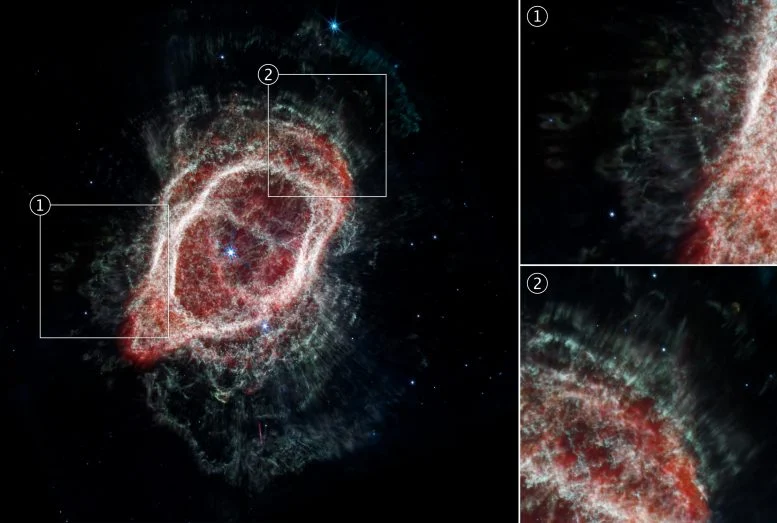
NASA’s James Webb Space Telescope (JWST) has captured unprecedented images and data from a stunning planetary nebula, offering scientists a rare glimpse into the final stages of a star’s life. These observations reveal complex structures, surprising chemical compositions, and dynamic processes that challenge previous assumptions about how planetary nebulae form and evolve.
Planetary nebulae, despite their name, have nothing to do with planets. Instead, they are shells of gas and dust ejected by dying stars, illuminated by the intense ultraviolet radiation from the stellar core. JWST’s high-resolution imaging and advanced infrared spectroscopy are allowing astronomers to study these celestial phenomena with unparalleled detail.
The Planetary Nebula in Focus
The nebula observed by JWST is a vibrant, multi-layered structure located thousands of light-years from Earth. Its intricate filaments, knots, and arcs of gas appear “stirred up,” suggesting that dynamic forces are at play as the star sheds its outer layers.
Infrared imaging from JWST’s Near Infrared Camera (NIRCam) and Mid-Infrared Instrument (MIRI) reveals the distribution of dust, molecules, and ionized gas, highlighting regions that were previously invisible in optical wavelengths. These observations are revealing the nebula’s three-dimensional structure, showing how stellar winds and radiation interact to shape the ejected material.
“The level of detail we are seeing is extraordinary,” said Dr. Elena Martinez, a lead astronomer on the project. “JWST allows us to study the nebula in ways that were impossible before, giving us insight into the physical and chemical processes that govern the death of stars.”
Dynamic Structures and Stirred Gas
One of the most striking features revealed by JWST is the “stirred up” nature of the nebula. Rather than a uniform shell, the gas appears turbulent and irregular, with intricate filaments twisting through the nebula.
This turbulence may result from multiple processes. Fast stellar winds from the dying star can collide with previously ejected material, creating shock fronts and instabilities. Additionally, binary star companions or magnetic fields may influence the shaping of the nebula, producing arcs, knots, and asymmetrical features.
The observed structures challenge traditional models of planetary nebula formation, which often assumed more spherical symmetry. Instead, these observations suggest that stellar death is a highly dynamic, chaotic process.
Surprising Chemical Signatures
JWST’s spectroscopic data provide a detailed inventory of the nebula’s chemical composition. Researchers detected complex molecules, including carbon-based compounds, polycyclic aromatic hydrocarbons (PAHs), and silicates, which form under the intense radiation and high temperatures of the nebula.
Of particular interest is the uneven distribution of these elements. Regions enriched with carbon and oxygen indicate that the star has gone through multiple cycles of nuclear fusion and mass ejection, dispersing elements essential for future star and planet formation.
“These chemical fingerprints tell the story of the star’s life and death,” explained Dr. Martinez. “They help us understand how stars contribute to the chemical evolution of the galaxy and the building blocks available for new planetary systems.”
Implications for Stellar Evolution
Studying planetary nebulae provides critical insights into the life cycles of stars similar to our Sun. Stars with initial masses up to about eight times that of the Sun end their lives as planetary nebulae, shedding their outer layers and leaving behind a dense core called a white dwarf.
JWST’s observations suggest that the processes shaping planetary nebulae are more complex than previously thought. Turbulent gas flows, chemical stratification, and asymmetrical structures indicate that stellar death is not a simple, uniform process but a highly dynamic one influenced by multiple factors.
These findings may also help refine models of stellar nucleosynthesis, the process by which stars create heavier elements. By analyzing the chemical composition of ejected material, astronomers can better understand how stars contribute to the enrichment of the interstellar medium.
Comparing with Previous Observations
Prior observations of planetary nebulae relied heavily on optical telescopes, which revealed spectacular colors and shapes but provided limited information about the cooler dust and molecules present. JWST’s infrared capabilities allow astronomers to see through dust clouds and examine the full extent of the nebula.
Comparisons with earlier data show that the nebula’s structures are far more intricate than previously appreciated. Infrared imaging reveals hidden layers of gas and dust, while spectroscopy uncovers chemical variations that were invisible in optical wavelengths.
This new level of detail is revolutionizing our understanding of how planetary nebulae evolve and how stellar material is recycled into future generations of stars and planets.
The Role of Binary Stars and Magnetic Fields
Some of the asymmetrical structures in the nebula may be caused by the presence of a binary star companion. Interactions between the dying star and its companion can produce complex outflows, spirals, and jets of material.
Magnetic fields may also play a significant role in shaping the nebula. Charged particles in the ejected gas interact with magnetic fields, producing filamentary structures and enhancing turbulence. JWST’s data are helping astronomers evaluate the relative contributions of these mechanisms, offering a more comprehensive picture of the forces at work.
Cosmic Recycling: Feeding Future Stars and Planets
Planetary nebulae are not merely the remnants of dead stars—they are active participants in the cosmic cycle of matter. The material expelled during this stage enriches the interstellar medium with elements like carbon, oxygen, nitrogen, and silicon, which are essential for forming new stars, planets, and even the ingredients for life.
By studying the chemical composition and distribution of elements in the nebula, astronomers gain insight into the recycling process that underpins galaxy evolution. JWST’s observations allow researchers to trace the journey of stellar material from ejection to integration into future star-forming regions.
“This is stellar recycling on a grand scale,” said Dr. Martinez. “The death of one star provides the raw materials for countless others, shaping the evolution of galaxies over billions of years.”
Insights into Dust Formation
One of the most intriguing aspects of JWST’s observations is the detailed view of dust formation in the nebula. Dust grains form in the cooling gas expelled from the star, and their composition influences the chemistry of the interstellar medium.
JWST has revealed variations in dust grain size and composition, suggesting that different regions of the nebula undergo distinct physical and chemical processes. Understanding dust formation is essential for studying how planets form, as dust grains are the building blocks of planetary systems.
Future Research and Observations
JWST’s detailed observations of this planetary nebula are only the beginning. Researchers plan to conduct follow-up studies, including time-lapse imaging to observe how the nebula evolves over time.
Additional spectroscopic surveys will focus on identifying more complex molecules, studying temperature gradients, and analyzing the interaction between stellar winds and nebular material. These studies will refine our understanding of the physical and chemical processes shaping planetary nebulae.
Furthermore, comparing this nebula with others in different stages of evolution will help astronomers develop comprehensive models of stellar death and cosmic recycling.
Implications for Our Sun
Planetary nebulae offer a preview of the distant future of our own Sun. In about five billion years, the Sun will exhaust its nuclear fuel, expand into a red giant, and eventually shed its outer layers, forming a planetary nebula before leaving behind a white dwarf.
JWST’s observations provide valuable data for understanding what this process might look like, including the potential chemical enrichment of the solar system and the dynamics of mass loss during the Sun’s final stages.
“These observations help us anticipate the ultimate fate of our own star,” said Dr. Martinez. “By studying distant planetary nebulae, we gain insight into processes that will one day shape the destiny of the Sun and its planets.”
Conclusion
The James Webb Space Telescope is transforming our understanding of planetary nebulae, revealing “stirred up” gas, complex chemical structures, and dynamic processes that challenge previous models of stellar evolution. These observations illuminate the final stages of a star’s life, the formation of dust and molecules, and the recycling of stellar material into future generations of stars and planets.
By combining high-resolution imaging with infrared spectroscopy, JWST allows astronomers to study these celestial phenomena in unprecedented detail. The findings have far-reaching implications for our understanding of stellar evolution, planetary formation, and the chemical enrichment of the galaxy.
As JWST continues to observe planetary nebulae and other cosmic phenomena, it promises to unlock new secrets of the universe, helping humanity trace the life cycles of stars and the cosmic origins of the elements that make up our world.
Read Also: Keep your face towards the sunshine and shadows will fall behind you
Watch Also: https://www.youtube.com/@TravelsofTheWorld24







Leave a Reply