
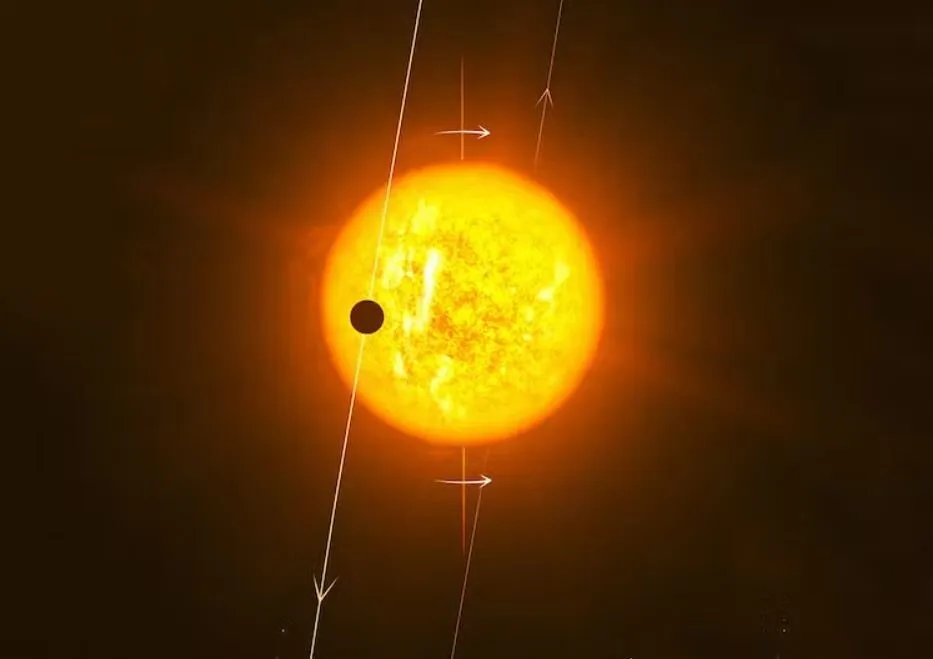
In the vast expanse of the universe, astronomers continue to discover planets that challenge our understanding of planetary formation and behavior. One of the most intriguing recent discoveries is a “puffy” alien world, a gas giant so inflated that it defies conventional planetary physics. Unlike typical gas giants, this planet exhibits properties that make it unusually large for its mass, leaving scientists puzzled and prompting questions about how planets form and evolve.
Discovery of the Puffy Planet
The alien planet, discovered using data from telescopes such as NASA’s Kepler Space Telescope and the Transiting Exoplanet Survey Satellite (TESS), is located hundreds of light-years from Earth. What caught astronomers’ attention was its extreme size relative to its mass, making it far less dense than Jupiter, Saturn, or even Neptune.
-
Orbital Characteristics: The planet orbits its star closely, completing a revolution in just a few days.
-
Host Star: Its parent star is slightly hotter and more luminous than our Sun, exposing the planet to intense radiation.
-
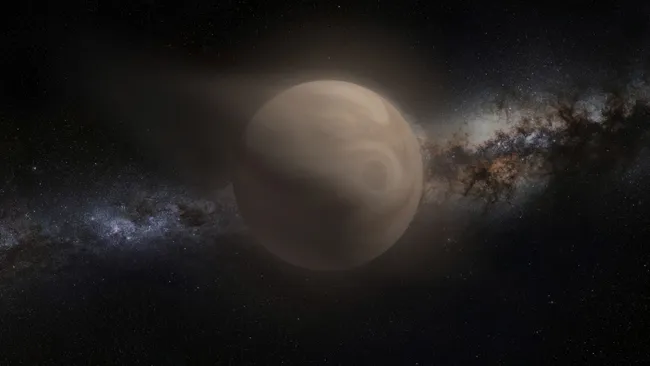
Size and Mass: Despite having a mass similar to Jupiter, the planet’s radius is inflated, making it appear as a “puffy” or bloated planet.
This combination of size, mass, and proximity to its star challenges traditional planetary models that link density to mass and size.
What Makes a Planet “Puffy”?
A “puffy” planet is essentially a gas giant with an unusually low density. While most gas giants have a balance between mass and gravitational compression, puffy planets appear inflated beyond what physics predicts. Scientists believe several factors contribute to this phenomenon:
-
Extreme Stellar Radiation: Close proximity to a hot star can heat a planet’s atmosphere, causing it to expand.
-
Tidal Forces: Gravitational interactions with the host star or nearby planets can generate internal heat, puffing up the planet.
-
Young Age: Some planets retain residual heat from formation, making them temporarily larger than expected.
-
Atmospheric Composition: Hydrogen and helium-rich atmospheres expand more easily under heat, increasing the apparent radius.
Despite these hypotheses, none fully explain the degree of inflation observed in the puffiest planets, leaving astronomers searching for new theories.
Breaking the Rules of Planetary Physics
Puffy planets defy many expectations of planetary behavior:
-
Density Paradox: Most planets follow a trend where greater mass leads to stronger gravity and higher density. Puffy planets, however, are extremely large but very low in density, sometimes less than 0.1 g/cm³, lighter than Saturn.
-
Inflation Beyond Predictions: Standard planetary evolution models cannot account for the extreme radii observed in some puffy planets.
-
Atmospheric Escape: Given their low gravity and proximity to a hot star, these planets should be losing mass rapidly. Yet, some survive for billions of years, challenging our understanding of atmospheric retention.
These anomalies make puffy planets natural laboratories for studying exoplanetary physics, atmospheric dynamics, and stellar-planet interactions.
Observational Techniques
Astronomers detect and study puffed-up planets using advanced methods:
-
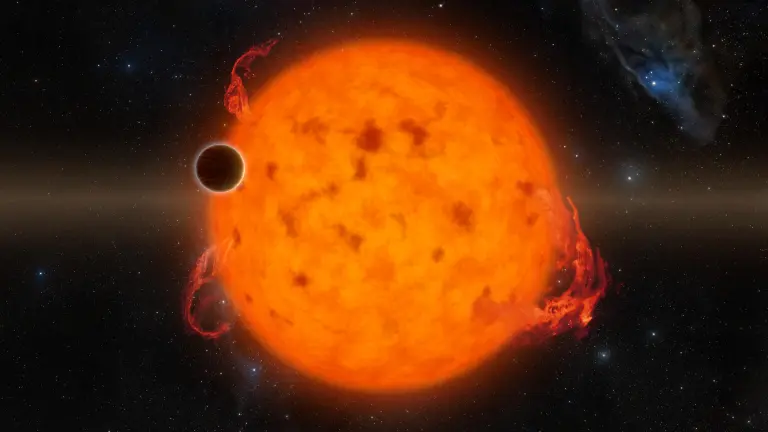
Transit Method: By measuring the dimming of a star’s light as a planet passes in front, scientists can determine its size. Puffy planets block more light due to their inflated atmospheres.
-
Radial Velocity: Observing the wobble of a star caused by the planet’s gravity allows measurement of the planet’s mass. Comparing mass and radius reveals the low density characteristic of puffiness.
-
Spectroscopy: Analyzing starlight filtered through a planet’s atmosphere provides clues about chemical composition, temperature, and expansion.
-
Space Telescopes: Instruments like Kepler, TESS, and Hubble provide high-precision photometry and spectroscopy, essential for identifying these unusual planets.
By combining these techniques, astronomers can build detailed profiles of puffed-up worlds, despite their vast distances from Earth.
Notable Examples of Puffy Planets
Several puffy planets have been identified, each pushing the limits of planetary science:
-
HAT-P-67b: A gas giant with a radius nearly twice that of Jupiter but only half its mass, orbiting a hot star.
-
WASP-17b: One of the largest exoplanets discovered, with extremely low density and an expanded atmosphere.
-
Kepler-12b: An inflated hot Jupiter with a radius 1.7 times larger than Jupiter, challenging thermal inflation models.
These planets share common traits: close orbits, high stellar irradiation, and unexpectedly low densities, suggesting environmental factors play a significant role in their inflation.
Why Puffy Planets Matter
Studying puffed-up planets is more than a curiosity—it provides valuable insights into planetary formation, evolution, and the physics of extreme environments.
-
Planetary Formation Theories: Understanding why some gas giants inflate can refine models of planet formation and migration.
-
Atmospheric Science: Puffy planets allow scientists to study expanded atmospheres in extreme conditions, revealing chemical processes and heat distribution.
-
Exoplanet Diversity: These planets demonstrate that planetary systems are far more diverse than previously imagined, challenging assumptions based on our Solar System.
-
Stellar-Planet Interactions: Observing how intense radiation and tidal forces affect planetary structure helps predict the evolution of close-in exoplanets.
In essence, puffed-up planets act as natural laboratories for testing extreme physics beyond Earth’s environment.
Theories Behind Planetary Inflation
Despite advances in observation, scientists continue to debate why some planets become so inflated:
-
Stellar Irradiation Hypothesis: Close proximity to a luminous star heats the planet, causing atmospheric expansion.
-
Tidal Heating Hypothesis: Gravitational interactions with the host star or neighboring planets generate internal friction, adding heat.
-
Delayed Cooling Hypothesis: Young gas giants retain heat from formation, delaying contraction and maintaining a large radius.
-
Ohmic Heating: Electrical currents induced in the planet’s atmosphere by stellar magnetic fields may deposit additional heat, inflating the planet.
Each hypothesis explains some cases but not all, suggesting multiple mechanisms might work together. Continued observation is essential to validate these theories.
Challenges in Studying Puffy Planets
Puffy planets present unique observational and theoretical challenges:
-
Distance: Many are located hundreds or thousands of light-years away, making detailed study difficult.
-
Atmospheric Loss: Intense stellar radiation can strip away atmospheres over time, complicating models of longevity and inflation.
-
Measurement Uncertainty: Determining precise mass and radius is critical but challenging, as small errors drastically affect density calculations.
-
Model Limitations: Traditional planetary physics models struggle to reproduce the extreme properties of puffed-up planets.
Despite these challenges, advancements in telescope technology and data analysis continue to improve our understanding of these exotic worlds.
Implications for Exoplanet Research
Puffy planets broaden the scope of exoplanet studies in several ways:
-
Redefining Planetary Norms: Their unusual properties force astronomers to reconsider what “normal” planets are like.
-
Insights into Hot Jupiters: Many puffed-up planets are classified as hot Jupiters, gas giants orbiting very close to their stars. Studying them informs migration theories and atmospheric physics.
-
Search for Habitability: Understanding extreme planetary environments aids in evaluating habitability and the limits of planetary survival.
-
Future Missions: Observatories such as James Webb Space Telescope (JWST) and upcoming space missions will provide higher-resolution data to probe these planets’ atmospheres and structures.
Puffy planets are a reminder that our Solar System is not the only blueprint for planetary systems, highlighting the complexity of exoplanetary science.
Future Observations and Research
Ongoing and future missions promise to deepen our understanding of puffed-up planets:
-
JWST: Will provide high-resolution spectroscopy, revealing detailed atmospheric composition and temperature profiles.
-
TESS Extended Mission: Continues to discover close-in exoplanets, including potential puffed-up worlds.
-
Ground-Based Observatories: Extremely Large Telescopes (ELTs) will allow direct imaging of these planets and their atmospheric properties.
These studies will test inflation theories, clarify the role of stellar irradiation, and refine our understanding of planetary physics under extreme conditions.
Conclusion
The discovery of a strange “puffy” alien world highlights the diversity and complexity of planets in the universe. Inflated gas giants defy traditional expectations of mass, radius, and density, challenging scientists to rethink planetary formation and evolution models.
Puffy planets, often found close to hot stars, provide a unique opportunity to study atmospheric inflation, tidal heating, and extreme stellar-planet interactions. They broaden our understanding of planetary systems, emphasizing that the universe is far more diverse than the neat models derived from our Solar System.
As technology advances and new observatories come online, astronomers will continue to uncover these unusual worlds, offering insights not only into the physics of planets but also into the fundamental processes shaping planetary systems across the cosmos. In doing so, puffed-up planets will remain some of the most fascinating and mysterious objects in exoplanetary science, constantly reminding us that the universe is full of surprises.
Read Also: Keep your face towards the sunshine and shadows will fall behind you
Watch Also: https://www.youtube.com/@TravelsofTheWorld24








Leave a Reply