
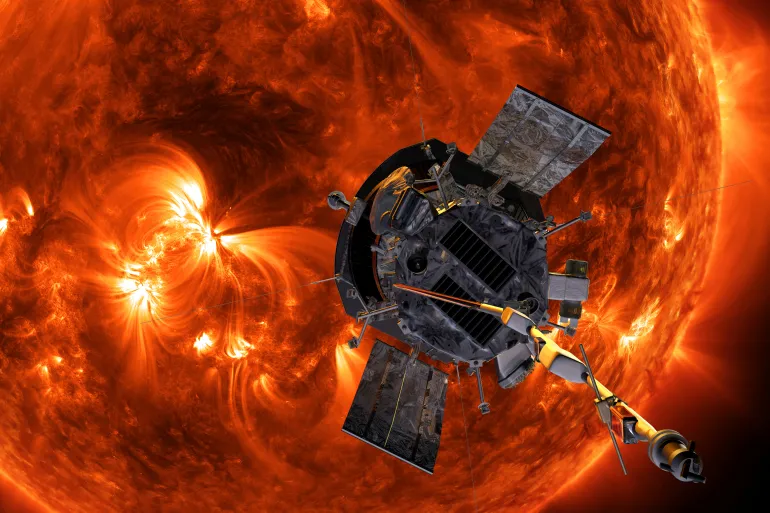
NASA’s ambitious mission to explore the Sun has reached a historic milestone. The Parker Solar Probe, launched in 2018, has been steadily pushing the boundaries of solar exploration by attempting the closest approach to the Sun in history. This daring mission aims to study the Sun’s outer atmosphere, or corona, in unprecedented detail, helping scientists better understand solar wind, solar storms, and the fundamental processes driving our star’s behavior.
With the Sun located approximately 93 million miles from Earth, approaching it closely poses extreme technological challenges. The Parker Solar Probe has been designed to withstand temperatures exceeding 2,500°F (1,377°C) and radiation levels far beyond what most spacecraft encounter. By flying through the Sun’s outer atmosphere, the probe is providing data that could revolutionize our understanding of space weather and its impact on Earth.
The Parker Solar Probe Mission
Named after Dr. Eugene Parker, the pioneering astrophysicist who first theorized the existence of the solar wind in 1958, the Parker Solar Probe is humanity’s first spacecraft specifically designed to fly into the Sun’s corona.
Mission Objectives Include:
-
Trace the flow of energy and heat in the corona: Understanding why the Sun’s corona is hotter than its surface is a long-standing puzzle in astrophysics.
-
Study the solar wind: By observing particles emitted by the Sun, scientists can better predict how the solar wind affects Earth’s magnetosphere and satellite operations.
-
Explore solar magnetic fields: The probe measures magnetic field fluctuations, providing insight into solar storms that can disrupt communication systems and power grids on Earth.
The spacecraft’s instruments are meticulously designed to collect high-resolution data while withstanding the extreme heat and radiation encountered near the Sun.
Engineering Marvel: How the Probe Survives Extreme Conditions
Flying so close to the Sun requires extraordinary engineering. The Parker Solar Probe incorporates several innovations:
-
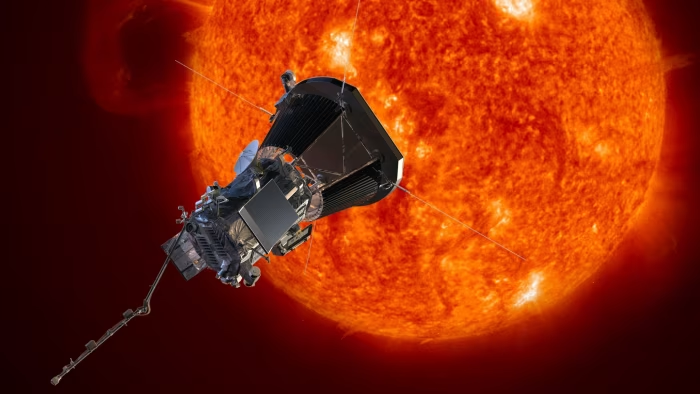
Thermal Protection System (TPS): A carbon-composite shield, approximately 4.5 inches thick, protects the spacecraft’s instruments from the intense heat. The TPS reflects and dissipates heat, allowing instruments to operate at near-room temperature.
-
Solar Array Cooling System: Specialized cooling systems prevent the probe’s solar panels from overheating while still generating energy.
-
Autonomous Systems: The probe operates independently, adjusting its orientation to keep the shield facing the Sun while maintaining communication with Earth.
This combination of advanced materials, autonomous navigation, and innovative cooling allows the probe to approach closer to the Sun than any human-made object in history.
The Closest Approach
The Parker Solar Probe is gradually spiraling closer to the Sun through a series of seven planned Venus gravity assists, which shrink its orbit and increase its speed. The spacecraft has already reached several record-breaking milestones:
-
First Record: Fastest human-made object in 2018, surpassing 213,000 miles per hour (343,000 km/h).
-
Closest Distance Record: Approaching within 15 million miles (24 million kilometers) of the Sun’s surface during recent orbits, much closer than the previous record set by the Helios 2 mission in the 1970s.
-
Future Target: The probe is expected to reach within 3.83 million miles (6.16 million kilometers) of the Sun by the end of its mission, flying directly through the corona.
Each close approach, or perihelion, provides an opportunity to gather unique data about solar activity and the Sun’s magnetic environment.
Scientific Instruments on Board
The Parker Solar Probe carries four main instrument suites:
-
FIELDS: Measures electric and magnetic fields in the corona, as well as radio emissions.
-
WISPR (Wide-field Imager for Parker Solar Probe): Captures images of the solar corona and solar wind in visible light, helping scientists visualize dynamic structures.
-
SWEAP (Solar Wind Electrons Alphas and Protons): Counts particles in the solar wind and measures their properties.
-
ISʘIS (Integrated Science Investigation of the Sun): Detects high-energy particles and traces their origin in solar eruptions and cosmic rays.
These instruments work together to provide a comprehensive picture of solar activity, from particle flows to magnetic fields and coronal structures.
Why This Mission Matters
Understanding the Sun is crucial not only for astrophysics but also for modern life on Earth:
-
Space Weather Prediction: Solar storms can damage satellites, disrupt GPS systems, and even cause power outages. The Parker Solar Probe’s data helps predict and mitigate these effects.
-
Human Space Exploration: As NASA plans future missions to the Moon and Mars, understanding solar radiation and particle events is essential for astronaut safety.
-
Fundamental Science: The mission addresses long-standing questions about solar physics, such as why the corona is hotter than the Sun’s surface and how the solar wind is accelerated.
By providing direct measurements from the Sun’s corona, the Parker Solar Probe is filling gaps that telescopes and Earth-based observations cannot address.
Early Discoveries and Findings
Even before reaching its closest approach, the Parker Solar Probe has yielded groundbreaking insights:
-
Solar Wind Dynamics: The probe observed unexpected “switchbacks” in the magnetic field, where the field lines suddenly reverse direction. These structures may play a key role in accelerating the solar wind.
-
Dust and Particles: Instruments detected variations in the density and composition of dust near the Sun, which affect how light and radiation interact with the corona.
-
Coronal Heating Clues: Early data suggests that small-scale magnetic interactions, called “nanoflares,” may contribute to the corona’s extreme temperatures.
-
Magnetic Field Behavior: Measurements show that the Sun’s magnetic field is more turbulent and complex than previously thought, providing new insight into solar storms.
These initial discoveries are already reshaping our understanding of the Sun and guiding the next phase of research.
The Mission Timeline
The Parker Solar Probe’s mission is planned to continue until at least 2025, with a total of 24 close passes of the Sun. The timeline includes:
-
Venus Gravity Assists: Using Venus’s gravity to gradually shrink its orbit around the Sun.
-
Incremental Closest Approaches: Each perihelion brings the probe closer, increasing the intensity of solar radiation and the value of collected data.
-
Data Transmission: The spacecraft transmits data back to Earth using high-gain antennas, though full data sets are often received after months of processing.
This careful, step-by-step approach ensures that the probe collects maximum scientific data while surviving extreme conditions.
Challenges and Risks
Operating near the Sun is not without risks:
-
Extreme Temperatures: Even with the TPS, minor failures could expose instruments to destructive heat.
-
Radiation Exposure: Solar flares and energetic particle events can damage electronics.
-
Communication Delays: High heat and autonomous operation require the probe to make decisions independently, increasing the risk of errors.
Despite these challenges, NASA’s rigorous design, testing, and monitoring have allowed the probe to exceed expectations and continue its mission safely.
Global Impact and Collaboration
The Parker Solar Probe mission has far-reaching implications beyond NASA:
-
International Research Collaboration: Data is shared with scientists worldwide, fostering global cooperation in solar physics.
-
Technological Innovation: Materials and systems developed for the probe may have applications in other spacecraft, satellites, and even terrestrial technologies.
-
Public Engagement: NASA frequently shares imagery, data, and educational resources, inspiring public interest in space exploration and science.
By combining scientific discovery with global collaboration and public outreach, the mission underscores the importance of exploring our closest star.
Future Prospects
The Parker Solar Probe is paving the way for future solar exploration missions:
-
Heliophysics Research: The probe’s data will guide future missions aimed at understanding solar storms, space weather, and the Sun-Earth connection.
-
Interplanetary Exploration: Understanding solar radiation and magnetic fields is essential for long-duration missions to Mars and beyond.
-
Next-Generation Instruments: Lessons learned from Parker Solar Probe will inform the design of instruments capable of even closer and more detailed solar observation.
As the probe continues its journey, it promises to provide a treasure trove of scientific knowledge that will shape our understanding of the Sun for decades to come.
Conclusion
NASA’s Parker Solar Probe represents a milestone in space exploration, as the closest-ever approach to the Sun pushes the boundaries of science, engineering, and human curiosity. By venturing into the Sun’s corona, the probe is revealing unprecedented insights into solar wind, magnetic fields, coronal heating, and particle dynamics. These discoveries are crucial for predicting space weather, protecting technology and astronauts, and advancing fundamental solar physics.
With each orbit, the Parker Solar Probe not only breaks records but also illuminates the mysteries of our nearest star, reinforcing the importance of daring exploration and innovative engineering in expanding humanity’s understanding of the cosmos. The mission exemplifies the intersection of science, technology, and perseverance, inspiring a new era of solar exploration that will benefit both Earth and future generations of space travelers.
Read Also: Keep your face towards the sunshine and shadows will fall behind you
Watch Also: https://www.youtube.com/@TravelsofTheWorld24







Leave a Reply