
What is 3I/ATLAS — and Why It Matters
3I/ATLAS is only the third confirmed interstellar object ever observed to pass through our Solar System — meaning it originated outside our Sun’s domain.
-
“Interstellar” refers to the shape of its orbit: hyperbolic, not bound to the Sun — so it’s just passing by.
-
Astronomers first spotted 3I/ATLAS in July 2025, thanks to the ATLAS survey telescope (Asteroid Terrestrial‑impact Last Alert System) in Chile.
-
Based on current trajectory estimations, its closest approach to Earth will be on December 19, 2025, at roughly 170 million miles (≈ 1.8 astronomical units) — safely distant, posing no threat.
Because interstellar visitors are extremely rare — only two have been confirmed before (‘Oumuamua and 2I/Borisov) — every opportunity to observe 3I/ATLAS is precious. It offers scientists a chance to study material formed around another star system, potentially revealing differences (or similarities) to icy bodies from our own Solar System.
What the New Images Reveal: Activity, Tails & Coma
In recent weeks, several observatories and spacecraft — operated by NASA and European Space Agency (ESA) — have captured fresh images of 3I/ATLAS showing signs of increasing activity.
Hubble’s Latest View (November 30, 2025)
-
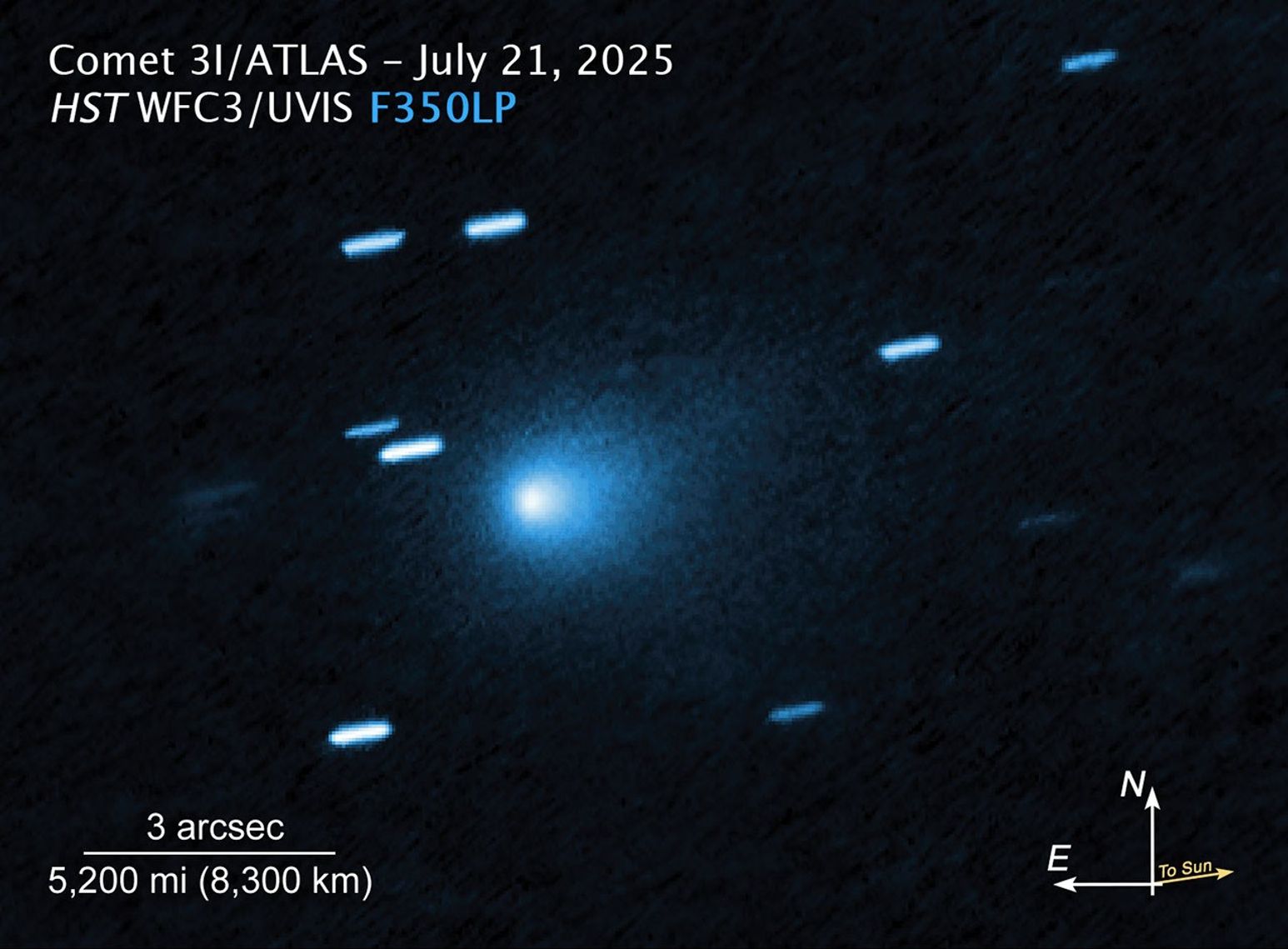
The Hubble Space Telescope took detailed observations of 3I/ATLAS when the comet was roughly 286 million kilometers from Earth.
-
The image reveals a bright nucleus surrounded by a fuzzy coma (a cloud of gas and dust), typical of comets warming up as they near the Sun.
-
There are faint hints of a tail and possible jets, indicating outgassing — volatile ices turning into gas as sunlight heats the comet.
Spacecraft Observations by NASA & ESA
Because 3I/ATLAS passed near Mars and traversed regions hard to view from Earth, space agencies used various spacecraft to track it:
-
The Mars Reconnaissance Orbiter (MRO) snapped an image on October 2, 2025, when the comet was only ~18.6 million miles from the orbiter — a remarkably close view.
-
Another spacecraft, MAVEN, recorded ultraviolet observations showing a halo of gas and dust, indicating hydrogen atoms being released — a telltale sign of sublimation (ice turning to vapor).
-
The ESA-led JUICE (Jupiter Icy Moons Explorer) also observed 3I/ATLAS shortly after perihelion (close approach to Sun) — capturing images that highlight both plasma and dust tails, suggesting strong cometary activity.
Collectively, these multi-point observations (from Earth, Mars orbit, deep‑space probes) give astronomers a comprehensive view of 3I/ATLAS’s evolving behaviour.
What This Activity Tells Scientists — and What’s Surprising
It Behaves Like a “Normal” Comet
Despite its interstellar origin, 3I/ATLAS shows familiar cometary behaviour: dust coma, gas emission, tails, outgassing as it warms — similar to comets born in our own Solar System.
This suggests that at least some comet‑forming processes around other stars may produce objects similar in structure and composition to Solar System comets. That has major implications: our models of ice and dust in protoplanetary disks might be more universal than assumed.
High Activity & Unexpected Composition
Observations via space telescopes (including the James Webb Space Telescope — JWST) and spectroscopic studies reveal interesting chemical makeup: 3I/ATLAS appears rich in carbon dioxide (CO₂), plus traces of water (H₂O), carbon monoxide (CO), and other volatile compounds.
-
The CO₂‑dominated coma (the gas envelope around the nucleus) is among the highest ever observed for a comet — quite different from typical Solar System comets, where water-driven outgassing dominates at similar distances.
-
The detection of water‑ice absorption and extended CO₂ outgassing suggests that 3I/ATLAS may have formed in an environment where ices differ from those we see here — possibly a colder or chemically distinct protoplanetary disk around another star.
This unusual composition raises questions: how much do interstellar comets vary? Does their volatile makeup reflect the environment of their home system? And what does that tell us about planetary formation around other stars?
Why This Close Encounter Matters — For Science and Humanity
A Rare Opportunity
Observing 3I/ATLAS up close — from multiple vantage points — is a once‑in‑decades opportunity. It lets scientists:
-
Compare interstellar and Solar‑System comets side-by-side.
-
Test theories of comet formation, composition, and evolution in different stellar systems.
-
Study how volatiles (like CO₂, H₂O, CO) behave under solar heating — especially when composition differs.
-
Gather data on interstellar chemistry, dust grain properties, and volatile inventory beyond our system.
Because most interstellar objects are tiny, faint, and fly past quickly, obtaining detailed images and spectra is extremely difficult. 3I/ATLAS’s relative brightness and activity make it a “best‑case” interstellar visitor.
Expanding Our View of the Universe
Comets — whether local or interstellar — are time capsules. They preserve icy and dusty materials from the early days of solar (or stellar) system formation. Studying them helps us understand how planets, comets, and even potential life‑building ingredients might form across the galaxy.
If 3I/ATLAS’s composition is representative of interstellar comets, it suggests that planets around other stars may have access to volatile mixes quite different from our Solar System’s — broadening the range of possible planetary environments.
Testing and Using Our Fleet of Spacecraft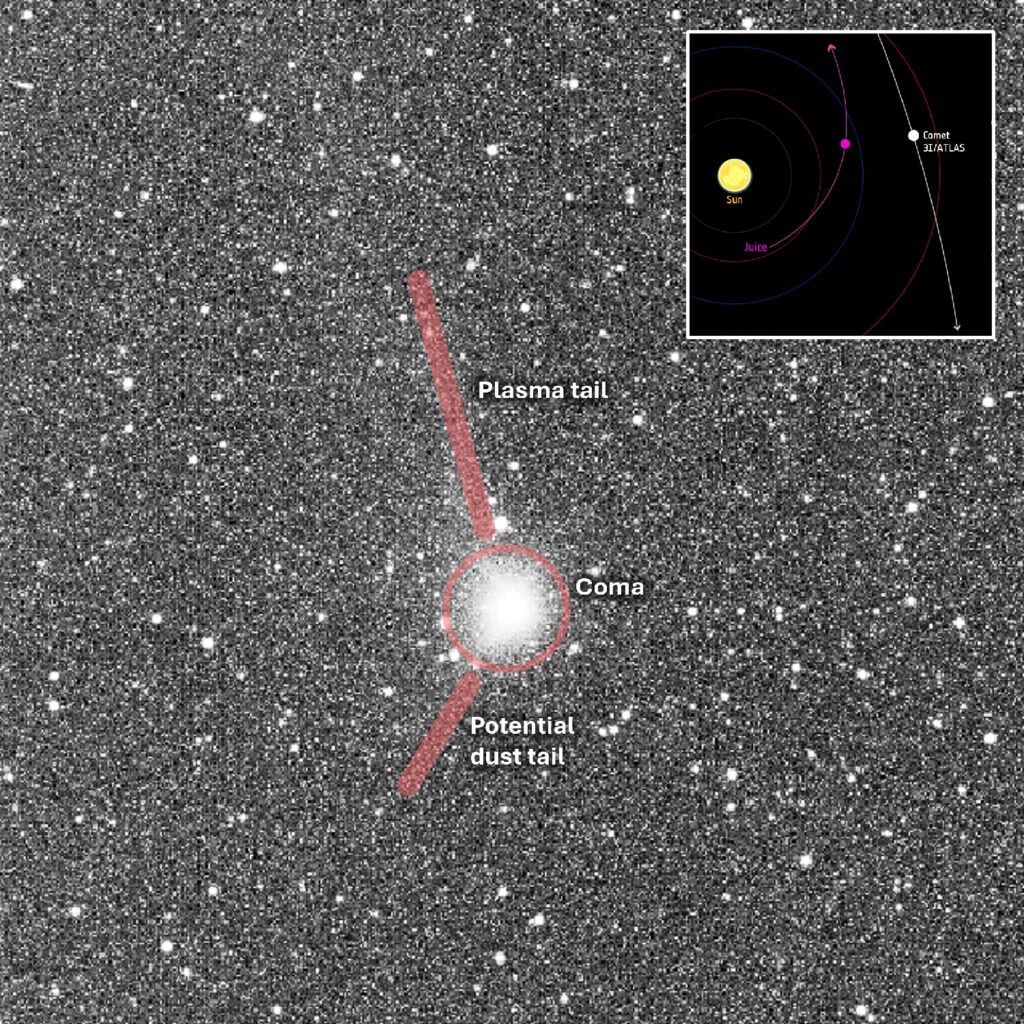
The event demonstrates the value of having a fleet of telescopes and spacecraft – orbiters around Mars, deep‑space probes, space telescopes, heliophysics instruments — all ready to observe unexpected visitors. It’s a powerful example of coordinated, multi‑platform astronomy.
Combined observations from missions as diverse as the STEREO solar observatory, Mars orbiters, JUICE, and Hubble / JWST show how flexible and interconnected space science has become.
What’s Next: Tracking 3I/ATLAS & What to Watch For
Even though 3I/ATLAS will make its closest approach to Earth on December 19, 2025, its journey continues:
-
After Earth‑pass, the comet heads out beyond Jupiter’s orbit in 2026. NASA expects to continue observations as long as it remains bright enough.
-
Scientists will monitor changes in the coma, outgassing, tail structure, and chemical composition — tracking how solar heating affects volatile release and how long the active coma persists.
-
Researchers hope to combine data from all observing platforms (ground‑based telescopes, space telescopes, orbiters, heliophysics missions) to build a comprehensive physical, chemical, and dynamical model of 3I/ATLAS.
-
Any surprises — irregular outgassing, unusual jets, anomalous chemical signatures, or non‑gravitational acceleration — could reshape our ideas about interstellar bodies.
What We Don’t Yet Know — and What Makes 3I/ATLAS Mysterious
Despite promising observations, many aspects remain uncertain or surprising:
-
The overall size of 3I/ATLAS’s nucleus is not precisely known — estimates range from hundreds of meters to a few kilometers.
-
Its unusually high CO₂-to‑H₂O ratio is puzzling; it may reflect formation conditions very different from typical Solar System comets — but whether that’s common among interstellar objects remains unclear.
-
Long‑term structural stability: as volatile ices sublimate, the nucleus may erode or fragment, possibly revealing more surprises (dust jets, fragment clouds, or even splitting).
-
Because 3I/ATLAS is a one‑time visitor (on a hyperbolic orbit), scientists must gather as much data as possible now — else it won’t return. Every observation counts.
What This Means for Us — Beyond the Science
The saga of 3I/ATLAS shows how increasingly connected our exploration of space has become. A single interstellar visitor ignites worldwide observation efforts — telescopes, orbiters, probes across multiple agencies — all focused on understanding something that began light‑years away.
It also underscores the value of preparedness: having multiple spacecraft, instruments, and networks ready to pivot and observe unexpected cosmic events. That flexibility expands what we can learn, especially when surprises arrive unannounced.
Moreover, 3I/ATLAS reminds us that the Solar System isn’t isolated. Interstellar particles, comets, maybe even interstellar dust clouds, can — and do — pass through. Each one carries information about distant stellar systems. They are natural messengers from afar, offering glimpses of alien planetary chemistry and formation environments.
Conclusion: 3I/ATLAS — A Rare Cosmic Gift, Unfolding in Real Time
With the latest images from NASA and ESA, 3I/ATLAS has begun to reveal its secrets — tail, coma, jets, unusual composition — all while speeding through our Solar System toward a safe passage by Earth on December 19, 2025. For scientists, this interstellar comet is a once‑in‑a‑lifetime opportunity; for all of us, a reminder of how vast and variable the galaxy is.
As long as observations continue, 3I/ATLAS will remain a subject of intense study — and perhaps, a source of surprises that challenge our understanding of what comets (and planetary formation) can be.
Read Also: Keep your face towards the sunshine and shadows will fall behind you
Watch Also: https://www.youtube.com/@TravelsofTheWorld24







Leave a Reply