
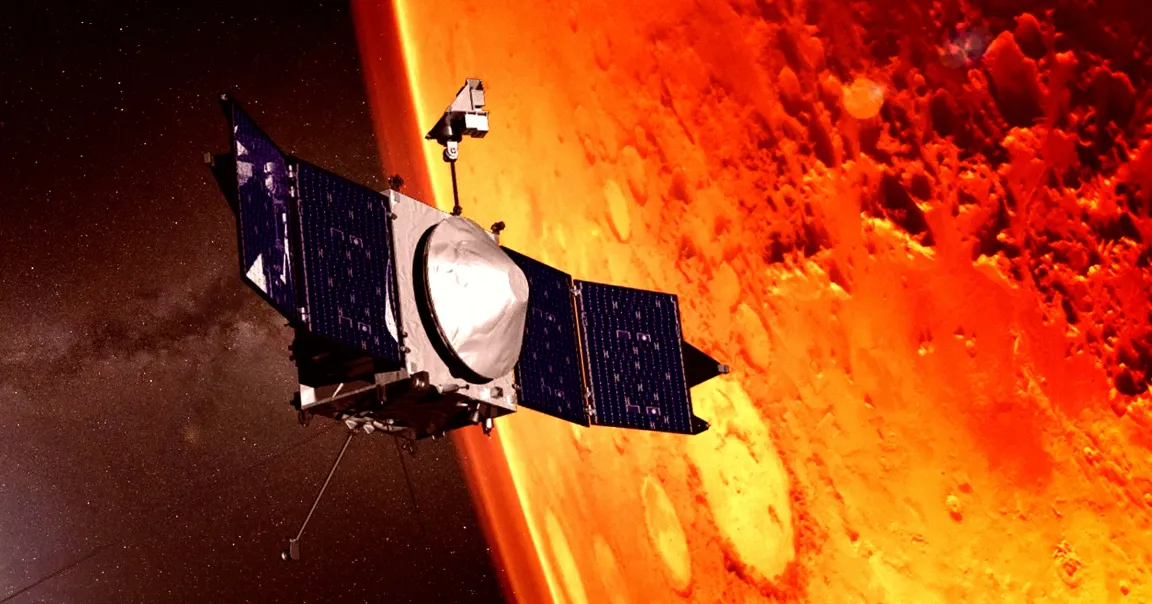
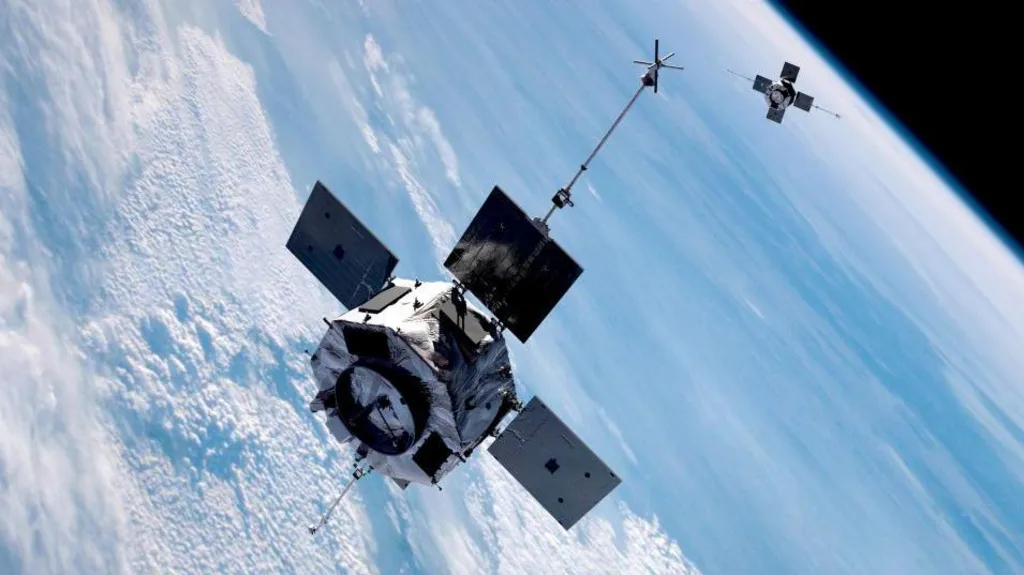
NASA is facing a major problem with one of its longest‑serving spacecraft around Mars — the Mars Atmosphere and Volatile Evolution (MAVEN) orbiter. On December 6, 2025, MAVEN mysteriously went silent and stopped communicating with Earth, its signal failing to reach NASA’s ground antennas after it passed behind the Red Planet.
MAVEN is a critical mission that has been studying Mars’ upper atmosphere for more than a decade. Its work has been key to understanding how Mars lost much of its once‑thick atmosphere and why it transformed from a potentially habitable world into the cold, dry desert we see today.
Before this incident, MAVEN was operating normally — its systems were working and sending routine telemetry back to Earth. But once it went around the far side of Mars and came back into view, no signal ever returned. NASA’s Deep Space Network, the global array of giant radio antennas used to talk to faraway spacecraft, waited but detected only silence.
This loss of contact was unexpected and worrying. MAVEN was not an old, short‑lived mission — it launched in November 2013 and reached Mars in September 2014, and it continued operating well past its original primary mission.
NASA teams have been trying intensely to re‑establish communication, but so far they have had no success. A fragment of tracking data received on the day contact was lost suggested MAVEN may have been spinning abnormally when it disappeared from view, and that its orbit might have been altered during the blackout period. But the true cause of the signal loss remains unknown.
What MAVEN Was Doing at Mars
To understand why this problem matters, it helps to know what MAVEN was doing at Mars:
Mission Purpose
MAVEN’s main science goal was to study the upper atmosphere of Mars, especially how the solar wind — a stream of charged particles from the Sun — strips atmospheric gases into space. This process is believed to have played a major role in Mars evolving from a warmer, wetter world into the cold desert it is now.
It has gathered unprecedented data on how Mars’ air interacts with solar activity, magnetic fields, and other important planetary processes. This information has helped scientists understand not just Mars’ history, but also how atmospheres evolve on other planets, including Earth.
Communication Relay
MAVEN also served as part of Mars’ communications network. It was one of several orbiters — including NASA’s Mars Reconnaissance Orbiter and Mars Odyssey, plus the European Space Agency’s ExoMars Trace Gas Orbiter — that relay signals between spacecraft on the surface (like the Perseverance and Curiosity rovers) and mission control on Earth.
Losing MAVEN’s relay capability temporarily complicates communications, but NASA says the other orbiters can fill in. Teams have already adjusted operations to rely more on the remaining orbiters while they continue attempts to contact MAVEN.
What Went Wrong — Theories and Investigations
The exact reason MAVEN stopped communicating isn’t yet known — and that’s the hardest part for mission controllers and planetary scientists.
Here’s what NASA and outside analysts think might have happened:
Unexpected Spin or Attitude Loss
Data from the brief signal fragment received on December 6 suggest MAVEN may have been spinning when it re‑emerged from behind Mars. A spacecraft normally keeps precise orientation so its antennas are aimed at Earth. If it is tumbling or rotating unpredictably, its radio dish may not point correctly, which would explain why signals were not detected.
Possible Orbital Change
The unusual signal pattern also hinted that MAVEN’s orbit might have changed more than expected during its period out of contact. An unexpected change in orbit could affect when and where NASA expects to receive signals and make it harder to maintain communications.
Solar Conjunction Complication
Shortly after losing contact, Earth and Mars were in a period called solar conjunction, when the Sun lies roughly between Earth and Mars. During this time, NASA deliberately avoids sending critical commands because solar interference can corrupt signals. This temporarily delayed some diagnostic attempts, though NASA has resumed communication efforts now that practical signal windows have returned.
NASA’s Response and Ongoing Efforts
NASA is treating this incident as a serious anomaly and has assembled a formal anomaly review board — a panel of engineers, mission specialists, and technical experts — to look into what happened. An anomaly board is usually convened when something goes wrong and there is uncertainty about the cause.
Mission teams continue using every available tool to try to reach MAVEN, including:
-
Re‑aiming Deep Space Network antennas during possible signal windows
-
Using larger observatories like the Green Bank Telescope to search for weak signals
-
Analyzing all past telemetry and tracking data for clues
So far, none of these efforts has restored communication. NASA has not yet confirmed whether MAVEN can be brought back online — but the fact that it went quiet unexpectedly and might be spinning or off‑orbit means this is a very challenging situation.
Impacts on Mars Exploration
The loss of MAVEN’s communications link has some consequences for ongoing Mars missions, but NASA is adapting:
Communications Network Adjustments
While MAVEN has been an important relay for surface robots, it wasn’t the only one. Other orbiters — such as Mars Reconnaissance Orbiter, Mars Odyssey, and the ESA’s ExoMars Trace Gas Orbiter — can still support rovers like Perseverance and Curiosity. Teams have re‑planned signal passes to rely on these spacecraft instead.
Rover Science Continues
NASA says the Perseverance rover — currently exploring Jezero Crater for ancient signs of life — continues its mission and science activities even without MAVEN’s relay. Adjustments to daily planning and data routes are being made to ensure scientific productivity continues.
Long‑Term Science and Atmospheric Understanding
If MAVEN remains lost, scientists will lose one source of direct atmospheric measurements from orbit. This would diminish some real‑time atmospheric science, but other missions (including orbiters and ground‑based instruments) can continue many studies.
The Bigger Picture — Why This Matters
NASA’s Mars program is one of the most ambitious in planetary exploration, with orbiters, landers, and rovers working together to answer big questions:
-
How did Mars’ climate evolve?
-
Why did it lose its thick atmosphere?
-
Did it ever support life?
-
What can planetary evolution teach us about Earth?
Losing MAVEN is significant because:
1. It’s a long‑lasting mission that exceeded expectations. MAVEN outlived its primary mission and continued producing valuable data for years. Its sudden silence represents the loss of institutional memory and ongoing scientific contributions.
2. Understanding atmospheric loss remains crucial for reconstructing Mars’ past — and MAVEN was the flagship mission for that. While other instruments have contributed, MAVEN’s direct measurements were unique.
3. It’s a reminder of the difficulty of deep‑space operations. Spacecraft so far from Earth must operate without physical repair, and communication gaps, unexpected motions, or anomalies can jeopardize decades of work in a moment.
4. It may affect future mission design and planning. Lessons from this incident — once understood — may help engineers design more robust systems, better fault protection, and stronger ways to recover spacecraft when signs go dark.
How the Space Community Is Reacting
Scientists, engineers, and space enthusiasts have expressed concern about this development. Many note that MAVEN’s silence — especially after it was working normally before passing behind Mars — indicates a baffling technical challenge that wasn’t predicted.
Experts say it’s too early to know whether MAVEN can be restarted or if this signals the end of its mission. Discovery of the cause will require in‑depth investigation. If it turns out that MAVEN’s trajectory or orientation changed in a way that prevents its antennas from pointing back to Earth, that could be a critical barrier to re‑establishing contact.
Some analysts also point out that losing long‑lived missions like this is part of the natural life cycle of exploration — vehicles eventually fail — but the manner of this loss, without warning, makes it particularly disappointing.
What’s Next?
NASA hasn’t given up. Engineers and mission planners continue listening for MAVEN signals and probing every possible way to reacquire the spacecraft. The anomaly review board’s findings, once complete, may help shape future attempts.
Meanwhile, Mars missions continue:
-
Perseverance presses on collecting samples and investigating ancient environments.
-
Other orbiters maintain scientific return and communication support.
-
Future missions — including sample return and new orbiters — continue to be planned and developed.
Summary
In short:
-
NASA’s MAVEN spacecraft suddenly lost communication with Earth on December 6, 2025 after passing behind Mars.
-
Attempts to reach it since then have failed, and NASA established an anomaly review board to investigate.
-
Some limited tracking data suggests MAVEN may be spinning or misaligned, possibly with an altered orbit, but the exact cause is unknown.
-
MAVEN was a major mission studying how Mars lost its atmosphere and has been operating far beyond its original lifespan.
-
Other Mars missions continue, and NASA is adapting communications routes to make up for MAVEN’s absence.
Read Also: Keep your face towards the sunshine and shadows will fall behind you
Watch Also: https://www.youtube.com/@TravelsofTheWorl







Leave a Reply