
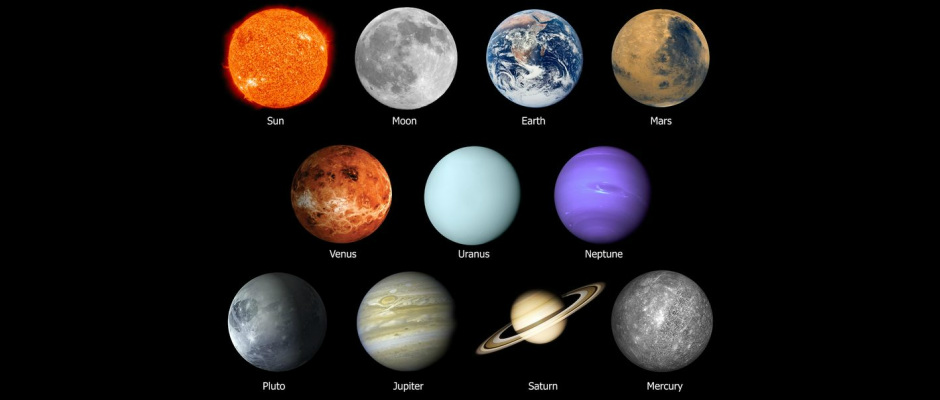
The Solar System is a vast and fascinating region of space, dominated by the Sun and populated by planets, moons, asteroids, comets, and other celestial bodies. The planets, in particular, have captured human imagination for centuries, each with unique features, compositions, and histories. Traditionally, the Solar System has been described as having nine planets: Mercury, Venus, Earth, Mars, Jupiter, Saturn, Uranus, Neptune, and Pluto. While Pluto has been reclassified as a dwarf planet by the International Astronomical Union (IAU), it remains a popular part of the traditional list. Understanding each planet and its characteristics gives us insight into the diversity and complexity of our cosmic neighborhood.
1. Mercury
Mercury is the closest planet to the Sun and the smallest in the Solar System.
-
Orbital Distance: Approximately 57.9 million kilometers (36 million miles) from the Sun.
-
Diameter: About 4,880 kilometers (3,032 miles).
-
Surface and Composition: Mercury is a rocky planet with a heavily cratered surface, similar to Earth’s Moon. It has a thin atmosphere composed mostly of oxygen, sodium, hydrogen, helium, and potassium.
-
Temperature: Mercury experiences extreme temperature variations due to its thin atmosphere, ranging from -173°C (-280°F) at night to 427°C (800°F) during the day.
-
Notable Features: Mercury has a large iron core, giving it a high density. Its slow rotation and fast orbit result in unusual day-night cycles.
2. Venus
Venus is the second planet from the Sun and often called Earth’s twin due to its similar size and composition.
-
Orbital Distance: About 108 million kilometers (67 million miles) from the Sun.
-
Diameter: 12,104 kilometers (7,521 miles).
-
Surface and Atmosphere: Venus has a thick, toxic atmosphere dominated by carbon dioxide, with clouds of sulfuric acid. Its surface pressure is 92 times that of Earth.
-
Temperature: Venus is the hottest planet in the Solar System, with surface temperatures averaging 465°C (869°F) due to a runaway greenhouse effect.
-
Notable Features: Venus rotates in the opposite direction to most planets (retrograde rotation) and has numerous volcanoes and vast plains.
3. Earth
Earth is the third planet from the Sun and the only known planet to support life.
-
Orbital Distance: 149.6 million kilometers (93 million miles) from the Sun.
-
Diameter: 12,742 kilometers (7,918 miles).
-
Surface and Atmosphere: Earth has a rocky surface with oceans covering about 71% of its surface. Its atmosphere is composed of nitrogen (78%) and oxygen (21%), supporting diverse life forms.
-
Temperature: Average surface temperature is about 15°C (59°F).
-
Notable Features: Earth has a strong magnetic field, tectonic activity, and a single natural satellite, the Moon. Its liquid water and stable climate make it uniquely habitable.
4. Mars
Mars, the fourth planet, is often called the Red Planet due to its reddish appearance caused by iron oxide on its surface.
-
Orbital Distance: Approximately 227.9 million kilometers (142 million miles) from the Sun.
-
Diameter: 6,779 kilometers (4,212 miles).
-
Surface and Atmosphere: Mars has a thin atmosphere made mostly of carbon dioxide. Its surface features include mountains, valleys, volcanoes, and polar ice caps.
-
Temperature: Average surface temperature is about -60°C (-76°F), but it can range from -125°C (-195°F) near the poles to 20°C (68°F) near the equator.
-
Notable Features: Mars has the tallest volcano in the Solar System, Olympus Mons, and a massive canyon, Valles Marineris. Its two small moons, Phobos and Deimos, orbit closely.
5. Jupiter
Jupiter is the fifth planet and the largest in the Solar System, a gas giant composed mostly of hydrogen and helium.
-
Orbital Distance: 778.5 million kilometers (484 million miles) from the Sun.
-
Diameter: 139,820 kilometers (86,881 miles).
-
Atmosphere: Jupiter’s atmosphere is thick and turbulent, with bands of clouds and storms. The Great Red Spot, a massive storm, has lasted for centuries.
-
Temperature: Average temperature in the upper atmosphere is about -145°C (-234°F).
-
Notable Features: Jupiter has at least 95 moons, including Ganymede, the largest moon in the Solar System. Its strong magnetic field and rapid rotation (about 10 hours per day) create intense radiation belts.
6. Saturn
Saturn is the sixth planet, famous for its spectacular ring system.
-
Orbital Distance: 1.43 billion kilometers (888 million miles) from the Sun.
-
Diameter: 116,460 kilometers (72,366 miles).
-
Composition: Saturn is a gas giant, mostly hydrogen and helium, with a small rocky core.
-
Temperature: Upper atmosphere averages -178°C (-288°F).
-
Notable Features: Saturn’s rings are made of ice and rock particles. It has at least 145 moons, including Titan, which has a thick atmosphere and lakes of liquid methane.
7. Uranus
Uranus is the seventh planet, an ice giant with a blue-green color due to methane in its atmosphere.
-
Orbital Distance: 2.87 billion kilometers (1.78 billion miles) from the Sun.
-
Diameter: 50,724 kilometers (31,518 miles).
-
Atmosphere: Composed mainly of hydrogen, helium, and methane.
-
Temperature: Extremely cold, with an average temperature of -224°C (-371°F).
-
Notable Features: Uranus rotates on its side (axial tilt of 98°), giving it extreme seasonal variations. It has 27 known moons and faint rings.
8. Neptune
Neptune is the eighth planet, another ice giant with striking blue color.
-
Orbital Distance: 4.5 billion kilometers (2.8 billion miles) from the Sun.
-
Diameter: 49,244 kilometers (30,598 miles).
-
Atmosphere: Composed of hydrogen, helium, and methane, with high-speed winds exceeding 2,000 km/h (1,200 mph).
-
Temperature: Average temperature is -214°C (-353°F).
-
Notable Features: Neptune has 14 known moons, with Triton being the largest, exhibiting retrograde orbit and geysers of nitrogen. It also has faint rings and dynamic storm systems.
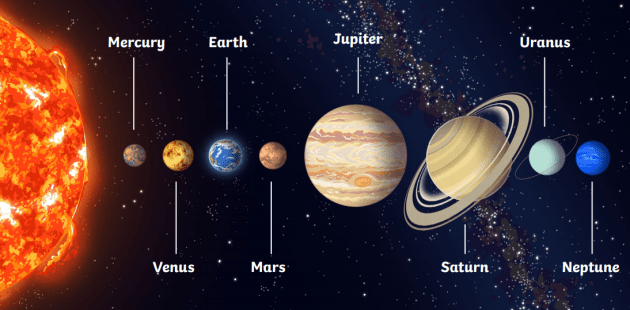
9. Pluto (Dwarf Planet)
Pluto was traditionally considered the ninth planet but was reclassified as a dwarf planet in 2006 by the IAU.
-
Orbital Distance: Approximately 5.9 billion kilometers (3.67 billion miles) from the Sun.
-
Diameter: 2,377 kilometers (1,477 miles).
-
Surface and Atmosphere: Composed mainly of ice and rock. Its thin atmosphere expands when closer to the Sun and freezes when farther away.
-
Temperature: Extremely cold, averaging -229°C (-380°F).
-
Notable Features: Pluto has five known moons, with Charon being the largest. Its orbit is highly elliptical and tilted compared to the other planets.
Planetary Classification
Planets are categorized based on composition and location in the Solar System:
-
Terrestrial Planets: Mercury, Venus, Earth, Mars — small, rocky surfaces, dense, and closer to the Sun.
-
Gas Giants: Jupiter and Saturn — massive, primarily hydrogen and helium, with extensive atmospheres and many moons.
-
Ice Giants: Uranus and Neptune — composed of heavier elements and ices, with cold atmospheres and strong winds.
-
Dwarf Planet: Pluto — small, icy, orbiting the Sun but not clearing its orbital path.
These classifications help scientists study the formation, evolution, and dynamics of planetary systems.
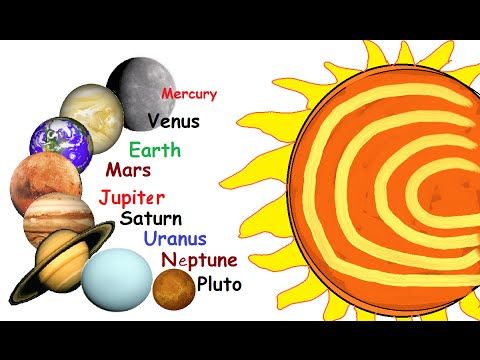
Key Characteristics Across the Planets
-
Size and Mass: Planets range from small, dense Mercury to massive Jupiter, influencing gravity, atmosphere retention, and geological activity.
-
Atmospheres: Composition varies widely, from the thin air of Mars to the thick, toxic atmosphere of Venus.
-
Moons: Number and size of moons vary significantly, affecting tides, orbital dynamics, and geological processes.
-
Temperature: Distance from the Sun largely dictates surface temperatures, with inner planets being warmer and outer planets extremely cold.
-
Rings: Only the gas and ice giants have prominent ring systems, composed of dust, ice, and rock particles.
Importance of Studying the Planets
Studying the planets provides insights into:
-
Planetary Formation: Understanding how planets form and evolve helps scientists learn about our Solar System and other star systems.
-
Climate and Atmospheres: Examining planetary atmospheres informs us about climate processes and potential habitability.
-
Space Exploration: Knowledge of planetary surfaces and conditions is essential for missions, robotics, and potential human exploration.
-
Comparative Planetology: Comparing planets helps identify patterns and anomalies, deepening our understanding of planetary science.
Conclusion
The nine planets of the Solar System, from Mercury to Pluto, showcase the remarkable diversity of celestial objects orbiting our Sun. Each planet has distinct characteristics, from Mercury’s extreme temperatures and Venus’s thick atmosphere to Jupiter’s massive storms and Neptune’s supersonic winds. Pluto, though reclassified, continues to intrigue scientists with its icy surface and dynamic atmosphere.
Studying these planets not only enhances our understanding of the Solar System but also provides a foundation for exploring exoplanets, assessing habitability, and preparing for future space exploration. Each planet tells a unique story about the formation and evolution of the cosmos, illustrating the complexity, beauty, and wonder of our celestial neighborhood.
Read Also: Keep your face towards the sunshine and shadows will fall behind you
Watch Also: https://www.youtube.com/@TravelsofTheWorld24





Leave a Reply