
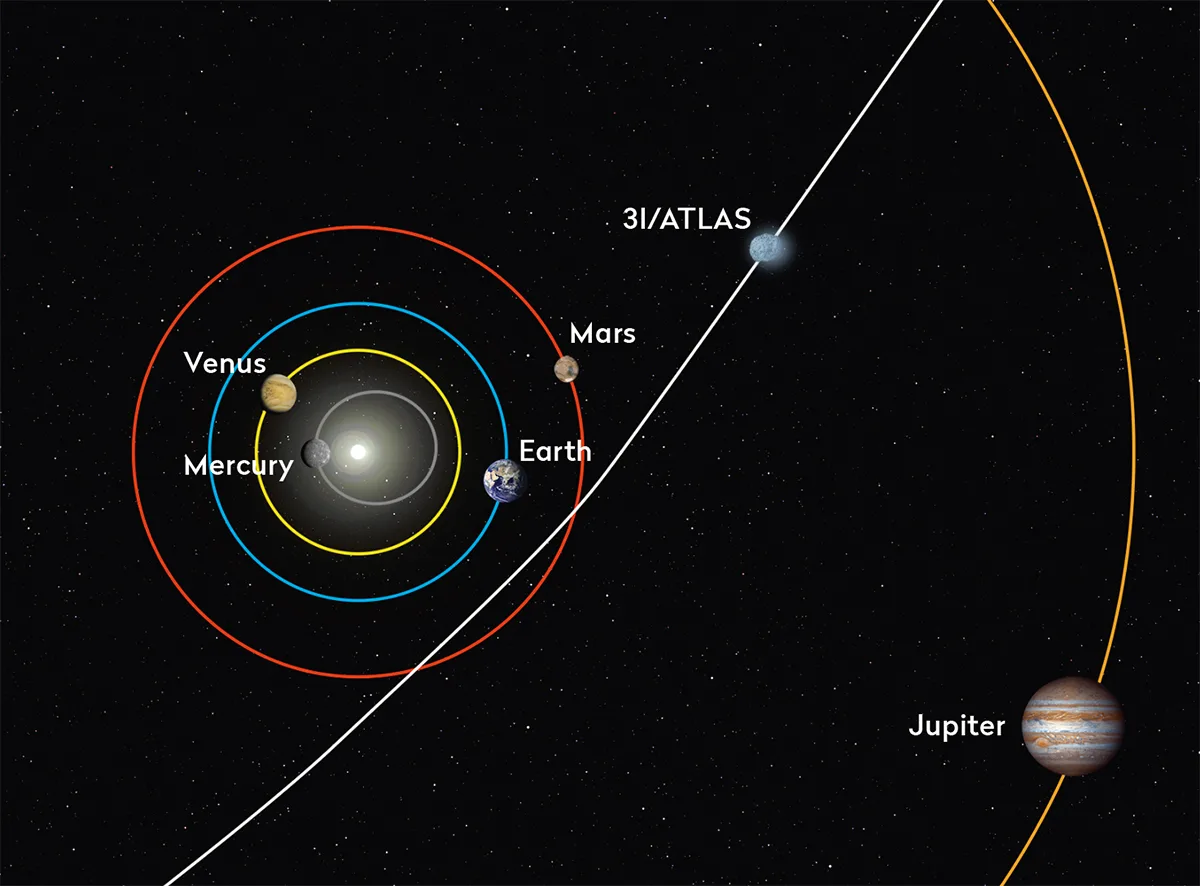
A Rare Visitor From Beyond — Meet 3I/ATLAS
In mid‑2025, astronomers detected a remarkable object entering our Solar System: 3I/ATLAS. Its hyperbolic orbit and high velocity meant it was not gravitationally bound to the Sun — clear evidence that it came from beyond our solar neighborhood.
This made 3I/ATLAS only the third confirmed interstellar object ever observed by humans — after ʻOumuamua (2017) and 2I/Borisov (2019).
Initial observations suggested comet-like behavior: a faint coma (a cloud of gas and dust around the nucleus) and a short tail — signs of outgassing as ices sublimate when warmed by the Sun.
With such an object now passing through our Solar System, astronomers worldwide began intense observation campaigns. But as 2025 progressed, something surprising happened: 3I/ATLAS acted up — drastically.
A Sudden Surge: Evidence That 3I/ATLAS May Have Exploded
Rising Activity — Well Beyond Expectations
As 3I/ATLAS neared perihelion (its closest approach to the Sun), observations detected dramatic increases in brightness and mass loss — far exceeding typical comet activity.
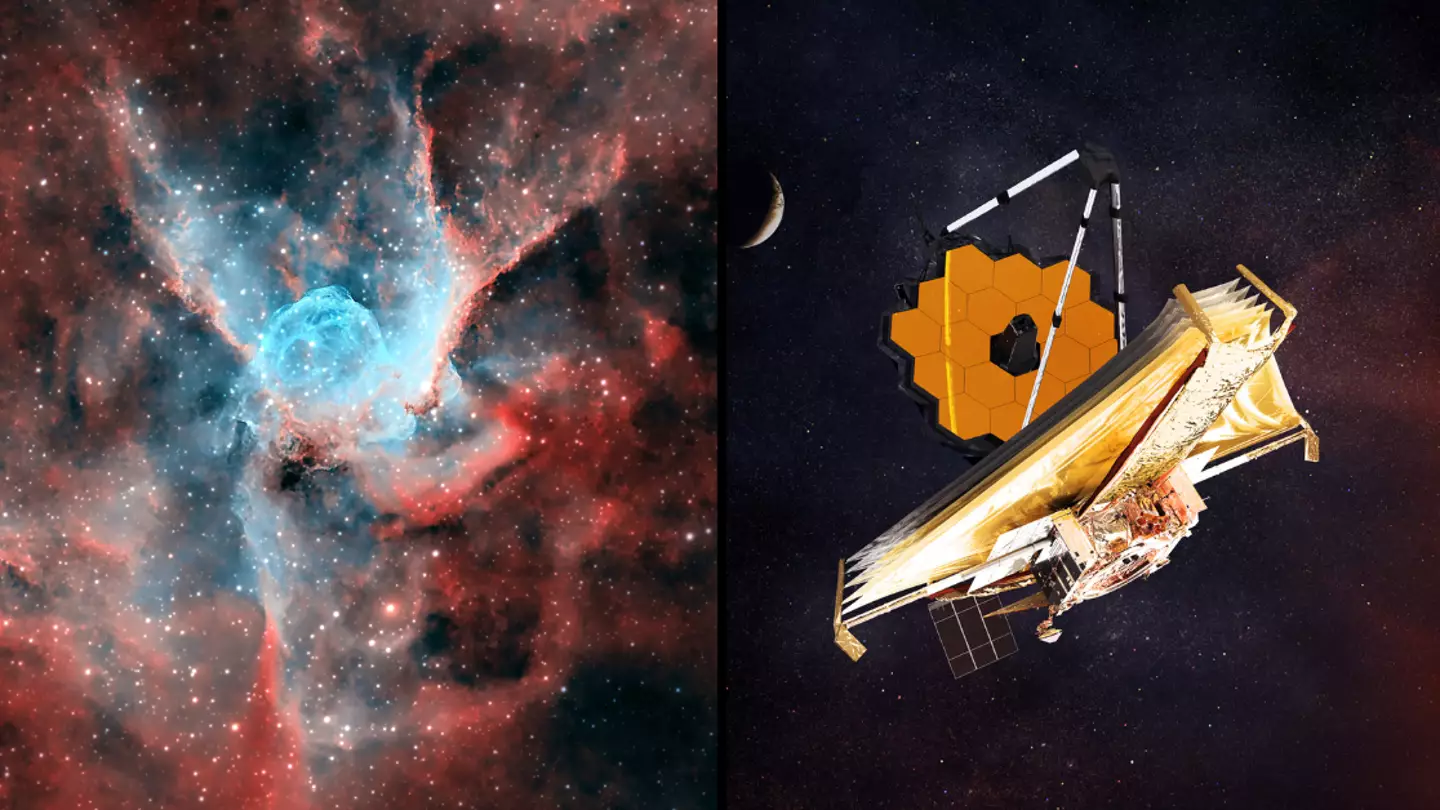
Spectroscopic data from the James Webb Space Telescope (JWST) revealed a coma dominated by carbon dioxide (CO₂), along with water (H₂O), carbon monoxide (CO), and other volatiles — a rare composition compared to many Solar System comets.
The inferred CO₂/H₂O ratio was among the highest ever recorded for a comet, hinting at an unusual internal makeup or formation environment.
But the real shock came when calculations showed that the amount of mass being lost — dust, gas, and volatile ices — surged so much that the surface area required to produce that output would have to be many times larger than what Hubble’s earlier images indicated. In other words: the object seemed to be shedding mass at a rate impossible for a simple, intact nucleus of the size estimated previously.
Breaking Apart — Possibly Into Many Fragments
Given this discrepancy, some scientists proposed a bold hypothesis: 3I/ATLAS may have broken apart — potentially exploding near perihelion. The breakup could increase the surface area dramatically (because many fragments present more surface exposed to solar heating than one intact object), explaining the unexpected mass loss and brightness surge.
Indeed, some recent images and analyses suggest the comet may have fragmented into multiple pieces (at least 16) after its close solar pass.
This “explosion at perihelion” scenario — if confirmed — would mark 3I/ATLAS as one of the most dramatic interstellar visitors studied to date.
What This Means — Scientifically and Cosmically
A New Kind of Interstellar Comet?
If 3I/ATLAS truly disintegrated under solar heating, it could mean that some interstellar comets are structurally fragile, with internal compositions or thermal properties quite different from typical Solar System comets.
The high CO₂ content and unusual outgassing behavior hint at a nucleus formed under different conditions — perhaps in a colder or chemically distinct protoplanetary disk around another star.
Such differences would expand our understanding of the diversity of small bodies in the galaxy, suggesting that comets from other star systems may behave in unexpected ways.
Insight into Interstellar Ice, Chemistry & Planet Formation
Depending on its composition, 3I/ATLAS may carry clues about the materials present in another star system — possibly including ices, organic molecules, and primitive dust grains. Studying its gas and dust output could help scientists compare formation conditions across different parts of the galaxy.
Moreover, if interstellar comets like 3I/ATLAS are common, they may play a role in distributing volatile compounds — water, CO₂, organic molecules — across stellar neighborhoods, affecting planetary formation and perhaps even the potential for life elsewhere.
Why So Much Caution — The Explosion Theory Is Not Proven
Although the exploding/comet‑breakup hypothesis is gaining traction, astronomers are cautious. Several key uncertainties remain:
-
Nucleus size and composition are still uncertain. Estimates vary widely; if initial assumptions about its size are wrong, the mass‑loss calculations also change.
-
Alternative explanations exist. Intense outgassing or unusual jet activity — albeit extreme — could produce rapid mass loss without requiring an explosion or fragmentation.
-
Observational limits. As 3I/ATLAS moves away from the Sun and dims, obtaining high-quality data becomes harder. Some of the “fragments” may simply be transient dust structures or jets.
-
Complex physics. Thermal stresses, internal layering, volatile distribution, radiation history — all complicate modelling how a comet behaves when heated for the “first time.”
In short: while “exploded interstellar comet” is a working hypothesis, it’s not yet a confirmed fact.
What Scientists Are Doing — Tracking, Observing, Debating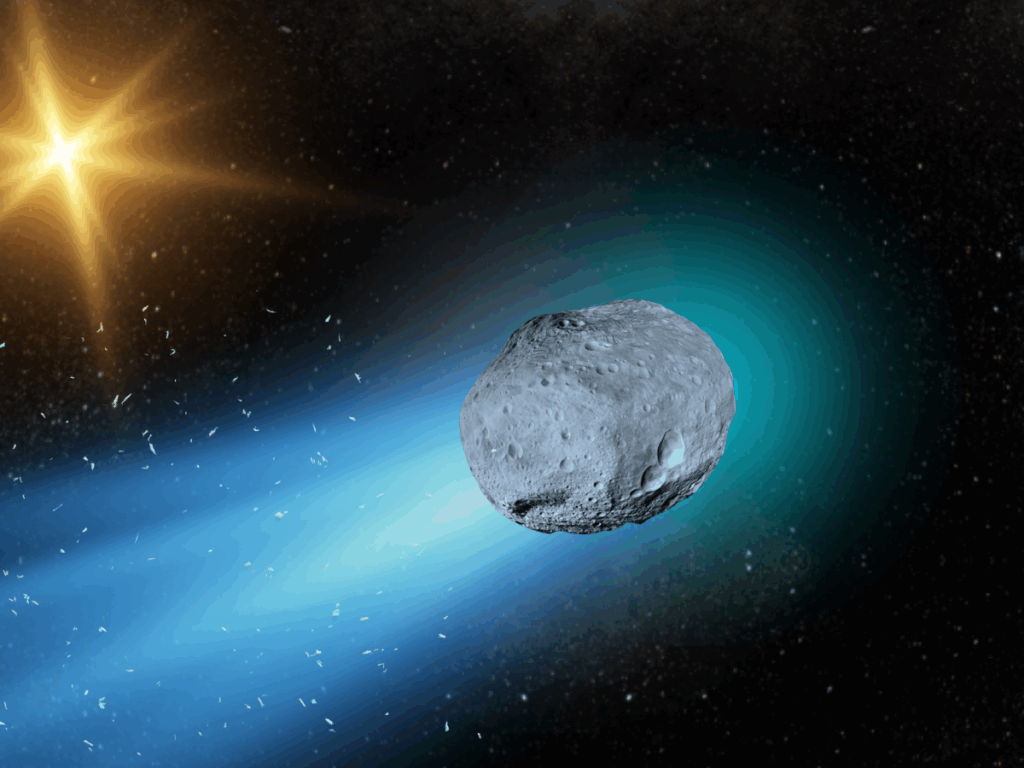
Because 3I/ATLAS remains one of the most important interstellar visitors ever recorded, research and observation efforts are now global and intense:
-
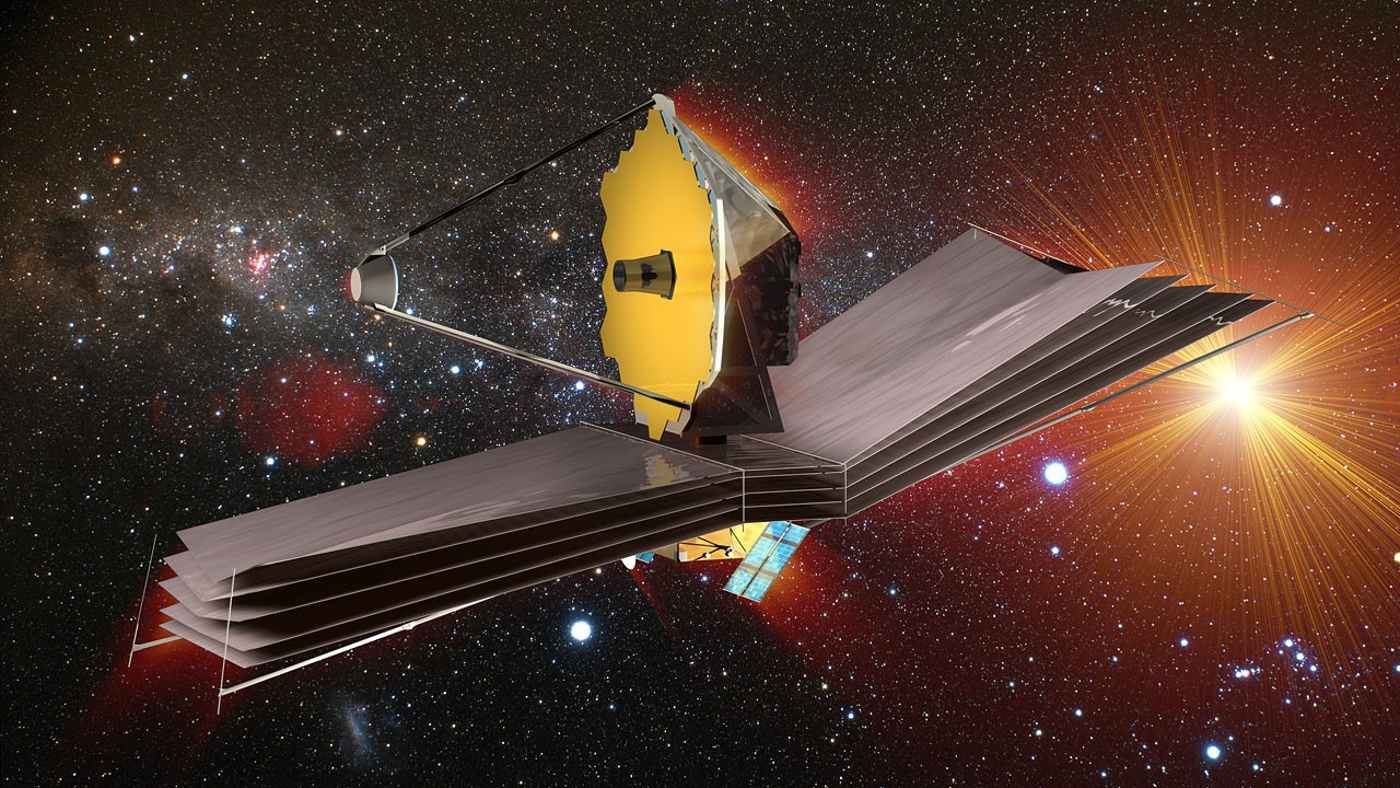
Telescopes — both ground-based and space-based, including JWST — continue to monitor the object and any fragments or coma evolution.
-
Spectroscopy aims to track gas emissions over time (CO₂, H₂O, CO, dust) to understand the composition and the mechanism behind the outburst.
-
Astrometric monitoring checks for changes in trajectory — which could indicate non-gravitational forces (e.g., from outgassing jets), shedding light on mass loss and dynamics.
-
Comparative studies: astronomers compare 3I/ATLAS’s behavior to that of known comets and previous interstellar objects (ʻOumuamua, 2I/Borisov) to see how unique or typical it is.
-
Theoretical modelling: researchers run simulations of thermal stress, fragmentation, volatile sublimation to test whether natural processes can account for the observed outburst or whether more exotic explanations remain viable.
What This Means for Humanity’s View of the Universe
The story of 3I/ATLAS — especially if it indeed exploded — challenges many assumptions:
-
Comets aren’t all alike. Interstellar visitors may be structurally and chemically different from Solar System comets, meaning our models of comet behavior may not apply uniformly across the galaxy.
-
We’re part of a dynamic galaxy. Objects from faraway star systems pass through — sometimes violently — reminding us how interconnected and alive the galaxy is.
-
Opportunities for discovery are rare but powerful. Each interstellar visitor offers a glimpse into distant formation zones, chemistry, and history. Their brief visits demand rapid, coordinated scientific action.
-
Humility before cosmic diversity. What we know about comets in our Solar System is just a part of the story; cosmic variety may be far richer, stranger, and more complex than previously imagined.
Conclusion — A Cosmic Mystery Still Unfolding
3I/ATLAS has already rewritten parts of the astronomical playbook. What began as “just another interstellar comet” has evolved into a possible exploding visitor from the stars, shedding mass at rates and with behavior unlike anything seen before.
Yet scientists remain grounded. The explosion or fragmentation hypothesis remains under scrutiny, and future observations — as the object travels out of our Solar System — will be crucial to confirm or refute it.
Whether or not 3I/ATLAS ultimately proves to have exploded, its appearance has already expanded our view of what interstellar objects can be. It’s a vivid reminder of how much we still don’t know — and how thrilling the unknown can be.
Read Also: Keep your face towards the sunshine and shadows will fall behind you
Watch Also: https://www.youtube.com/@TravelsofTheWorld24





Leave a Reply