
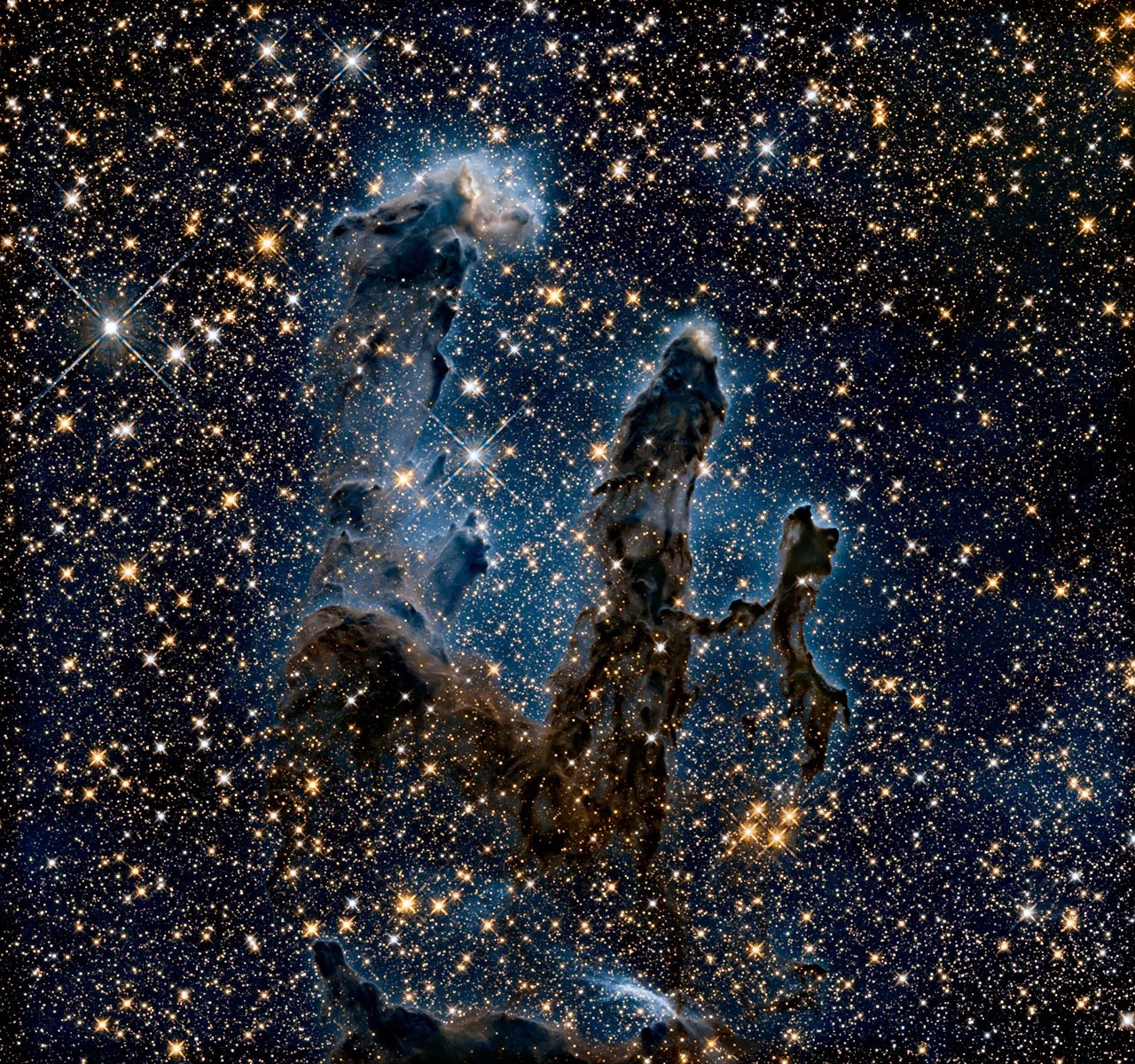
A Long‑Loved Cosmic Icon, Seen Anew
The “Pillars of Creation,” located in the Eagle Nebula (M16), have been a symbol of cosmic wonder since they first gained fame in 1995 via the Hubble Space Telescope. That original image captivated the public with its towering clouds of gas and dust — dramatic, mysterious, and evocative of star formation.
Now, the James Webb Space Telescope (JWST) has delivered a brand‑new, more detailed infrared portrait of the Pillars, revealing previously hidden aspects of this stellar nursery.
In this new view — captured by Webb’s Near‑Infrared Camera (NIRCam) and complemented by its Mid‑Infrared Instrument (MIRI) — we don’t just see the familiar dust columns: we see hundreds of newborn and forming stars, glowing inside and around the pillars.
What the New Webb Image Shows
• Dust, gas — and star nurseries
The pillars themselves are composed of interstellar gas and dust. In the NIRCam view, these look like semi‑transparent spires or arches rising up like cosmic rock formations — but made of material that is ever-changing and alive with activity.
• Stars being born
Webb’s infrared vision penetrates the dust to reveal protostars — infant stars still forming within dense clouds. These appear as bright red orbs, often with diffraction spikes (a characteristic of Webb’s mirror).
Because these stars are newly minted, extremely young by cosmic standards (some just hundreds of thousands of years old), seeing them helps astronomers study what early star formation actually looks like — right at the beginning.
• Jets, shocks, and stellar feedback
Along the edges of the pillars are streaks and wavy lines — not lava, but supersonic jets and outflows from forming stars. As these jets slam into surrounding gas and dust, they create “bow shocks,” sculpting the structure of the nebula itself.
These features give a sense of dynamic, violent processes: matter collapsing under gravity, heating up, ejecting material, reshaping the nebula — all signs of active, ongoing creation.
• Dust revealed in mid‑infrared
Using its MIRI instrument, Webb also captures a composite view where the dusty environment becomes more prominent. In mid-infrared light, much of the formed stars fade, but dense dust glows — showing the raw material from which future generations of stars may emerge.
This combined NIRCam + MIRI view gives a fuller picture: stars in one layer, dust and gas in another, all interacting and evolving inside the Eagle Nebula.
Why This Image Matters: Science Beyond the Beauty
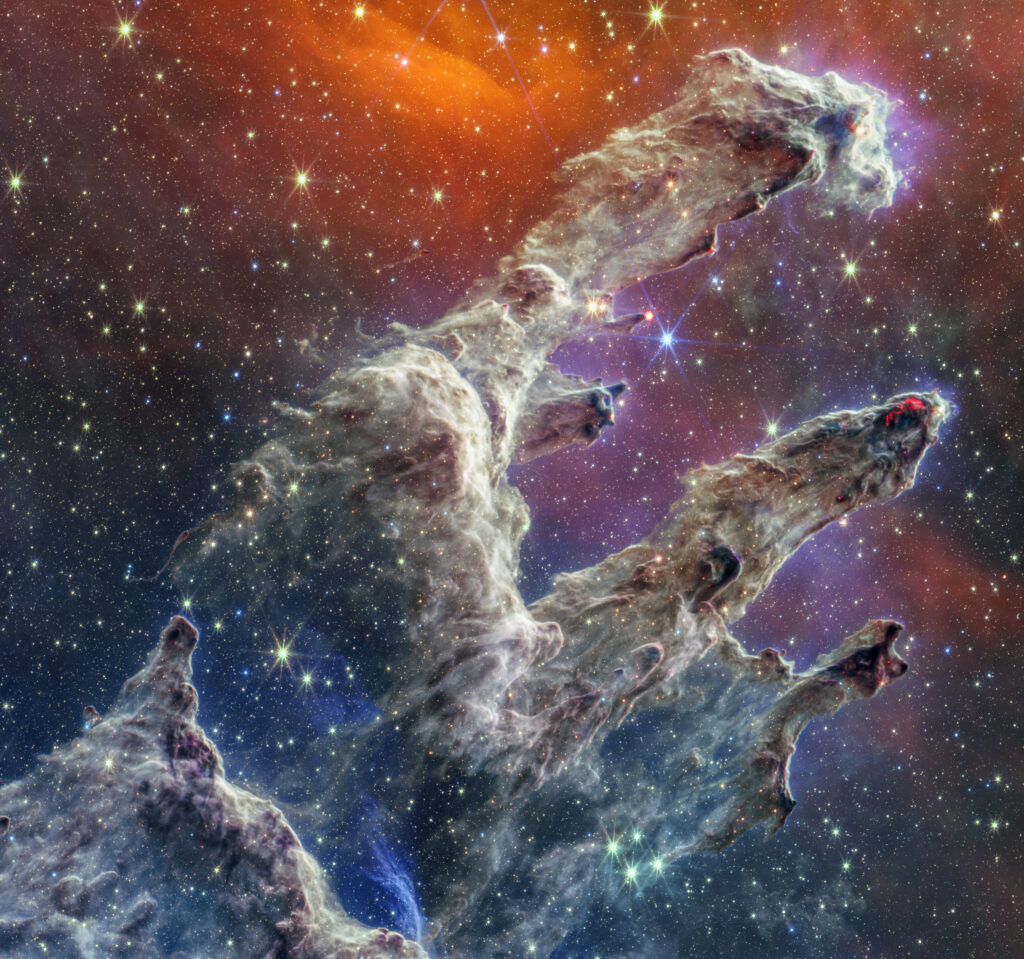
By combining images of the iconic Pillars of Creation from two cameras aboard the NASA/ESA/CSA James Webb Space Telescope, the Universe has been framed in its infrared glory. Webb’s near-infrared image was fused with its mid-infrared image, setting this star-forming region ablaze with new details. Myriad stars are spread throughout the scene. The stars primarily show up in near-infrared light, marking a contribution of Webb’s Near-Infrared Camera (NIRCam). Near-infrared light also reveals thousands of newly formed stars – look for bright orange spheres that lie just outside the dusty pillars. In mid-infrared light, the dust is on full display. The contributions from Webb’s Mid-Infrared Instrument (MIRI) are most apparent in the layers of diffuse, orange dust that drape the top of the image, relaxing into a V. The densest regions of dust are cast in deep indigo hues, obscuring our view of the activities inside the dense pillars. Dust also makes up the spire-like pillars that extend from the bottom left to the top right. This is one of the reasons why the region is overflowing with stars – dust is a major ingredient of star formation. When knots of gas and dust with sufficient mass form in the pillars, they begin to collapse under their own gravitational attraction, slowly heat up, and eventually form new stars. Newly formed stars are especially apparent at the edges of the top two pillars – they are practically bursting onto the scene. At the top edge of the second pillar, undulating detail in red hints at even more embedded stars. These are even younger, and are quite active as they form. The lava-like regions capture their periodic ejections. As stars form, they periodically send out supersonic jets that can interact within clouds of material, like these thick pillars of gas and dust. These young stars are estimated to be only a few hundred thousand years old, and will continue to form for millions of years. Almost everything you see in this scene is lo
The new JWST image of the Pillars of Creation isn’t just visually stunning — it has deep scientific importance. Here’s why:
-
Better data on star formation. By revealing large numbers of protostars, astronomers can count how many stars form in a given volume, how quickly they form, and how many don’t — key metrics for building accurate models of star formation.
-
Understanding the role of dust and gas. The mid‑infrared data from MIRI lets scientists estimate how much gas and dust remains — the “raw ingredients” for future stars and planets. This helps refine models of how stellar nurseries evolve over time.
-
Revealing dynamic processes. The visible jets and shocks show how young stars influence their environment. Stellar feedback — outflows, radiation, collisions — plays a huge role in shaping nebulae, triggering or suppressing further star formation. JWST gives us direct observational evidence of those mechanisms at work.
-
Bridging telescopes and wavelengths. By comparing older visible-light images (like from Hubble) with JWST’s infrared view, scientists gain a multi-layered understanding of the same region. Different wavelengths reveal different physical processes.
In short: JWST doesn’t just show us a pretty picture — it helps astronomers decode what’s really happening in a stellar nursery.
What the Pillars of Creation Teach Us About Our Universe
-
Star formation is ongoing and dynamic. These clouds are not static monuments — they are cradles of creation. Every observation captures a fleeting moment in a much longer cosmic story.
-
The seeds of stars — and possibly planets — are laid in dust and gas. Observing dust-rich regions helps us understand how systems like our own Solar System might form.
-
Feedback loops matter. Jets, radiation, and stellar winds from newly forming stars shape the environment, influencing how, where, and when new stars can form.
-
Multispectral astronomy is crucial. Different wavelengths (visible light, near-infrared, mid-infrared) reveal different aspects of cosmic phenomena — combining them gives a richer, fuller picture of the Universe’s complexity.
A Cosmic Laboratory — What’s Next
With the new JWST data, astronomers will:
-
Catalogue and track protostars and young stars inside the Pillars, mapping their distribution, age, and activity.
-
Use mid-infrared dust observations to estimate mass, density, and composition of gas/dust clouds — helping predict future star formation.
-
Monitor how jets and outflows from stars evolve, and how they influence the surrounding nebula over time.
-
Combine data with other telescopes (radio, submillimeter, optical) to build a complete, multi‑wavelength model of the Eagle Nebula’s evolution.
These efforts will deepen our understanding of stellar nurseries — including how systems like our own Sun and planets may have originated.
Why This Still Captivates Us
Human beings are storytellers. For decades, the original “Pillars of Creation” photograph inspired wonder, curiosity, even existential reflection. What does it mean to live on a cosmic scale? Are we alone? Where do we come from?
With JWST’s new image, that sense of wonder deepens. We see infancy — the first spark of stars themselves — and we realize how transient, how alive, how precarious the cosmos is. We glimpse the process that created not just distant stars, but perhaps the very atoms in our bodies.
And we are reminded: even in the deepest dark, creation continues.
Read Also: Keep your face towards the sunshine and shadows will fall behind you
Watch Also: https://www.youtube.com/@TravelsofTheWorld24






Leave a Reply