
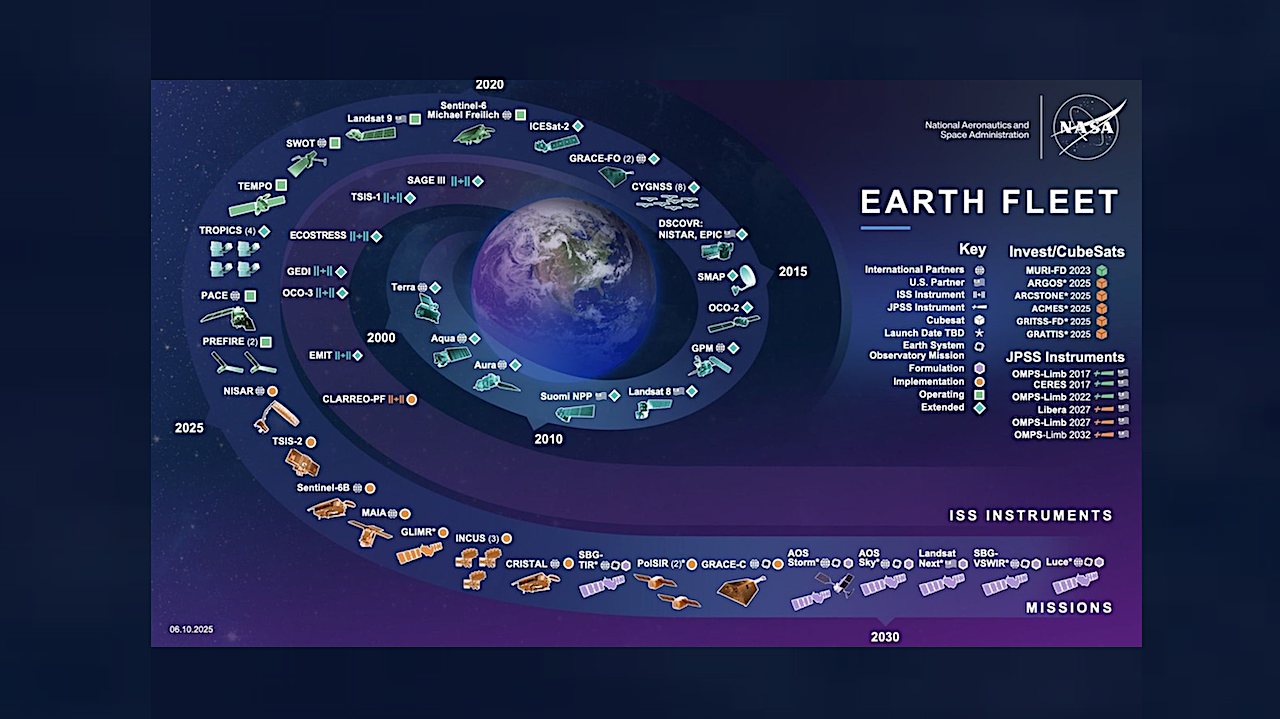
This letter from Earth scientists has also been published in Science magazine and is reprinted here with the permission of the authors [Science, 389, 357-358. doi:10.1126/science.adz6100]: “In May, the US administration proposed budget cuts to NASA, including a more than 50% decrease in funding for the agency’s Earth Science Division (ESD) (1), the mission of which is to gather knowledge about Earth through space-based observation and other tools (2).
The budget cuts proposed for ESD would cancel crucial satellites that observe Earth and its atmosphere, gut US science and engineering expertise, and potentially lead to the closure of NASA research centers. As former members of the recently dissolved (3) NASA Earth Science Advisory Committee, an all-volunteer, independent body chartered to advise ESD (4), we warn that these actions would come at a profound cost to US society and scientific leadership.
NASA ESD measurements provide critical information supporting environmental and resource management and community decision-making. In collaboration with the National Oceanic and Atmospheric Administration (5), ESD develops and launches satellites that track weather and pollution. Weather forecasts, including artificial intelligence−based apps on cell phones, rely on this information and will suffer if there are fewer measurements available. ESD measurements are also used in near real-time to diagnose fire risk, support US wildland fire management, and track active fires and their impacts (6).
Read Also: Keep your face towards the sunshine and shadows will fall behind you
Furthermore, the data collected by ESD are used to monitor croplands and rangelands, make commodity forecasts, and provide early-warning data for potential crop failures, water availability, and irrigation needs (7). ESD satellite data underpin drought, flood, and hurricane forecasting and are used to monitor water quality, fisheries, and harmful algal blooms (8, 9). This information supports public water management, coastal communities, and commercial and recreational fishing. ESD satellites also track sensitive ecosystems, delivering important data to support wildlife and habitat conservation and management (10).
The US has long been the global leader in Earth-observing satellite technology (11). If the proposed cuts are realized, the US will surrender this leadership to countries in Asia and Europe. Given that the cuts would prevent the US from training and preparing the next generation of the scientific and technical workforce, the consequences would be long-lasting. NASA ESD accounted for just 0.03% of US spending in 2024 (12). This investment returns its
value many times over by improving predictions, by spurring technological innovation and high-tech jobs, and by forging the knowledge of the planet that is needed for short- and long-term planning.
Watch Also: https://www.youtube.com/@TravelsofTheWorld24






Leave a Reply