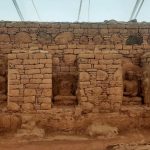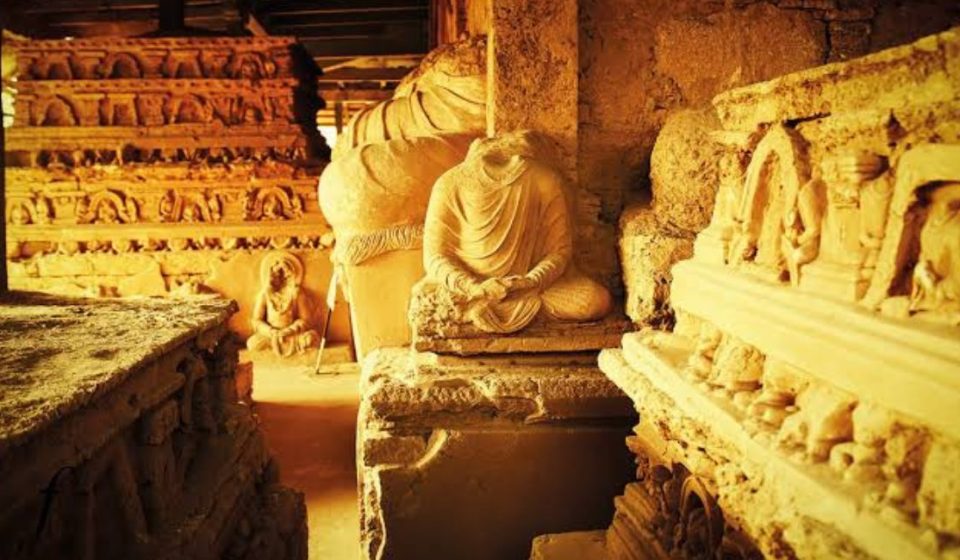

The labels in this particular glass case in the Taxila Museum’s collection describe the items within as accurately as an archaeologist’s field notebook might: “Left Foot, Hand, Ear and Palm,” and adjacent to it, “Bearded Head of an Ascetic.” Both artefacts are attributed to the 3rd-4th century AD and originate from the same remarkable source – the Dharmarajika Stupa, the oldest and most culturally significant of all the Buddhist sites in the entire Taxila valley. If the previous display of severed Buddha heads touched upon the devastation of physical integrity, this case takes us deeper, into the archaeological waste dump of an erased religious universe where even individual detached limbs and body parts – an isolated hand, a delicately cupped ear, an open palm – could be valued and preserved.
The Great Stupa That Started It All:
To properly comprehend why so much material survived from Dharmarajika in particular, we must first grasp what this site truly represented. Known commonly as the Great Stupa of Taxila, Dharmarajika is a Buddhist stupa built around the 3rd century BCE over the relics of the Buddha by Ashoka, Emperor of Magadha. This wasn’t just one monastery out of many; it was, arguably, the fulcrum upon which Buddhist Taxila pivoted, the very place where the Buddha’s most significant physical remains were entombed. The fragments, such as pieces of bone, constituted the focal relic content of the stupa, representing the Buddha’s physical essence and attracting pilgrims who came from across the ancient Buddhist world.
 As reverence for the stupa and its relics grew, it eventually spawned a large complex of subordinate stupas, monasteries, and prayer halls that surrounded it; collectively, these are part of the Ruins of Taxila, listed as a UNESCO World Heritage site in 1980. [ResearchGate] The site was excavated between 1913 and 1916 under John Marshall, making it among the first ever systematically excavated sites in the Taxila valley, and even prior to the establishment of the museum itself.
The fragmented objects on exhibit here – a hand curled into a fist, an open palm facing skywards, a foot with articulated toes, a perfectly curled ear – weren’t mere scattered debris. Rather, they were fragmented remnants of devotionally rendered stucco figures that once decorated the niches lining the walls of Dharmarajika and the structures that eventually grew up around the stupa. The presence of these items reinforces the site’s identity as a pilgrimage hub, where devotional images of the Buddha and attendant deities adorned the numerous niches in the chaitya-hall walls and, indeed, throughout the monastery complex itself; for instance, a head of a Bodhisattva about 9 inches high was uncovered in one chapel. [ResearchGate] As explained in the section about the garden Buddha statue, Gandharan artists created stucco figures by shaping soft material over an armature, often embellishing the final product with paint or gold leaf.
This technique allowed for meticulous detail, capturing the subtle articulation of fingers and the gentle drape of skin at the wrist or ankle, but unfortunately, stucco lacks the inherent strength of stone. Earthquakes frequently toppled the structure, causing the delicate figures to fracture at their weakest points – elbows, wrists, ankles, the juncture of ear to skull. Consequently, few complete narrative figures have survived in situ; the recurrence of this phenomenon is also likely one reason why many stupas were reconstructed and decorated with stucco in subsequent phases. [Sailingstone Travel] Thus, when archaeologists excavated the Dharmarajika site years later, they were sifting through precisely these sorts of collapsed components – not fully formed figures, but the disassembled essence of adoration.
See Also: https://www.youtube.com/watch?v=iyU4cZor_Gg
The Bearded Ascetic – A Different Kind of Face:
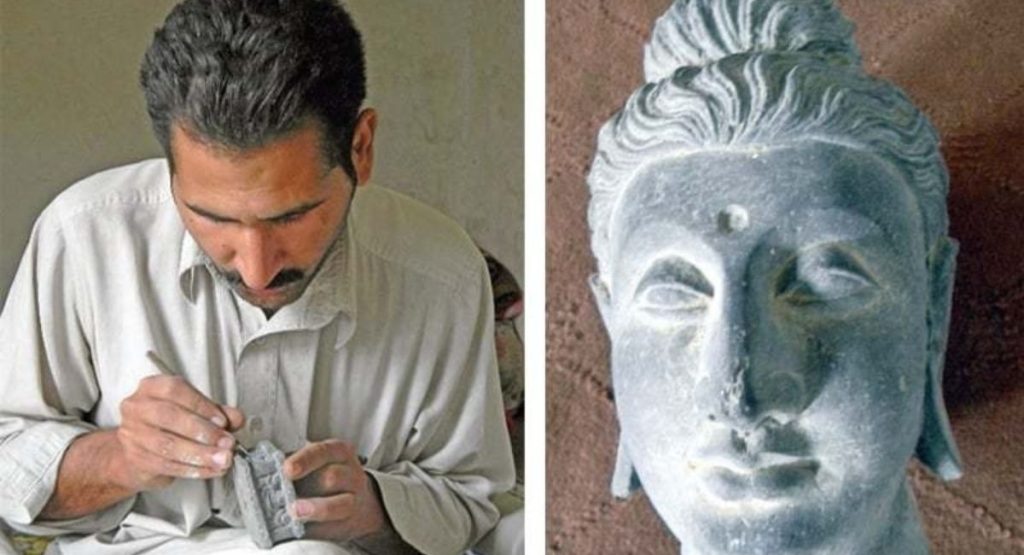
“ The heavily textured beard and hollowed, gaunt face of this individual likely depict one of the many holy men, hermits or ascetics who lived at or visited the monastic complex. More interestingly, it could represent the Buddha during the harsh period of austerities, which predated his enlightened state. This contemplation of extreme self-deprivation, and its inadequacy as a path to enlightenment when compared to the moderate middle path he eventually identified, became a hallmark psychological theme of Gandharan art. Thanks to their familiarity with Hellenistic realistic styles, Gandharan sculptors could render human suffering and physical depletion in excruciatingly vivid detail, a departure from the more idealised portrayals seen elsewhere in early South Asian devotional art.
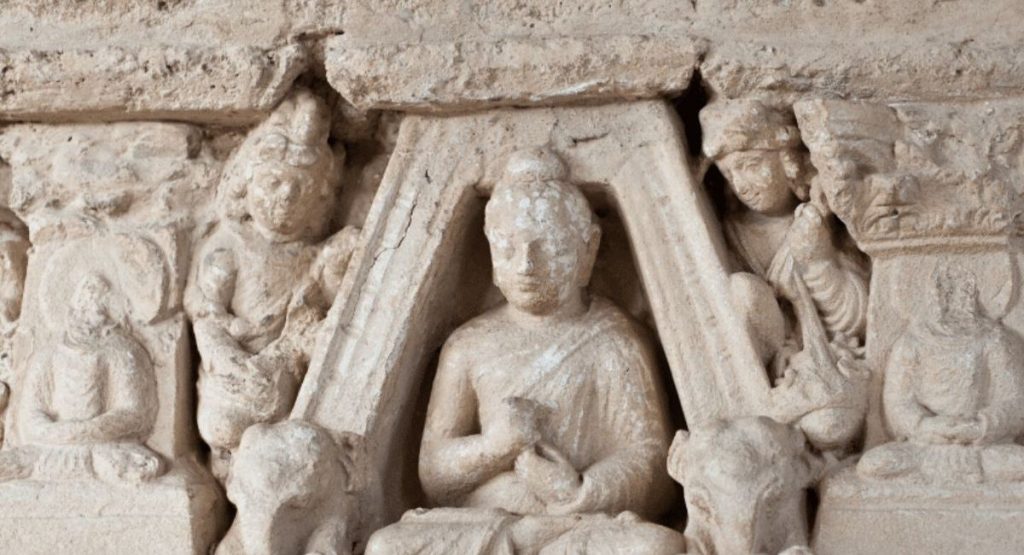
This bearded ascetic might well have been a figure in his own right — a fellow renouncer, a devout seeker of enlightenment, or one of the numerous other attendants on relief carvings illustrating Buddha’s life or the lives of the pious men who served as his entourage.
Fragments as Evidence, Not Just Loss:
We could be forgiven for observing this glass case and seeing only ruin – the sorry epilogue of a magnificent civilisation. However, many scholars who have meticulously studied sites such as Dharmarajika have come to regard these fragments as more than just loss. They are actually primary evidence, revealing aspects of life and culture that complete artworks cannot. Surveying the site, excavators discovered four large schist religious artworks (some fractured) in addition to a startling sixty-three stucco heads and large torso fragments, suggesting an incredible population of sacred images on the grounds.
What this sheer number of individual parts can show us, and a solitary, complete Buddha in a garden cannot, is how vibrant, visually saturated Dharmarajika’s monasteries were – a sensory explosion of dozens, or even hundreds, of stucco and stone religious images adorning walls, niche after niche, each one hand-made, painted and worshipped by residents and visitors alike.
Small Things, Properly Labelled: there is also something almost profoundly tender in the decision of the museum to itemise the fragments in such exquisite detail – “Left Foot, Hand, Ear and Palm.” Such a level of curation suggests a philosophical attitude that validates even fragmented evidence of a past culture, treating even single bits of broken material with importance, dignity and care. In fact, where many of Taxila’s best known art works-many of which are on display in museums in places such as Lahore and London, are carved from stone, many pieces from Dharmarajika and other Taxilan stupa complexes, like those in the museum at Taxila itself, are stucco because Buddha images and Bodhisattvas made of stucco often had to be applied to the outside of the structures to be effective. [Blogger] Standing at this display, after absorbing the majestic scale of the monumental garden Buddha and the somber symmetry of the string of dismembered Buddhas, we are now gaining a fuller understanding of Gandharan Taxila – not merely as a place captured in time, but as an actual archaeological record of a real, living religious society that, over the centuries, was born, was built upon and enriched, was violently disrupted, was buried by sand, and eventually, painstakingly resurrected by archaeologists determined to bring even its smallest shattered pieces to light.
Read more at: https://www.discovernewsdaily24.com/taxila-museum-sacred-relics-display-keeping-alive-the-spirituality-ofgandhara/