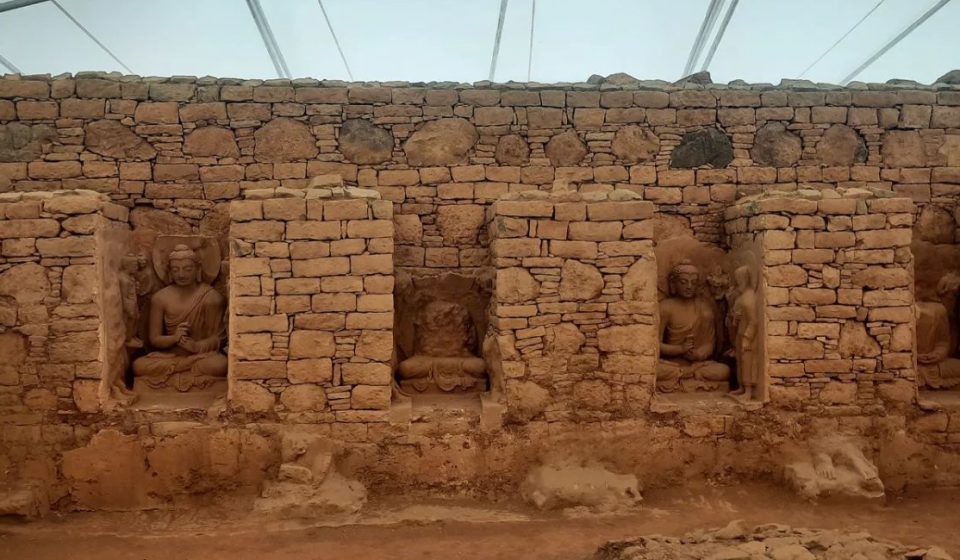

This particular photograph is different from everything that came before it. The garden Buddha, the museum’s orderly rows of headlessBuddha statues and separate arms and feet from Dharma Rajika – those all had been removed from where they originated from the earth and placed in orderly displays or tranquil gardens under glass, apart from where they were painstakingly carved and worshipped centuries before. This photograph reveals a much rarer and much more potent kind of sight -Buddha statues still sitting in the exact niches into which they were first carved by the artisans who crafted them, even at this late stage of seventeen centuries!- Jaulian, where a wall stands, showing you what the actual skin of an ancient stupa might look like, peeled open and examined, but never disassembled.
A Hill Above a World That Was Lost
Jaulian is situated on the crest of a hill roughly seven kilometers north of the Taxila Museum. Jaulian, erected in the 2nd century CE, the same era as the adjacent Mohra Muradu monastery. The elevated location would have enabled people at Jaulian to easily view passing pilgrims or traders, the Buddha would not have needed to leave their secure haven except when called away by duties – it also offered an additional means of controlling access and ensuring privacy for those resident at the monastic complex. World History Encyclopedia
As a Center of learning, Julian became known, at the height of its development, throughout the world. The monastery is a monastic center which includes a giant stupa, a shrine, and a ruin of a Buddhist monastery, at which scholars from India, Afghanistan, China, Persia, Greece, etc., visited and attained enlightenment through Buddhist philosophy and scripture learning and teachings beforeany Europeans University ever existed in the world. PunjabResearchGate:
What Stopped it All.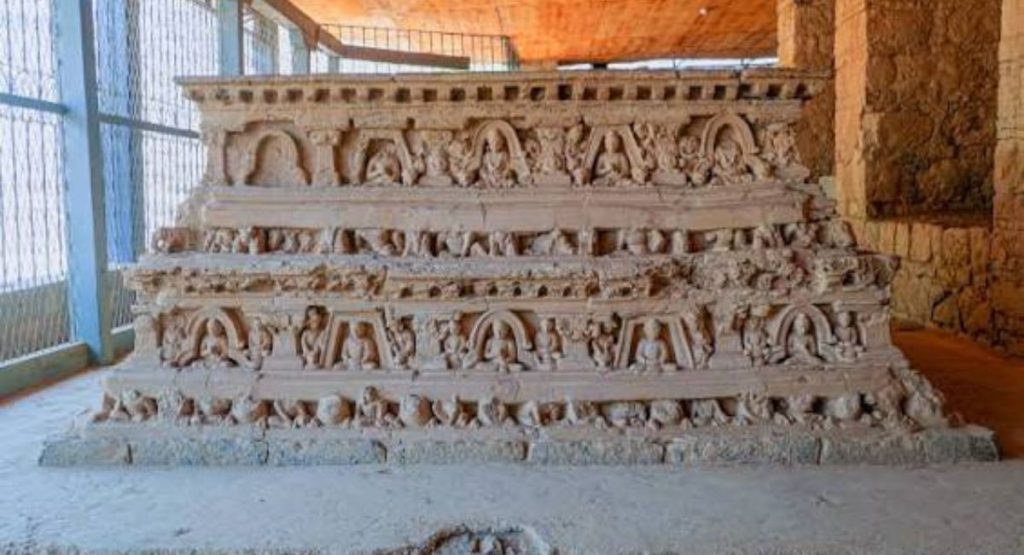
It is thanks to how this site was destroyed, as evidenced in this photo where these weathered Buddhas sit, seated and watching, in their wall, that this wall even survives. Jaulian, like the rest of ancient Taxila, was sacked during the White Huns invasion of the 450’s CE, and after that was abandoned as it had become known, for a certain period of time. Following the fall, rulers such as the Hun king Mihirakula would have carried out his persecution of the inhabitants of the region’s Buddhists, and the area was never fully recovered. World History Encyclopedia
By the curious hand of fate the fact that the Buddhas have remained and not simply broken to pieces across layers of excavation at the much more densely populated monastic communities nearby has allowed for a certain visual completeness at Jaulian-or rather, this section of Jaulian, since when the site was first excavated (in 1916-17) by Mr. Natesa Aiyar under the directions of Sir John Marshall, the excavators had to peel back quite literally meters of the surrounding material from the ancient site, uncovering this wall, an art gallery that hadn’t been exposed in close to fourteen centuries! Sailingstone Travel
How to Read the Photograph… of the Wall
In viewing the wall itself, what we’re seeing is actually not simply Buddha images that have been stuck to the side of a mound as decoration, but how this wall served to articulate the very spatial organization of a Gandharan stupa court, often getting lost from the more scattered artifacts that sit isolated in cases around museum displays. The plinth, for instance, is pilastered with colossi of the Buddha in meditation at various poses along the edge, the Buddhas seated in their own niche spaces and set on plinths with Buddhas spaced above, with Buddha statues spaced around the main stupa at each cardinal direction. Grokipedia
Notice also in this picture the arrangement of Buddhas, some are sitting, with accompanying standing Buddha and Bodhisattvas next to them, they form a great procession in every direction! The cumulative effect of rank upon rank of sitting meditativeBuddha statues along the stupas and surrounding architecture was that it once surrounded the worshipper from all four sides, creating an overwhelming sense of devotion and wonder as one walked around the site. Wikipedia.
In addition to the central Buddhas and their attendants, 27 smaller stupas, 59 chapels with images illustrating Buddha’s life, etc., are located in the site, which means the pictured wall alone contributes only a fraction of the visual impression of this entire Buddhist sanctuary. University of Oxford
Read more at: https://www.discovernewsdaily24.com/taxila-museum-two-thousand-years-in-a-single-garden/
The Very Stuff of Creation
Look closely at the sitting figures: they’re actually not carved out of stone, but out of stucco plaster over an inner brick core. Even after 18 centuries of exposure to the elements, and even with wear and tear showing from the decay of plaster material itself, you can still very clearly see the form of the seated Buddha in each of them, with their attendant bodhisattvas or attendant devotional images: their hand position and meditative posture is quite distinct, and most clearly visible here, with each image enclosed in a separate alcove on the outer face of a plinth that wraps around the mainstupa, with each statue spaced evenly and distinctly and perfectly to either side of a vertical dividing piaster. World History Encyclopedia
The Roof That Proves Our Progress.
In the upper center of the photograph, a vast modern, steel and fabric canopy is suspended over the wall-protecting, preserving. A roof protects the stucco figures against any moisture at Jaulian, and it is, today, guarded day and night. It represents the only case within theTaxila valley wherein local authorities had the good fortune to realize that the material at that particular site was valuable enough and fragile enough to install an architectural roof for protection, because, after all, no local governing body could install such architecture anywhere at Taxila but a few structures that were, when all is taken into account the worth of their artwork in value, more important than the rest in relation to their historical importance.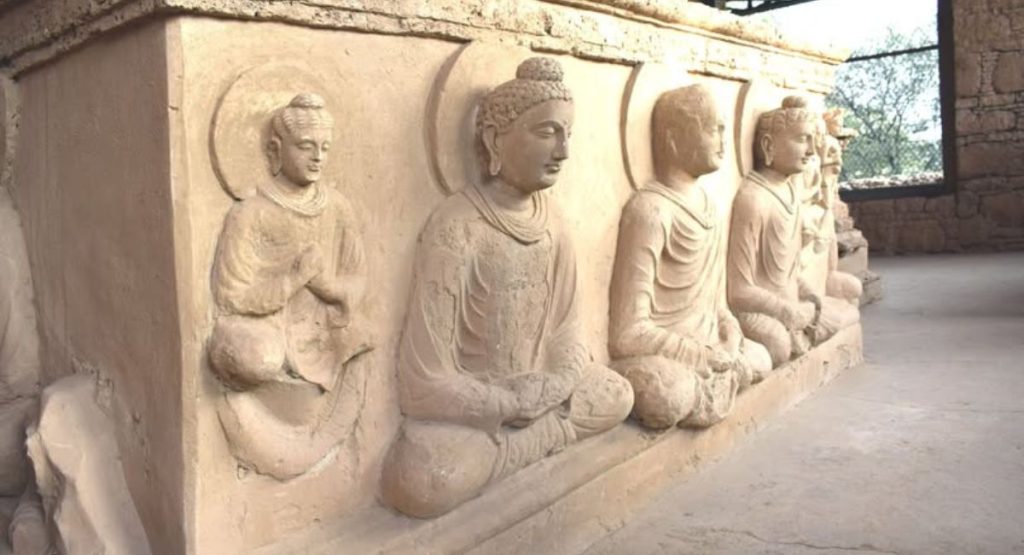
Wikipedia: A Couple of the Famous Guys In The Wall
It is important to note, however, that in amongst the statues in votive stupas in Jaulian, in one particular stupa, there is actually a Buddha statue which, because of a navel that is pierced in its mid-section with a hole, is known to the locals of Jaulian as a Healing Buddah, and people still visit thisstupa, at which to place fingers within the navel, or hole, and seek out a cure for one disease or another! It so happens that there is a Kharoshthi inscription at the bottom of that particularBuddhah, which says that it was commissioned and paid for by a devoted local, wealthy pilgrim named Buddhamitra- someone who it is said to have “ delighted in the law”– and, interestingly enough, the Buddhas and their attendants may also not even be quite as old as is assumed because there is proof ofactive Kharoshthi at the site up to the fifth century. University of Oxford + 2
We cannot know, even by now if any Buddhas captured here are actually from that famousHealingBuddha; however, this general arrangement of seated Buddhas on the site at Jaulian is consistent throughout, and many Buddhas along this Wall, and everywhere within this particular site have individual donation records, inscribed underneath the statue’s feet. On the back of each Buddha’s right thigh may be read an inscribed name – the name of a pilgrim or monk who donated and paid for the sculpture, as if his act of devotion had been arrested by the very act of commissioning it.
A Very Different Kind of Experience.
The overwhelming and solitary radiance of the gardenBuddha, the sterile ordered presentation of detached head Buddhas in a museum case, and the lonely, fragmented hands and feet of a Dharmarajika-These all have led to a singular feeling-a loneliness to this kind of archaeological experience. By Contrast to those experiences, this experience- of the Wall at Jaulian- presents Buddha as he was: not alone, but within a community, in a ritual context, never removed and simply protected beneath and buried under for over fifteen centuries! There may be one important consideration here as in fifth-century Taxila, the only thing left that could protect it from rain was a building, but now as in the photograph, the building that can do that to the statue would be only a wall.
See Also: https://www.youtube.com/watch?v=iyU4cZor_Gg