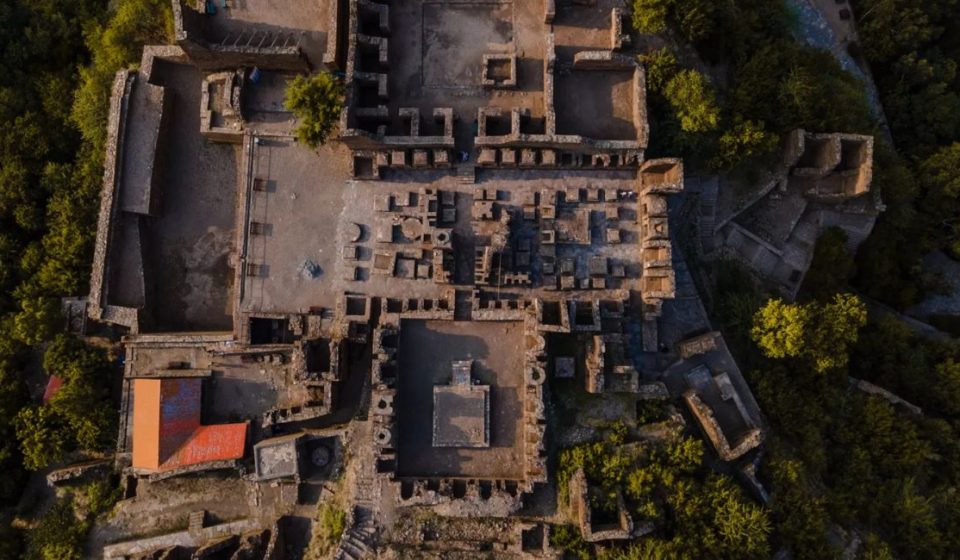

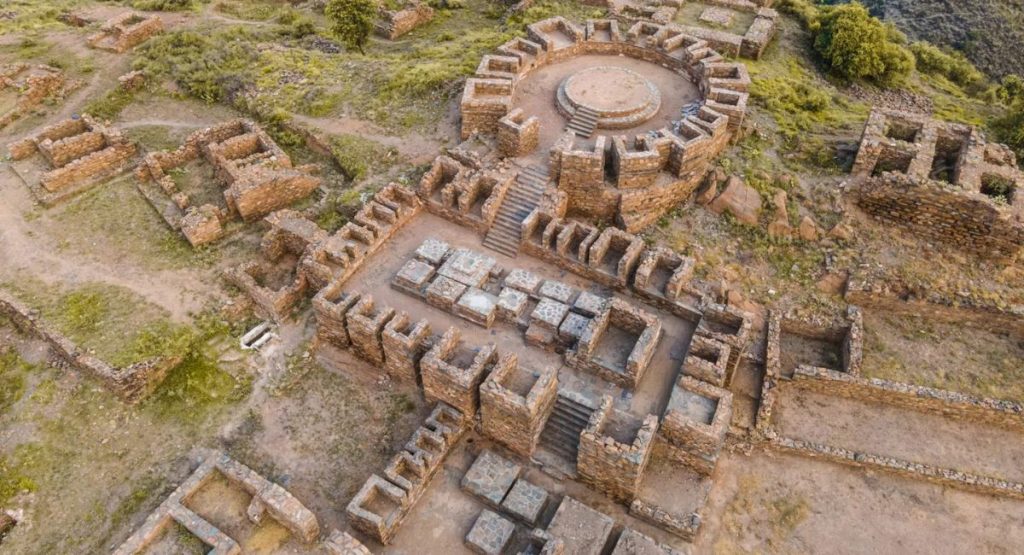
There is something an aerial photo can capture that the perspective of a pilgrim or a visitor on the ground never can: the full architectural rationale of a monastic site, revealed in its entirety as a stone blueprint excavated from the hill slopes. That circular central courtyard where the main stupa sits, those criss-crossing stone staircases that carve down the incline, the many rectangular chapel rooms that spill out in every direction – it all adds up to Jamal Garhi, a hilltop Buddhist monastic site near Mardan city, KPK province, still among the most readily readable ancient religious compounds anywhere in the Gandharan world.
Selected for elevation, Jamal Garhi is located approximately 120 meters (390 ft) above the plain at an elevation of about 150 m (490 ft) above the surrounding plain on a hill near the village of Jamal Garhi in Mardan District, Khyber Pakhtunkhwa, Pakistan. It is located to the northeast of the Mardan city on the Western offshoot of Paja Hill at a distance of approximately 15 km along the Mardan–Katlang Road. It was chosen not just for the view, but because of its considerable altitude and thus remoteness from secular disturbances, yet accessibility to pilgrims approaching along these and other routes, offering commanding vistas across the surrounding cultivated valleys. Jamal Garhi’s commanding location above the fertile plains on the northwestern spur of a hill would have been striking, as well as defensive.
How we see it: A circular structure is visible that comprises the whole complex. 7 m (22 ft) in diameter. The stupa was surrounded by small niches or chambers for sculptural images. This layout of circular, devotional, courtyard-style religious structure surrounded by small niches for Buddhist art is visible throughout this and other related Gandharan monastery sites; for example, numerous of them ring the central circle at Sirkap (Taxila), while similar niches have been identified on the circular court of the Bhamala monastery site.
Archaeological excavations show that Jamal Garhi was the centre for a monastic community. It was built around the time as Jaulian as described below and has been divided into two principal sections, the stupa area and monastic complex. A considerable amount of Buddhist art (sculptures and architectural members) has been recovered. An arrangement in terraces is seen here, with a large circular courtyard at the summit.
Two intersecting cross-shaped staircases that run down through the centre of the monument clearly show that the stupa site was arranged on steps comprising three terraces. Photodharma Buddhist travel to Jamal Garhi’s three terraced steps with intervening structures. 7 m in diameter, and was surrounded by niches for sculptured images. 7 m in area with a vaulted ceiling of rough construction.
In the middle and lower areas of the stupa site are other circles of cells for monks with surrounding galleries. One particular feature of this layout at Jamal Garhi is that, in addition to the three levels of cells, there is an additional level above the main stupa containing another round stupa and cells! This, the middle or lower stupa area, was linked to the main stupa courtyard above by a broad ceremonial stairway built in the centre. This circular courtyard above the central, middle group contains an enormous stūpa itself surrounded by a circular arrangement of about 53 niches for sculptural images.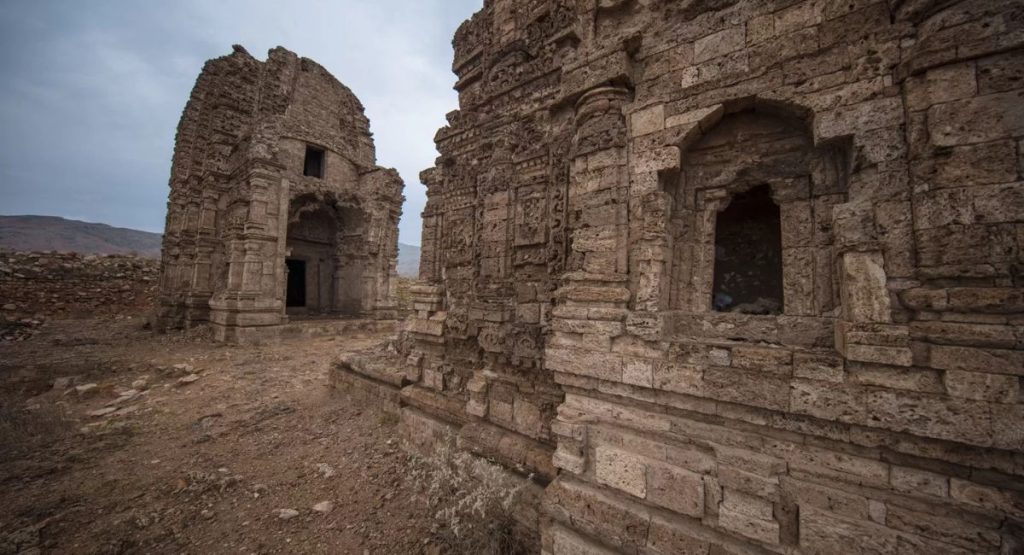
There are several layers or terraces, with large groups of small, rectangular chambers arranged in a grid pattern. Two staircases connect each layer. e. Dharmarajika stupa.
The overall layout clearly shows the complete structure, consisting of a large circular stupa courtyard and then multiple steps, which descend to smaller, circular areas, also dotted with chambers. Photodharma Buddhism travel. An interesting feature not readily apparent from this ground photo is the existence of two huge cross-shaped staircases that join each other in the middle, and connect all these levels. These appear clearly in the photograph, cutting through the cross shape on each level, and descend all the way from the circular courtyard at the summit to the lowest tier on the other side. Photographer.
It is possible that two additional smaller stupas are also located on the different levels of the stupas complex that surrounds the chapel for the art production. It appears to have been arranged in layers like an auditorium in front of the stupa. Photodharma Early discovery Jamal Garhi was discovered by Alexander Cunningham in 1848 and excavated with less success. The site was, however, excavated by Lt.
T. P. Crompton during the winter months of 1863-4. A large numbers of images was discovered.
These statues, which have mostly been moved to various museums in the world, are one of the richest collections of the Gandhara school of art. As one of the early excavated Gandharan monasteries, Jamal Garhi is of enormous archaeological importance, especially because Cunningham dated it to before the Kushana period. Other similar finds made in the early twentieth century on other Gandharan monasteries would further attest to his early, accurate chronometric analysis of this historically significant site, including the famous site of Taxila by John Marshall. Its placement, however, in this article toward the end, is solely based upon chronological proximity, for this discovery date pre–dates most of the monumental work on other Gandharan monasteries that was to be carried out decades later.
Sir John Marshall’s work at Taxila in 1913. This discovery date also suggests an extremely early genesis of monastic culture in the Gandhara region, and it is considered to be one of the very earliest monasteries established. Sir John Marshall referred to the site in 1904 as probably one of the earliest Buddhist monasteries to have been constructed in the Gandhara region. Naratonorwich A messy discovery. History: Like most discoveries in archaeological excavation of the time, the first investigations were crude and unscientific, and led to much looting and damage of the site.
For example, in an attempt to find some gold within a stupa of the complex, Colonel Lumsden attempted the excavation of a stupa in 1857. He found nothing more than some stone blocks. Later, excavations by Lt. Crompton succeeded, and thousands of Buddhist sculptures were unearthed.
The problem now became how to preserve and transport the sculptures. In many cases, they were broken or, when too many were found to ship, smashed to pieces. Those not lost, were largely deposited in museum collections worldwide, such as the Indian Museum, Calcutta and the British Museum, London. The site remained open to looters, collectors, and souvenir hunters for almost 70 years before becoming a protected archaeological monument in 1920.
See Also: https://www.youtube.com/watch?v=iyU4cZor_Gg
From 1920 to 1923, Harold Hargreaves of the Archaeological Survey of India performed systematic work here, which exposed the entire layout of the stupa and associated monastery buildings. Jamal Garhi was, due to its early date and the rich findings, a priority for the ASI, with two subsequent excavations being undertaken: between 1924 and 1929 and 1963 and 1964. Photodharma Buddhist travel Empires on top of Jamal Garhi must have witnessed several centuries of political upheaval as one of three prominent Gandharan sites that experienced, successively, the rise and fall of Indo-Parthian rulers, then Kushan emperors (including such legendary rulers as Kanishka), followed by the Little Kushan state before collapsing from the invasion of the Hephthalite Huns (White Huns). This collapse occurred at roughly the same time as the destruction of many other Gandharan sites, circa 5th-6th century CE.
An inscribed stone relief discovered during the 1907-08 ASI excavation at Jamal Garhi bore a date that can be translated from the Kharoshthi script as Samvat 359, equating to 275 CE. This offers a valuable snapshot in time that has been correlated with other historical evidence, confirming that Jamal Garhi’s active lifespan falls neatly within the historical frame of Gandharan monastic Buddhism and providing a solid historical benchmark for the region’s historical narrative. This date also places it securely in the Kushan period. Sculptural legacy Jamal Garhi’s extensive artistic repertoire contributes notably to our understanding of Gandharan iconography.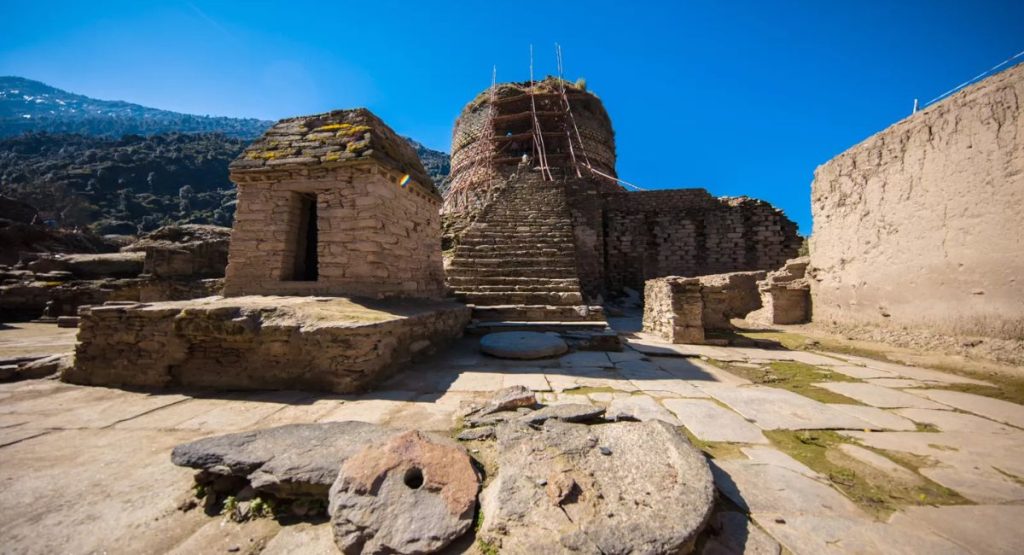
The analysis details the structures comprising the stupa unearthed by Cunningham and compares it to the statuary that he uncovered, notably the “Fasting Buddha” group of sculptures, now distributed in national museums like the National Museum of Pakistan and the British Museum. They contextualise these art objects within specific doctrinal traditions related to monastic rule and devotional practices, linking back to previously identified ascetic art themes and demonstrating that monasteries in the Gandharan world occasionally cultivated distinct artistic specialisms-such as depicting emaciated Bodhisattvas at Jamal Garhi-to meet the specific devotional needs of their pilgrims. Naratonorwich “Fasting Buddha” in the British Museum; photograph and transcription of an inscribed tablet on which the carving was discovered, published in the Peshawar Museum Guide Book. Naratonorwich. A more recent period of activity. Recent archaeological work in 2012 uncovered evidence of further layers beneath the original structure, including coins dating to 158 CE, a sculpture plate, a Buddha head, and remnants of a lake.
However, these discoveries also occurred against the backdrop of recent threats; in that same year, damage from an earthquake the previous year required emergency repairs to prevent the full collapse of walls at the Gandharan monastery. The KPK government provided assistance for preservation work on the monastery, highlighting its importance as a tourist attraction, but additional support is needed to ensure its long-term integrity. Naratonorwich As this bird’s eye photo demonstrates, it would be extremely hard to imagine this complete structure. This photo reveals Jamal Garhi not as a collection of ruins, but as a whole functioning structure.
As a matter of fact, this photo is even more useful than a guide to this monastery. It would be difficult for an inexperienced visitor to imagine such a coherent plan, simply by visiting the site. So this photograph demonstrates more vividly than any account the layout of this great site.
Read more at: https://www.discovernewsdaily24.com/taxila-museum-two-thousand-years-in-a-single-garden/