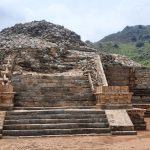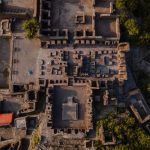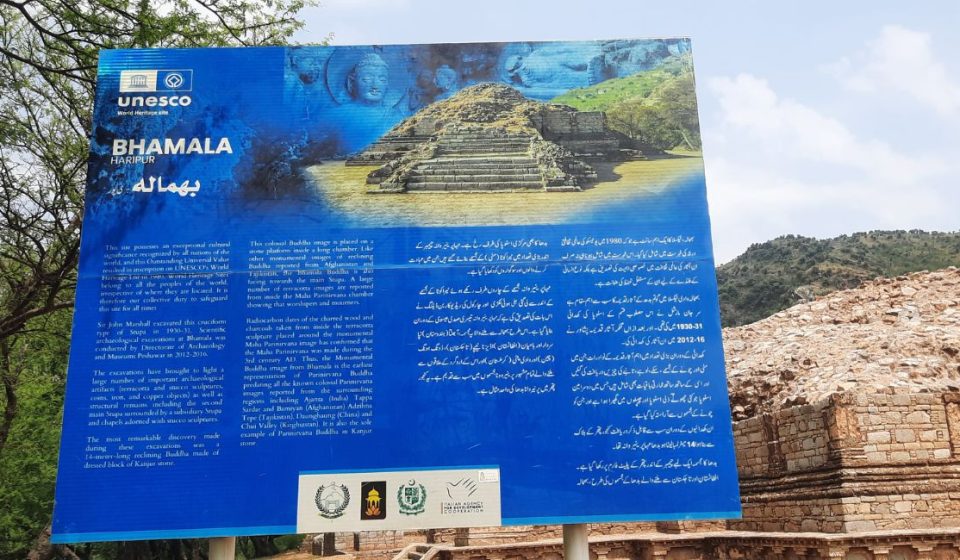

This UNESCO info sign, pictured before the exact site it details, gives us insight into a place unlike any other we’ve covered. We are no longer in Taxila itself, but in Haripur District, on a hill above the Haro River – Bhamala, where rests an utterly mind-blowing claim to fame: this is the location of the earliest colossal depiction of the Buddha’s demise discovered anywhere on Earth, and within the Buddhist world more broadly. Stupa shaped like nothing else in Gandhara. The first thing the sign highlights is the structure itself, the aspect most unusual about Bhamala: “Bhamala is one of the most important Buddhist archaeological sites in the Taxila region near Khanpur Dam in Haripur district of Khyber Pakhtunkhwa province. ” What this means – that it has a cross-shaped footprint – isn’t obvious.
Not in Gandhara anyway. At least, not by comparison. ” Other sites of the area (Jaulian, Dharmarajika) did have clusters of small, ‘votive’ stupas built by pilgrims around the main shrine – small echoes of the primary monument. This one did too, just that it was “arranged around a far stranger central form”.
The First Dig, and Why It Stopped Short. The first archaeologists on scene were Sir John Marshall (famous for excavating Harappa and Mohenjo-Daro), who dug at Bhamala in 1930–31. However, he was somewhat less thorough here, largely as he felt his resources would be better invested in other local sites, most notably Sirkap.
The dry humour of a contemporary account:
” This meant that its greatest secrets lay buried for a further eight decades. Discovery that changed everything. Then came the most recent major research: scientific excavations conducted between 2012–2016 by Peshawar’s Directorate of Archaeology and Museums. It was during this work that Bhamala’s secrets finally saw the light of day. The dig yielded numerous key archaeological finds, including terracottas and stucco sculptures, coins, and iron and copper items.
Structural discoveries also came thick and fast, including another main stupa at the site, this one also with a subsidiary stupa and chapels with rich stucco detailing.
But one discovery put all others in the shade:
” That’s some 46 feet if you include the surrounding area, putting it among the largest Parinirvana Buddhas found anywhere in the world. What the statue actually represents, the reclining Buddha doesn’t simply show the Buddha resting. Rather, it illustrates the exact, profound moment of Mahaparinirvana – what Buddhists refer to as his final passing, or entry into ultimate nirvana after exiting the physical world. This huge, colossal figure lies stretched out on a stone platform in a long chamber.
Like the other very large Parinirvana Buddhas found in Afghanistan and Tajikistan, the figure is depicted facing the stupa. ” Why it matters The reason that this Parinirvana Buddha is so important in the scheme of Bhamala (and the whole world of Buddhism) isn’t simply the statue’s enormous scale. That massive figure has been carbon-dated, using charred wood and charcoal extracted from within terracotta figures located around the colossal Parinirvana image itself. The result?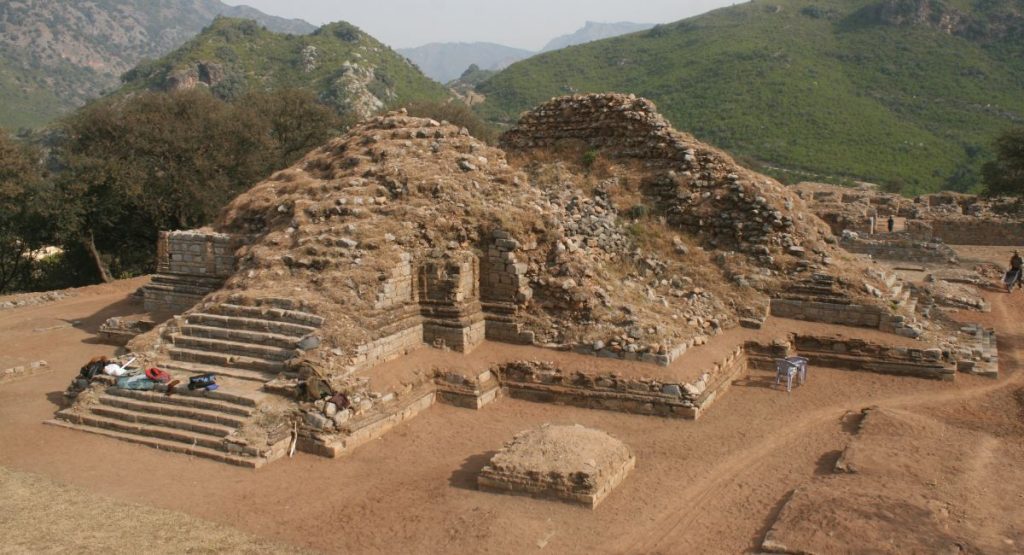
Read more at: https://www.discovernewsdaily24.com/taxila-museum-two-thousand-years-in-a-single-garden/
3rd century AD. What this means is that Bhamala holds the earliest known representation of the Parinirvana Buddha, predating every other comparable structure anywhere else on the subcontinent and in surrounding regions like India (Ajanta), Afghanistan (Tappa Sardar and Bamiyan), Tajikistan (Adzhina-Tepe), China (Dunhuang), and Kyrgyzstan (Chuy Valley). It’s also one-of-a-kind in being made of Kanjur stone. That’s right.
Every other great sleeping Buddha you’ve ever been told about in Asia – from those on Sri Lanka’s south coast to those carved into rock faces in the caves of China – is in fact showing a theme that was first realised in colossal scale, based on current archaeological evidence, at this particular hill above Pakistan’s Haro River. Researchers also discovered another first for the site – a “double-halo” Buddha statue. This additional decorative feature further enhances Bhamala’s uniqueness among Buddhist monuments. UNESCO listing gives real-world impact. The UNESCO World Heritage designation shouldn’t be dismissed as simply a bureaucratic stamp of approval. “
However, unlike many UNESCO site designations, this one has had a positive, real-world impact in terms of preservation, since it has supported the restoration efforts to secure the ancient remains, especially the central stupa. “ What we’re still learning about Bhamala Other, more established sites like Jaulian and Dharmarajika are essentially complete in their archaeological study for now. Bhamala, however, is quite different. During the initial 2012–2016 excavation phase, approximately 30 stucco sculptures were recovered from the courtyard of the cross-shaped stupa, a largely intact Parinirvana panel image among them.
Just one season unearthed over 100 coins dating to the 4th and 5th centuries AD, proving that the site was both thriving and connected to broader networks of trade and culture during centuries after its construction. Given this very recent history of discovery, it’s remarkable to stand where Sir John Marshall once did, looking out at the ruins and this informational sign. Much of Bhamala’s story has, after all, been written in living memory – the archaeology of the Taxila valley continues, and we are privileged to bear witness to at least part of that ongoing work.
See Also: https://www.youtube.com/watch?v=iyU4cZor_Gg