
Sirkap: The Shrines on Pillars
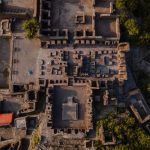
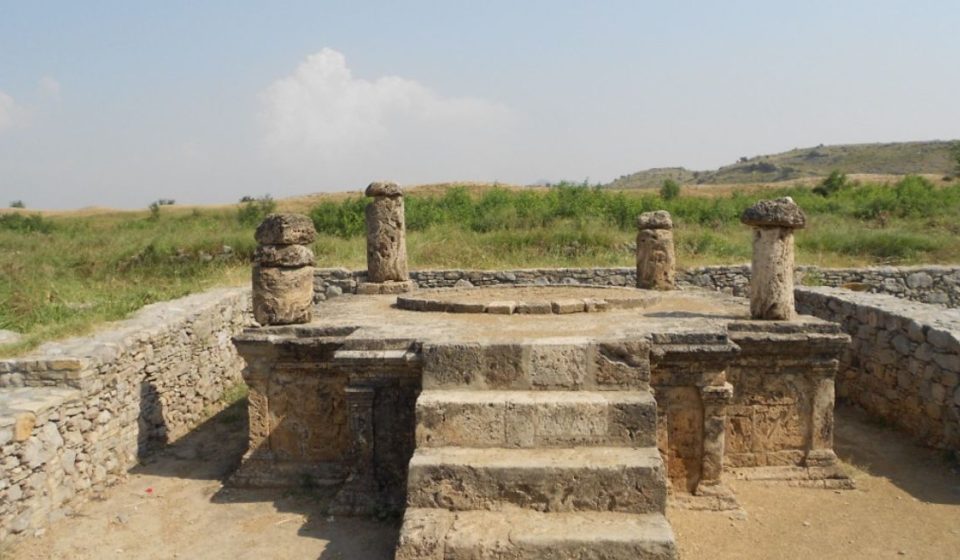
Following the awe-inspiring aerial view of Sirkap’s larger circular layout, our camera angle comes back to the ground level, settling on this much smaller construction. From a flight of small stairs, we reach a square, elevated stone terrace, where four weathered pillars mark the corners. The entire terrace is encircled by a low stone wall forming a semicircle on the viewer’s side. This tiny devotional structure is situated in the area of the Indo-Greek city that we saw earlier through its keys and locks; where the keys revealed a normal, daily household’s lifestyle, this modest platform hints at a more spiritual dedication, one tucked away amidst the otherwise mundane grid of Sirkap’s streets and dwellings.
It isn’t just a city of homes
While it’s understandable to think of Sirkap only in terms of its celebrated grid layout and its Hellenistic city plan (covered earlier under its keys and locks); Sirkap was far from merely a secular city of traders and artisans. All along the main North-South axis were temples, housing units, stupas, and shrines. Reflecting its passage through Greek, Scythian, Parthian, and finally Kushana rule, each dynasty added its particular religious structures to existing buildings as layers. This resulted in the great wealth of small, religious platforms, as this photograph illustrates, scattered in amongst the dwellings of Sirkap.
What makes this platform special?
Based on its form-a raised square platform with steps, pillars at the corners, and surrounded by a low wall, these structures are typically regarded as being small votive or memorial stupas or dedications made by private individuals or small communities. The belief is that some of Sirkap’s stupas were likely thrown from their position by the large earthquake of the 1st century A.D., and as the new city was rebuilt, surviving stupas were encircled by a wall, as appears to be what happened with this platform here.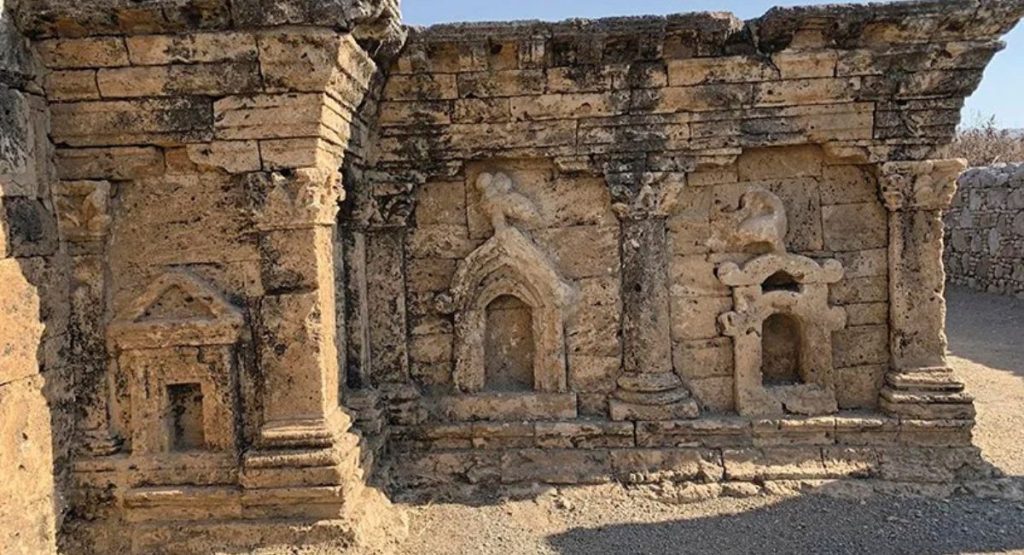
Read more at: https://www.discovernewsdaily24.com/jamal-garhi-a-monastery-from-the-air/
It is most probable that the pillars on the platform supported an awning or umbrella or merely designated the boundary for sacred purposes in a way common to most Buddhist stupas – pillars define a consecrated zone beyond the mundane earth. The stucco and wall relief of Hindu gods as well as typical religious Buddhist deities found at Sirkap, reflect the synthesis of Greek and Buddhist cultures that occurred during this period, and you can see traces of that in this image: on the lower portion of the stone-work, traces of small panels with faint carvings can still be made out. The variety of religious structures found in Sirkap speaks not just to its pluralism but also to the fact that ordinary people, too, engaged in religious activity. There was an indigenous Sun Temple and a Jain Stupa, among other monuments.
A pillar within the walls records an inscription by the crown prince Ashoka, while outside the city walls lies an Aramaic inscription on a pillar detailing the erection of a structure by one of its top officials during the time of his father. Small or grand, the need to connect to the transcendent permeated society in Sirkap.
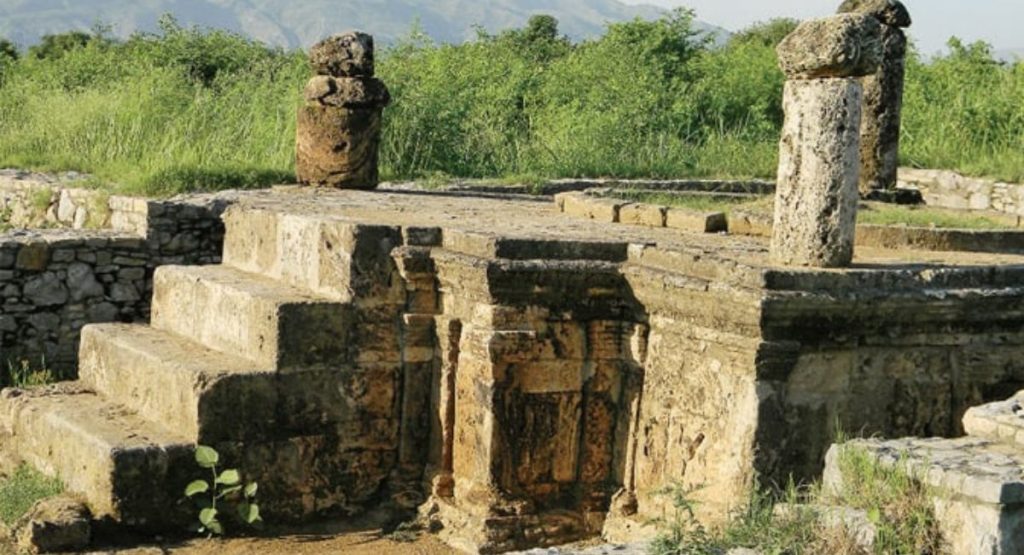
Compared to the massive scale of Sirkap’s Apsidal Temple at a nearby location that stretched nearly 70 meters x 40 meters, in fact, even bigger than the footprint of Athens’ Parthenon, this very small structure can seem utterly insignificant. But it’s this lack of grandeur that is, in a sense, also its most important characteristic. The ancient world wasn’t solely a monument-driven one. Many devout acts were small, private, or community-based.
This modest platform in a housing block in Sirkap demonstrates how personal devotions can weave seamlessly into the everyday life of an urban centre. Today, all you can do is stand on the raised stones of this long-gone community space-the remnants of many faiths-and try to imagine the world it represented: a vibrant and interconnected part of the Hellenistic-Buddhist-Jain heart of what was once Sirkap.
See Also:https://www.facebook.com/groups/Archaeology.Prehistoric/posts/758941157588429/