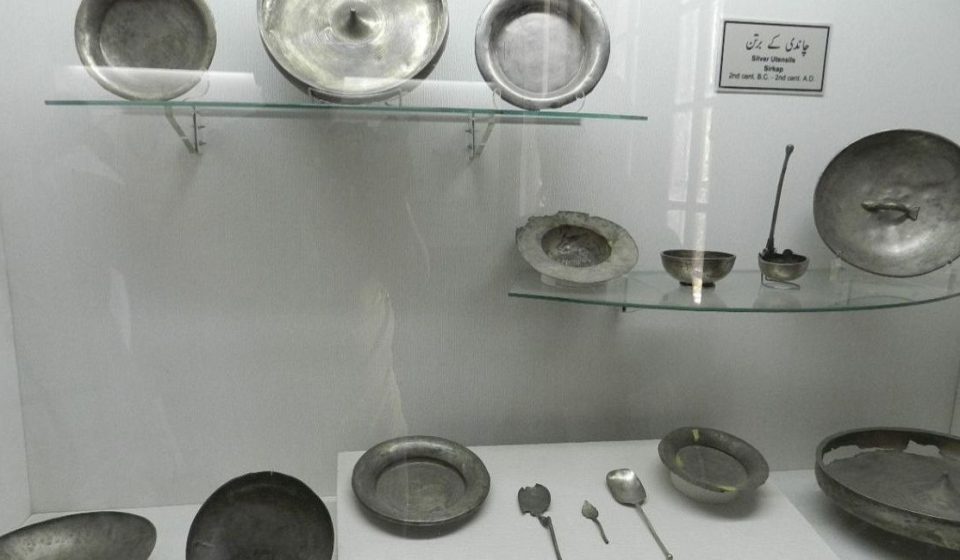

Silver Tableware & Adornments From Sirkap.
These images showcase a priceless hoard of silver articles and decorations found during excavation at Sirkap, a primary urban center within ancient Taxila. The artifacts on display in the display at this museum date primarily from the 2nd Century BCE – 2nd Century CE, the very period in which Taxila, a renowned center of trade, religion, culture, and craft work, was at its pinnacle of glory. Made of the treasured metal silver, the pieces hint at the material wealth, skill level, and daily existence of these past dwellers who came long before our time – almost 2000 years ago. Ancient monuments at South Asia, such as these objects of exquisite metal work – artifacts and embellishments which time hasn’t been able to corrode or despoil – bear testimony to Taxila, for centuries, known as perhaps the premier hub in South Asia!
Taxila had the importance of a huge archaeological and historical center that has acquired importance from all around South Asia, to be located where the trade roads converged in Ancient Taxila. This resulted in the arrival and movement of travelers and traders and also facilitated cultural and ideological movement. Trade across South Asia, Central Asia, and the Middle East has made it a nexus where various civilizations have met throughout. Silverware in Taxila; In an image here, the collection features both hollowware and also personal ornaments, mostly of Silver.
In another one on top shelf and the first on top can see both types of artifacts in an Image and in Image also where different utensils and decorations made of Silver have been displayed in Museum in museum which date as per label on the show-case about 2nd BC – 2nd AD have been shown which are a show of what the people of Ancient Taxila were in terms of wealth and aesthetic sense!
Top shelf:
On the top shelf are several vessels made of silver. The one in the center has a wide mouth and a handle extending from it. The wide opening probably served to store oils, perfumes, and similar items, and the handle possibly enabled users to pick it or lift it up while in use, or when pouring the contents. The vessel on its left has a circular body and an upward-expanding neck, tapering into a spout from which liquids were poured.
Such vessels often held perfumes or medicinal oil in ancient times; given that they’re silver, they probably belonged to the more affluent segment of society. The one at far left resembles a small bowl, while in between these vessels is another rounded object, possibly used for storing some precious item or used in rituals.
Smaller rounded objects:
In between these larger vessels are smaller ones with narrower openings. These were generally used to store something special; something that required care and meticulous preservation, like medicines, precious stones, or fine ingredients, and what better could store such valuable items in the ancient world than fine Silver! The large one on the right is a silver armband, and the two round things at the bottom in the centre are some rings, while at the far right, you see some small jewellery pieces or ornaments, perhaps for adorning someone’s personage or as ritual accessories.
Lower portion of display:
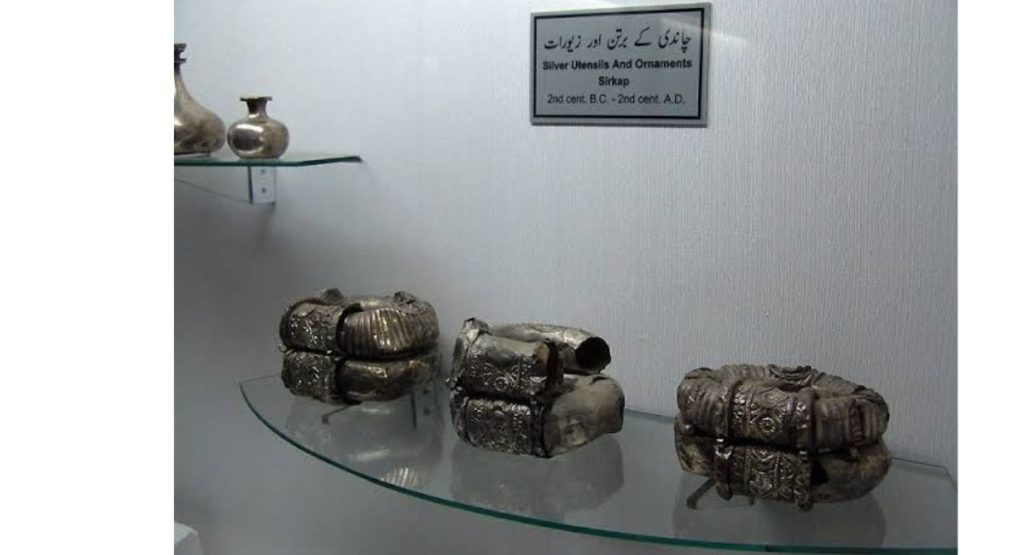
The bottom half of this museum show case are all of silver too, the right side showing larger silver bracelets/arm-guards for the men as their strength symbols or personal ornamentation, and on the far right side, you may note a jewellery item that may have belonged to women. Also at the centre, showcasing some kind of bangles or ornate circular designs. On the far left of this section, show the more intricate items, such as decorative ornaments with what looks like some patterns engraved into them; perhaps to serve the function of adorning one’s dress or some religious ceremony. The Importance of Silver in Ancient Societies. In ancient civilizations such as those inhabiting this region millennia ago, silver held a position of high regard for both monetary value and aesthetic appeal.
It was often employed to produce jewelry, ritual implements, and household objects belonging to the elite due to its relative rarity compared to other common metals like iron or copper. Such a prized possession signifies wealth, status, and influence within a community. Sirkap’s role in trade and connectivity. The location of Sirkap made it a pivotal trading city in antiquity, connecting diverse regions and cultures. Situated along major routes of commerce linking South Asia with Central Asia and the Middle East, it facilitated the exchange of goods, ideas, and technologies.
These trade networks are clearly reflected in the quality and artistic sophistication of artifacts found at the site, suggesting interaction with diverse artisan traditions and access to high-value materials like silver. Economic prosperity of Ancient Taxila and Sirkap. The abundance of Silver artifacts discovered at Sirkap highlights the economic prosperity of Ancient Taxila. As a leading commercial entrepôt in its time, it likely generated significant wealth through trade and taxation. The presence of finely crafted Silver articles, both utensils and ornaments, indicates that residents could afford precious materials, signaling their affluence and their capacity to engage in transactions involving substantial economic value.
Read more at: https://www.discovernewsdaily24.com/taxila-museum-two-thousand-years-in-a-single-garden/
Expertise of Ancient Craftsmen of Silver in Sirkap; Craftsmanship in Sirkap was at a very advanced level, as evidenced by the intricate designs, precise workmanship, and smooth finish of the silver objects shown. These pieces were fashioned using advanced metallurgical techniques, including shaping, casting, engraving, and polishing. The artistry and skill of these ancient silversmiths is remarkable, showcasing a sophisticated understanding of material properties and decorative motifs. Understanding Social History of the Ancients through these items: History has been interpreted and reconstructed from these objects on numerous levels.
Who wore what and to what ends?. Such items do highlight the difference in social hierarchies in terms of display, ornamentation, and household luxury in the ancient world. Also, on account of cultural significance, the usage patterns of silver were associated with cultural practices and belief systems, including their utilization in religious rituals, ceremonial activities, and social events, thereby emphasizing the role that these objects played within the fabric of their society.
The Importance of Conservation:
Preservation of ancient artifacts is critically important to protect them for the study and enjoyment of future generations. Silver artifacts, though durable, can degrade over time through tarnishing and corrosion if not properly maintained and stored. Museums work to conserve these artifacts by controlling environmental factors, conducting appropriate cleaning and stabilization techniques, and storing them in secure, climate-controlled environments to minimize further damage. Future of Ancient Sirkap Heritage through these Artifacts
These SILVER artifacts tell stories of the rich history, art, and culture of ancient Taxila by showcasing how the people of that era lived, decorated their persons, and performed rituals, with its people who used these items, and also, it highlights the economic, cultural, and historical significance. These SILVER artifacts also serve to educate the current generation to respect and protect the heritage of past civilizations, with their significant archaeological value and impact in shaping civilizations of many ages. Therefore, it’s indeed necessary to safeguard and protect such historical riches, lest they fall into irreparable conditions in the harsh and cruel world of modern times.
See Also: https://www.youtube.com/watch?v=iyU4cZor_Gg