
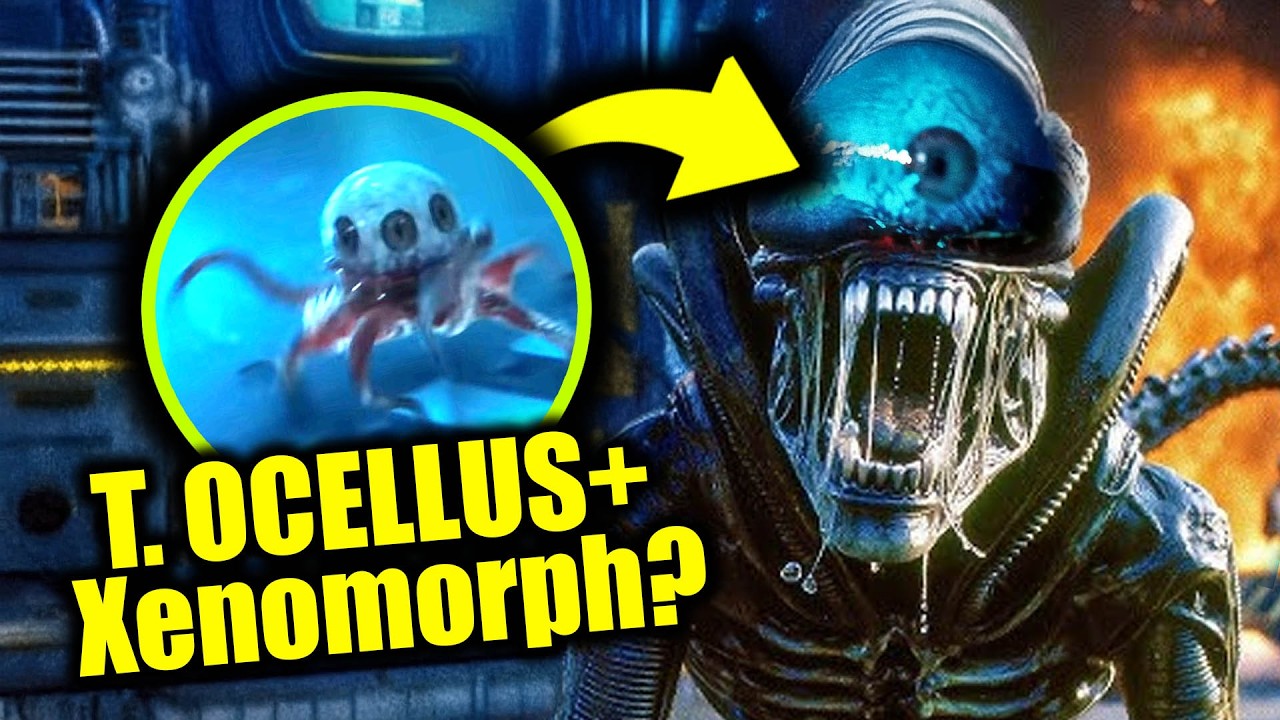
The Alien franchise has continually pushed the boundaries of science fiction and horror. From the terror of the original Xenomorph to the exploration of hybrid organisms in Prometheus and Alien: Covenant, fans have always been fascinated by the complexities of alien biology. With Alien: Earth, the series takes another bold step forward with T-Ocellus, the franchise’s new nightmare—a massive, sentient eyeball monster. But recent developments have introduced a shocking twist: a new Xenomorph appears to be under the control of T-Ocellus.
This revelation has sent fans into a frenzy. How is it possible for T-Ocellus to control a Xenomorph? What does this mean for Earth and humanity? And how does this affect the lore of the franchise? In this article, we break down the origins, biology, and implications of this unprecedented development.
1. T-Ocellus: The Ultimate Observer
T-Ocellus, also known as the Eyeball Monster, is designed to be a biological intelligence collector. Unlike the traditional Xenomorph, which hunts through instinct and aggression, T-Ocellus relies on observation, calculation, and manipulation. Its defining feature is a massive, exposed, sentient eye capable of independently analyzing its surroundings.
Key abilities include:
-
Rapid learning and adaptation
-
Psychological manipulation of prey and other creatures
-
Environmental control, especially within confined lab or urban settings
-
Surveillance and strategic planning
These traits allow T-Ocellus not only to survive but to assert dominance over other alien organisms, including the Xenomorph.
2. The New Xenomorph: A Controlled Predator
In Alien: Earth, scientists observe a strange phenomenon: a Xenomorph appears to act in ways contrary to its natural instincts. Normally aggressive and autonomous, this Xenomorph follows unusual patterns:
-
Avoiding direct confrontation unless strategically advantageous
-
Retreating when cornered, rather than attacking blindly
-
Acting protectively toward T-Ocellus in shared environments
These behaviors suggest that the Xenomorph is not acting purely on instinct but is being influenced—if not directly controlled—by T-Ocellus.
3. How Could T-Ocellus Control a Xenomorph?
There are several theories within the lore and among fans:
a) Neural Manipulation
T-Ocellus’s massive eye is not only a sensory organ but may also emit neural signals capable of influencing other organisms. This could allow it to override a Xenomorph’s instinctual behavior, creating a symbiotic relationship.
b) Chemical Control
Given that alien biology is complex, T-Ocellus may secrete pheromones or biochemical agents that alter the Xenomorph’s aggression or cognitive processing.
c) Evolutionary Advantage
It’s possible that T-Ocellus represents a higher evolutionary tier than the Xenomorph. By controlling Xenomorphs, it can harness their physical prowess while avoiding direct confrontation, creating a biological army that combines intelligence with strength.
4. Implications for the Alien Ecosystem
The potential control of a Xenomorph by T-Ocellus has enormous implications:
-
Hierarchy Shift: Xenomorphs are typically apex predators. Being controlled suggests a shift in dominance within the alien ecosystem.
-
Hybrid Warfare: Combining the intelligence of T-Ocellus with the physicality of a Xenomorph creates a near-unstoppable predator.
-
Human Vulnerability: Humans are now not just prey to independent Xenomorphs but also to a strategically coordinated alien force.
This development elevates the stakes in Alien: Earth, highlighting the franchise’s ability to expand its horror beyond single-species threats.
5. Evidence from the Series
Throughout Alien: Earth, several scenes support the idea of Xenomorph control:
-
Scene 1: A Xenomorph pauses mid-attack when T-Ocellus enters the room, suggesting recognition or influence.
-
Scene 2: The Xenomorph assists in neutralizing human opposition without direct commands, indicating strategic coordination.
-
Scene 3: Close-ups of the Xenomorph’s head and T-Ocellus’s eye hint at a psychic or sensory link, reinforcing the control theory.
While never explicitly stated, these subtle cues have led fans and theorists to believe that T-Ocellus exerts a level of influence unprecedented in the franchise.
6. The Science Behind It (Fictional)
From a speculative biology perspective, T-Ocellus controlling a Xenomorph could be explained as:
-
Neurochemical Domination: Releasing chemicals that modify neural responses in the Xenomorph.
-
Bioelectric Control: Using electrical impulses to influence motor functions.
-
Cognitive Override: T-Ocellus’s eye acts as a super-sensory organ, linking to the Xenomorph’s neural network.
Though fictional, these ideas fit within the established Alien universe, where bioengineering and alien evolution have repeatedly defied Earthly science.
7. What Makes T-Ocellus Unique
T-Ocellus is not just a predator—it is a strategist, manipulator, and evolutionary superior. Its ability to potentially control a Xenomorph demonstrates:
-
Superior intelligence compared to previous alien species
-
Adaptability to Earth’s environment
-
Ability to create symbiotic relationships that maximize survival
-
Psychological dominance over both humans and other aliens
This is a marked departure from traditional Alien threats, which rely primarily on instinct, parasitism, and physical terror.
8. Themes and Symbolism
The T-Ocellus-Xenomorph dynamic explores several recurring Alien themes:
-
Human Arrogance: As with previous films, human interference with alien biology triggers unforeseen consequences.
-
Control and Obedience: T-Ocellus represents a higher intelligence manipulating a lethal organism, showing that domination can occur without brute force.
-
Evolution and Adaptation: The franchise reinforces the idea that survival favors intelligence and strategy over pure aggression.
It also introduces a horror of calculated oppression, where creatures are weaponized not by humans, but by other aliens.
9. Fan Theories and Speculation
Fans have speculated on several possibilities:
-
Could T-Ocellus create an army of controlled Xenomorphs, potentially overtaking Earth?
-
Is the controlled Xenomorph an experimental hybrid, combining T-Ocellus’s intelligence with Xenomorph physicality?
-
Could future films explore Xenomorphs rebelling against their new master, setting up a complex predator-versus-predator narrative?
These theories show how deeply the franchise has expanded beyond simple survival horror into strategic alien ecosystem storytelling.
10. Conclusion: A New Chapter in Alien Horror
The emergence of a Xenomorph potentially controlled by T-Ocellus marks a major evolution in the Alien franchise. No longer are the Xenomorphs merely instinct-driven predators; under T-Ocellus’s influence, they become instruments of strategy, surveillance, and calculated destruction.
This development elevates Alien: Earth from a standard monster story to a narrative about intelligence, control, and evolutionary hierarchy. Fans are witnessing a new era where horror is not just about being hunted, but about being outsmarted by forces far beyond human comprehension.
As T-Ocellus demonstrates, the true terror of the Alien universe is not just physical danger—it is calculated, intelligent, and ever-adapting evolution. And if it can control the ultimate predator, humanity may truly be the underdog.
Read Also: Keep your face towards the sunshine and shadows will fall behind you
Watch Also: https://www.youtube.com/@TravelsofTheWorld24














Leave a Reply