
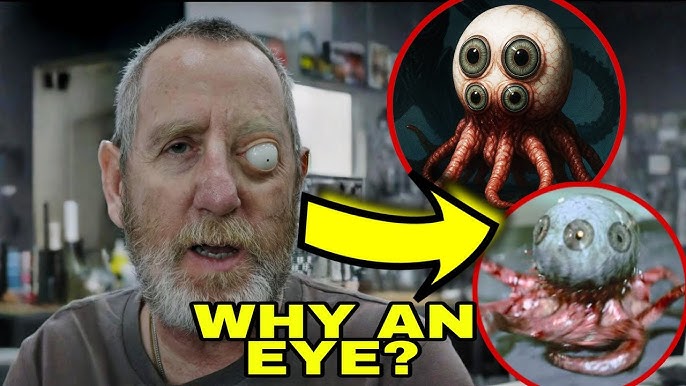
The Alien franchise has never been content to repeat itself. From the moment H.R. Giger’s original Xenomorph terrified audiences in 1979, the series established a reputation for bold, unsettling creature design that evolves with each new chapter. With Alien: Earth, the franchise takes another daring step forward—introducing one of its most disturbing creations yet: the Eyeball Monster, officially known as T-Ocellus.
Unlike the sleek, biomechanical Xenomorph, T-Ocellus is raw, organic, and deeply unsettling. Its defining feature—a massive, exposed, living eye—marks a radical shift in how Alien portrays extraterrestrial threats. But this creature didn’t emerge by accident. Bringing T-Ocellus to life required a careful blend of artistic vision, practical effects, cutting-edge CGI, and thematic intent.
Here’s an in-depth look at how the creators of Alien: Earth conceived, designed, and realized the terrifying Eyeball Monster.
1. Reimagining Alien Horror for Earth
One of the biggest challenges facing the Alien: Earth creative team was this: how do you make alien horror feel fresh when the Xenomorph is already iconic?
Setting the story on Earth fundamentally changed the rules. The Xenomorph thrives in confined, industrial spaces—spaceships, colonies, and stations. Earth, however, is familiar, populated, and heavily monitored. A new kind of monster was needed—one that felt believable in controlled environments like labs, cities, and research facilities.
That’s where the idea of T-Ocellus began.
Rather than creating a faster or deadlier predator, the creators focused on observation, surveillance, and psychological dread. The monster wouldn’t just hunt humans—it would study them.
2. The Concept Behind T-Ocellus
According to the Alien: Earth design team, the early concept for T-Ocellus revolved around a single question:
“What if the alien’s most powerful weapon wasn’t its claws—but its perception?”
The name T-Ocellus reflects this idea. “Ocellus” refers to simple eyes found in many organisms, suggesting primitive but highly effective vision. The “T” designation hints at its experimental origins—likely the result of human tampering with alien biology.
From the beginning, the creature was designed to feel:
-
Unfinished
-
Unstable
-
Unnatural
It wasn’t meant to look like a perfected species, but rather a biological experiment that shouldn’t exist.
3. Designing the Eyeball Monster
Breaking Away from Giger—Without Losing Alien DNA
One of the boldest creative decisions was moving away from the biomechanical style popularized by H.R. Giger. While the Xenomorph’s ribbed exoskeleton and metallic textures remain iconic, the creators of Alien: Earth wanted something more vulnerable—and therefore more disturbing.
T-Ocellus features:
-
A huge, exposed eye with visible veins
-
Soft, fleshy textures instead of armor
-
Semi-transparent tissue
-
Constant subtle movement, as if the body is never at rest
This design makes viewers uncomfortable because it breaks the visual “rules” of monster safety. Armor suggests strength. Flesh suggests pain.
And pain is scarier.
4. Why an Eye? The Psychology of Fear
The decision to make the eye the monster’s defining feature was deeply intentional.
Eyes symbolize:
-
Awareness
-
Judgment
-
Surveillance
-
Vulnerability
In horror, exposed eyes trigger instinctive discomfort. Humans are hard-wired to protect their eyes, so seeing one weaponized feels wrong on a primal level.
The creators leaned into this by giving T-Ocellus an eye that:
-
Moves independently
-
Focuses unnaturally long
-
Appears to “think”
In many scenes, the monster doesn’t attack at all—it simply watches. Characters react with panic not because they’re being chased, but because they’re being studied.
5. Practical Effects First, CGI Second
Despite modern technology, the Alien: Earth team followed a classic Alien principle: practical effects come first.
Animatronics and Prosthetics
A full-scale practical version of T-Ocellus was built for close-up shots. This included:
-
A mechanical eyeball capable of subtle movement
-
Silicone skin with layered translucency
-
Hidden internal motors to simulate breathing and twitching
These practical elements allowed actors to react to a physical presence, preserving authenticity.
Digital Enhancements
CGI was then layered on top to:
-
Enhance eye reflections
-
Add micro-movements
-
Create impossible anatomy shifts
-
Blend practical and digital seamlessly
Rather than overpowering the design, CGI was used to amplify discomfort, not spectacle.
6. Movement: Making It Feel Alive
One of the most unsettling aspects of T-Ocellus is how it moves—or doesn’t.
Unlike the aggressive Xenomorph, T-Ocellus:
-
Moves slowly
-
Pauses frequently
-
Tilts and focuses its eye before acting
Movement references included:
-
Deep-sea creatures
-
Cephalopods
-
Medical footage of living tissue
This creates the sense that the monster is processing information, not reacting emotionally. Its stillness becomes threatening.
7. Sound Design: The Monster You Hear Before You See
Sound played a crucial role in bringing T-Ocellus to life.
Instead of roars or screeches, the creature emits:
-
Wet, organic sounds
-
Subtle clicks and pulses
-
Low, almost inaudible vibrations
The eye itself has a faint sound when it moves—described by the sound team as “a biological camera lens.”
Often, audiences hear T-Ocellus before they see it, increasing tension and anticipation.
8. Thematic Purpose: More Than Just a Monster
T-Ocellus isn’t just there to scare people—it exists to reinforce Alien: Earth’s core themes.
Human Arrogance
Like many Alien creatures, T-Ocellus is the result of human experimentation. It represents the belief that alien life can be controlled, studied, and weaponized.
Surveillance Culture
The monster mirrors modern fears about constant monitoring—cameras, data tracking, loss of privacy. It sees everything, silently.
Evolution Without Morality
T-Ocellus is not evil. It simply exists. Its horror comes from the realization that alien biology doesn’t care about human values.
9. Fan Reaction and Franchise Impact
Fan reactions to T-Ocellus have been intense—and divided.
Some fans praise:
-
The originality
-
The return to psychological horror
-
The expansion of alien biology
Others miss:
-
The traditional Xenomorph focus
-
The biomechanical aesthetic
But almost everyone agrees on one thing: T-Ocellus is unforgettable.
By introducing a creature so different from the Xenomorph, Alien: Earth opens the door to a broader alien ecosystem—suggesting that the universe contains countless forms of horror, not just one.
10. A New Direction for Alien Creatures
The Eyeball Monster proves that the Alien franchise doesn’t need to rely solely on nostalgia. By blending classic horror principles with modern fears, the creators of Alien: Earth have crafted a monster that feels both alien and timely.
T-Ocellus doesn’t chase you.
It doesn’t roar.
It doesn’t need to.
It simply watches—learning, adapting, waiting.
And in a franchise built on the fear of the unknown, that may be the most terrifying evolution yet.
Read Also: Keep your face towards the sunshine and shadows will fall behind you
Watch Also: https://www.youtube.com/@TravelsofTheWorld24













Leave a Reply