
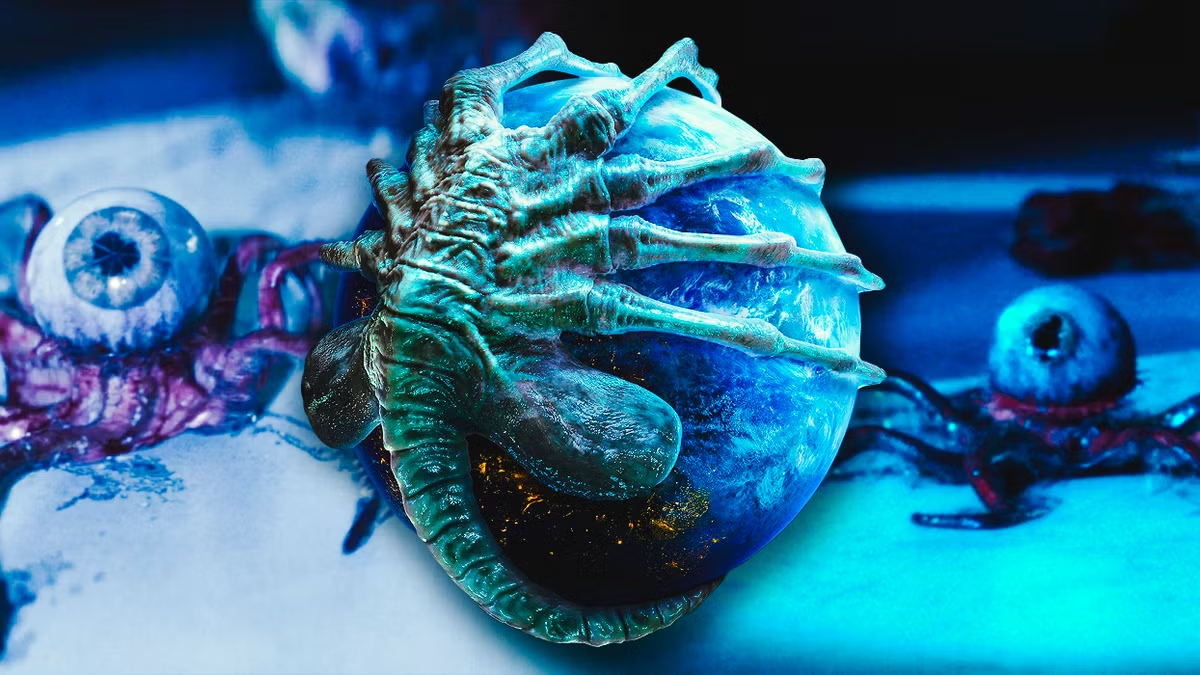
The Alien franchise has always been synonymous with fear, body horror, and deeply unsettling creature design. Since 1979, audiences have been traumatized by the biomechanical terror of the Xenomorph—a creature that feels less like an animal and more like a living nightmare. With the arrival of Alien: Earth, the franchise has once again proven that it is not afraid to push boundaries. Among its most disturbing innovations is a grotesque new creature that fans have dubbed the “Eyeball Monster.”
This horrifying entity marks a bold creative shift for the franchise, expanding the concept of alien terror beyond the familiar Xenomorph template. But what exactly is this eyeball monster? Where did it come from? How does it fit into Alien canon? And why is it so deeply unsettling? Let’s break down the biology, symbolism, and narrative importance of Alien: Earth’s most terrifying new monster.
1. A Franchise Built on Fearful Evolution
To understand the significance of the Eyeball Monster, it’s important to understand how Alien has historically approached creature design. The original Xenomorph wasn’t just scary because it killed people—it was horrifying because it violated biological norms. Its parasitic reproduction, acidic blood, and biomechanical form blurred the line between organism and machine.
Over the years, the franchise expanded this idea. Films like Aliens, Alien³, Resurrection, Prometheus, and Alien: Covenant experimented with variations: Queens, Runners, Neomorphs, Engineers, and synthetic hybrids. Each iteration explored a new aspect of evolution, infection, or creation.
Alien: Earth continues this tradition but takes it in a new direction—focusing less on claws and teeth, and more on surveillance, perception, and psychological terror. The Eyeball Monster is not just a predator. It is a watcher.
2. What Is the Eyeball Monster?
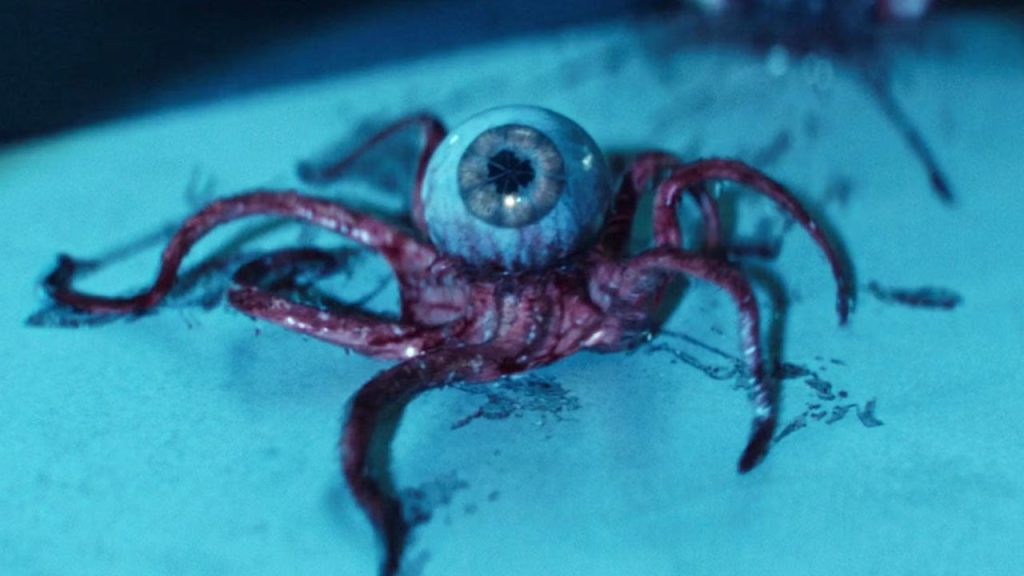
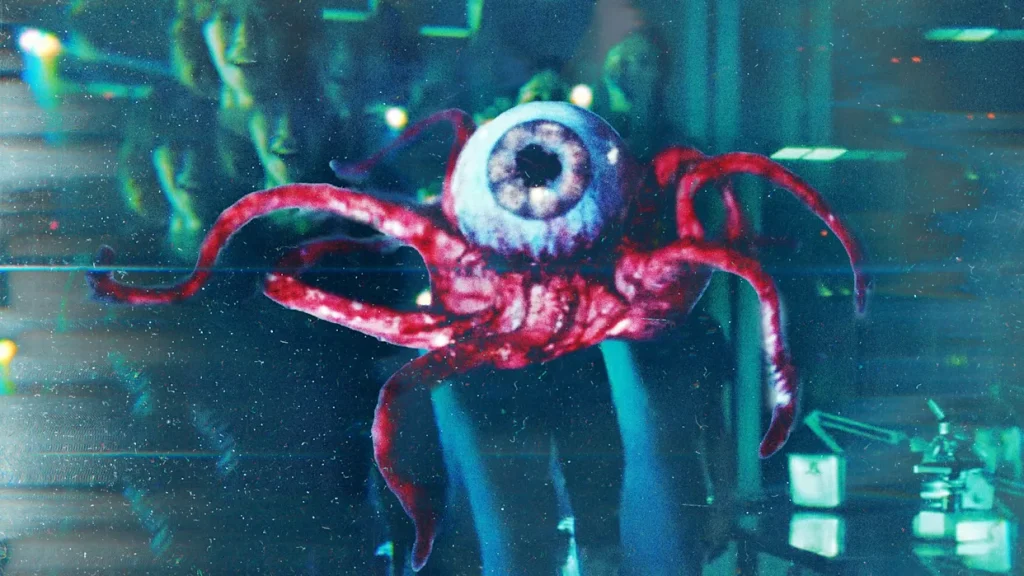
The Eyeball Monster is a newly introduced alien organism that appears in Alien: Earth as part of a broader experimentation arc involving alien biology and human interference. Unlike the traditional Xenomorph, this creature does not resemble a humanoid insect or reptile. Instead, its most dominant feature is a large, exposed, organic eye, often embedded in a distorted, fleshy body.
The creature’s anatomy is intentionally disturbing:
-
A massive, glossy eyeball capable of independent movement
-
Vein-covered tissue instead of armor plating
-
A semi-fluid body that appears unstable and unfinished
-
Limited limbs or appendages, suggesting a different evolutionary path
Rather than charging or attacking immediately, the Eyeball Monster often observes, tracks, and reacts slowly—making its presence deeply unsettling.
3. Why the Eye Is So Disturbing
Eyes have always held a special place in horror. They represent awareness, judgment, and vulnerability. An exposed eye is inherently uncomfortable—it suggests pain, fragility, and invasion.
In Alien: Earth, the Eyeball Monster weaponizes this discomfort. Its eye is not passive. It moves unnaturally, focuses too long, and seems to study its surroundings. Characters in the show frequently react with panic not because the creature attacks—but because it sees them.
This taps into a primal fear:
👉 the fear of being watched
👉 the fear of being known
👉 the fear of having no privacy or escape
Unlike the Xenomorph, which stalks and kills, the Eyeball Monster observes first, making the threat feel inevitable rather than sudden.
4. Is It Related to the Xenomorph?
One of the biggest questions fans have asked is whether the Eyeball Monster is a new form of Xenomorph—or something entirely different.
The answer appears to be both.
Within Alien: Earth, it is implied that the Eyeball Monster is the result of human experimentation on alien material, possibly derived from Xenomorph or Engineer biological components. Rather than following the traditional facehugger-to-chestburster cycle, this creature seems to represent a failed or altered evolutionary branch.
Key differences from classic Xenomorphs include:
-
No visible exoskeleton
-
No acidic blood (at least not weaponized)
-
No queen-based reproductive structure
-
A focus on sensory dominance rather than physical strength
This suggests the Eyeball Monster may be an early-stage hybrid, a surveillance organism, or even a biological tool rather than a pure predator.
5. A Monster Designed for Earth
One of the most important thematic shifts in Alien: Earth is the setting itself. Unlike earlier films that kept the horror confined to spaceships or distant colonies, this series brings alien terror directly to Earth.
The Eyeball Monster reflects this change.
On Earth, brute-force predators would be quickly noticed and eliminated. A creature designed to observe, adapt, and infiltrate makes far more sense. The Eyeball Monster appears optimized for:
-
Monitoring human behavior
-
Navigating controlled environments
-
Existing within laboratories or urban spaces
-
Serving as an early-warning or intelligence-gathering organism
In this way, it represents a more realistic alien threat—one that doesn’t immediately destroy, but learns.
6. Body Horror Reimagined
The Alien franchise has always excelled at body horror, and the Eyeball Monster takes this to a deeply psychological level. Instead of explosive violence, its horror comes from:
-
Unfinished anatomy
-
Constant organic movement
-
A sense of biological wrongness
-
The implication that it should not exist
It looks less like a finished creature and more like a biological experiment that escaped containment. This aligns perfectly with the franchise’s long-running theme: humanity’s dangerous obsession with playing god.
The monster feels like a punishment for curiosity—a reminder that alien biology does not obey human rules.
7. Symbolism: What the Eyeball Monster Represents
Beyond its physical horror, the Eyeball Monster carries strong symbolic meaning.
a) Surveillance and Control
The monster reflects modern fears about constant surveillance—cameras, data tracking, artificial intelligence, and loss of privacy. It watches silently, making humans feel powerless.
b) Scientific Arrogance
Like many Alien creatures, it represents the consequences of unchecked experimentation. It exists because humans tried to control alien life rather than understand it.
c) Evolution Without Morality
The creature is not evil—it is simply the result of biology adapting. This reinforces the Alien theme that nature has no ethics, only survival mechanisms.
8. Why Fans Are So Divided
The introduction of the Eyeball Monster has divided fans.
Supporters argue:
-
It refreshes the franchise
-
It expands alien biology creatively
-
It returns to psychological horror
-
It avoids overusing the Xenomorph
Critics argue:
-
It doesn’t feel “Alien enough”
-
The Xenomorph should remain central
-
The design is too abstract
However, even critics often admit that the monster is unforgettable, which is arguably the most important achievement in horror design.
9. How It Changes the Franchise’s Future
The Eyeball Monster opens the door to a broader alien ecosystem. Rather than relying solely on one species, Alien: Earth suggests a universe filled with:
-
Experimental organisms
-
Biological tools
-
Hybrid life forms
-
Alien evolution influenced by humans
This shift allows future stories to explore horror in new ways—focusing on infection, surveillance, psychological breakdown, and ethical collapse rather than pure physical threat.
It also reinforces the idea that the Xenomorph is not the end point—but one expression of a much larger biological nightmare.
10. Final Thoughts: A New Kind of Alien Terror
The Eyeball Monster in Alien: Earth may not replace the Xenomorph—but it doesn’t need to. Instead, it expands what alien horror can be.
Where the Xenomorph is violence, the Eyeball Monster is awareness.
Where the Xenomorph kills, the Eyeball Monster watches.
Where the Xenomorph hunts, the Eyeball Monster studies.
In doing so, Alien: Earth proves that true horror doesn’t always come from teeth and claws. Sometimes, the most terrifying thing is the feeling that something is watching you—and learning.
This bold new creature reminds us why Alien remains one of the most innovative horror franchises ever created: it evolves, adapts, and finds new ways to make us afraid.
Read Also: Keep your face towards the sunshine and shadows will fall behind you
Watch Also: https://www.youtube.com/@TravelsofTheWorld24













Leave a Reply