
A Legacy Born From Humble Beginnings
To understand the significance of the 1932 President Convertible Sedan, it helps to know where Studebaker came from. The Studebaker brothers — Henry and Clem — began building wagons in South Bend, Indiana, in 1852. From those humble roots, they transitioned into automobile manufacturing in the early 20th century, producing their first gasoline‑powered car in 1904. Over subsequent decades, Studebaker developed a reputation for innovative engineering and solid construction, steadily climbing the ranks of American carmakers.
By the late 1920s, Studebaker created the President line as its flagship luxury offering. Introduced in 1928, the President was designed to compete with the highest‑end vehicles available — a bold ambition that would culminate in the stunning 1932 Convertible Sedan.
Setting the Standard: Engineering Excellence
What truly set the 1932 Studebaker President apart was its engineering — a blend of robust power, smooth performance and thoughtful innovation.
At its heart was a 337 cubic‑inch inline eight‑cylinder engine rated at 122 horsepower at 3,200 rpm. For the time, this was a formidable output, especially from a naturally aspirated engine, and quite competitive with engines from more prestigious rivals. Its design featured nine main bearings instead of the more common five main bearings found in other automakers’ straight‑eight powerplants, improving lubrication, durability and smoothness — key factors in a luxury car’s performance and refinement.
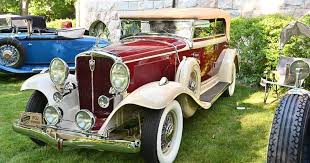
Studebaker didn’t just focus on power. The President’s mechanical package included modern amenities such as synchromesh transmission — a system that made shifting smoother and more effortless without the need for double‑clutching. It also boasted free‑wheeling gears and advanced filters for air, oil and fuel, along with a vibration damper to reduce engine shake. These improvements weren’t simply technical jargon; they translated into a more comfortable, refined and pleasurable driving experience, marking the President as a serious contender in its class.
Design That Turned Heads
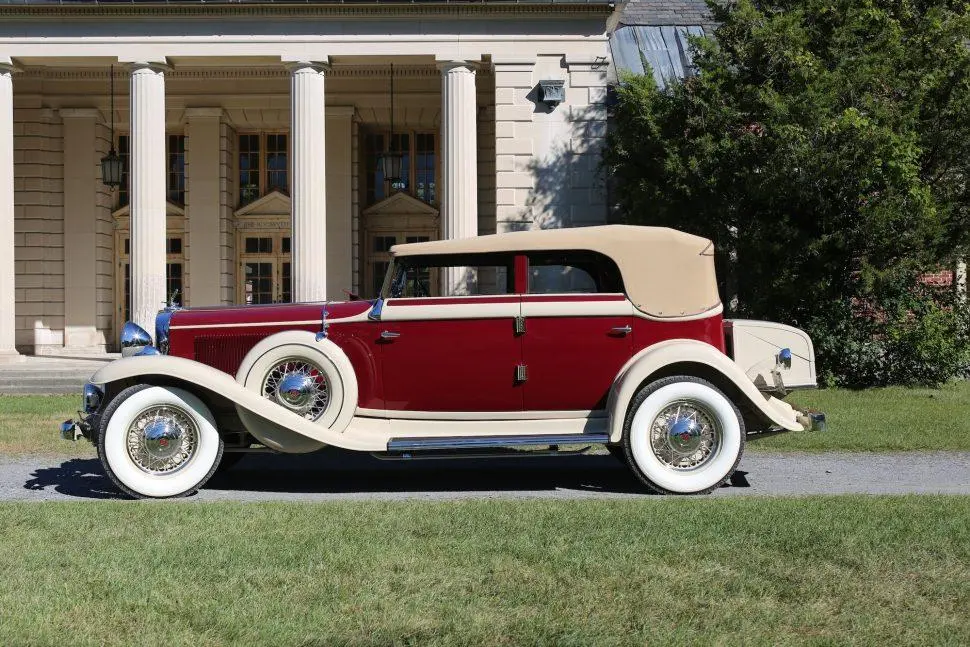
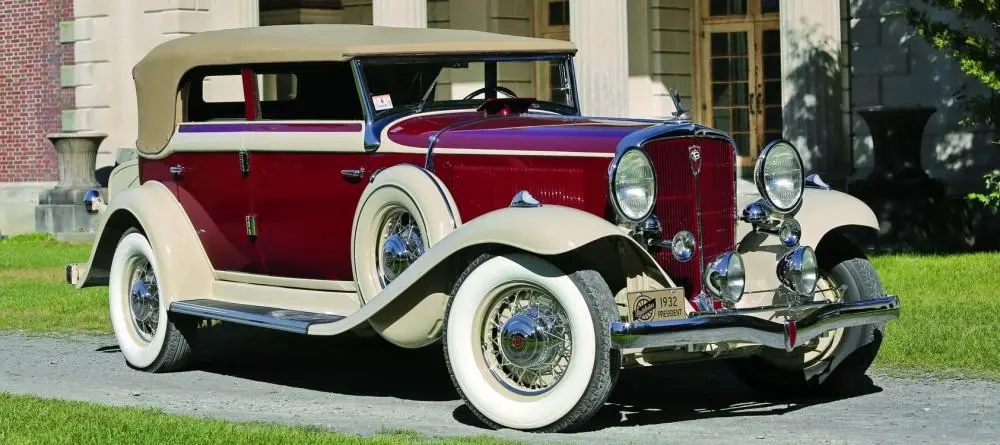
Mechanically impressive though it was, the President Convertible Sedan was equally commanding in its presence. Built on a 135‑inch wheelbase, it was larger and more stately than most Studebaker models, setting it apart visually and physically. Its sweeping fenders, slanted windshield and distinctive radiatior grille gave it an elegance and authority that rivaled cars from costlier marques.
One styling touch that became a hallmark was the oval “Ovaloid” headlamps — unique to Studebaker at the time and a visual signature that helped distinguish the President from other automobiles of the era. These headlamps weren’t just decorative; they signaled a bold design direction that balanced tradition with forward‑looking flair.
The convertible sedan body itself was a rare and desirable form. Of the 2,399 Presidents built in 1932 across all body styles, only a small handful were Convertibles, and today only two or so are known to survive. This scarcity adds to the model’s mystique and collectible appeal.
Luxury and Craftsmanship Inside and Out
Inside, the President Convertible Sedan was finished with the quality expected in a top‑tier automobile. Upholstery, trim and craftsmanship reflected Studebaker’s commitment to a refined passenger experience. While many cars of the era were spartan by today’s standards, winning luxury models offered attention to detail — from instrument panel design to seating comfort — that made long journeys more enjoyable.
The refinement didn’t stop at appearance. The driving experience — smooth acceleration, capable engine torque, and responsive handling — made the President feel modern even alongside vehicles costing much more. In an age where many Americans relied on basic transportation, here was a machine that provided comfort, capability and status in equal measure.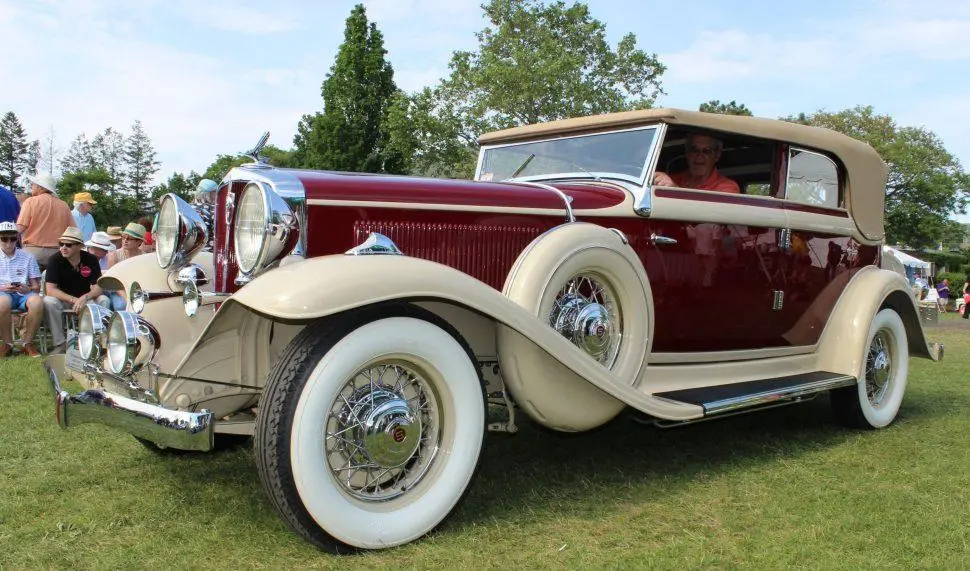
Performance and Competition
Studebaker didn’t shy away from competition. Throughout the late 1920s and early 1930s, Presidents enjoyed success in numerous speed and endurance events, proving the capability of their engineering. In multiple Indianapolis 500 races during this era, production‑based Studebaker engines performed admirably, scoring several top finishes and showcasing Studebaker’s technical competence.
Such achievements weren’t merely trophies on a shelf — they helped build the President’s reputation among consumers who valued both prestige and performance. For a company headquartered in South Bend, Indiana — far from the more famous automotive centers of Detroit or Cleveland — this was a valuable distinction: proof that Studebaker could play in the highest leagues of automotive performance and luxury.
The Convertible Sedan’s Rarity and Restoration
The story of the 1932 President Convertible Sedan’s resurgence in the 21st century is almost as dramatic as its original launch. One surviving example, belonging to Dr. George Vassos of Massachusetts, has become legendary in the classic car world.
Originally sold new in California, this particular President spent years in Mexico before being repatriated to the U.S. in the 1970s. By the time Dr. Vassos acquired it in 2007, the car needed extensive restoration. The original gauges were gone, the engine had been replaced with an earlier variant, and layers of interior upholstery obscured its original craftsmanship. Over nine years of dedicated restoration, Vassos and collaborators — including the Antique Studebaker Club — painstakingly returned the car to its original specification, even locating its original straight‑eight engine.
When finally completed, the President Convertible Sedan returned to public view at prestigious concours events. Its most notable triumph came at the 2016 Hemmings Motor News Concours d’Elegance, where it won Best in Show, a remarkable achievement given the level of competition and the historic significance of automobiles entered alongside it. This victory was a testament not just to the car’s beauty, but to the excellence of its design, engineering and restoration.
Studebaker’s Place in Automotive History
The President Convertible Sedan stands as more than a rare classic. It embodies an era of ambition — when Studebaker, a company with deep roots in the heartland of America, sought to prove it could match the world’s most esteemed automobile makers in innovation, style and performance. While financial realities would eventually push Studebaker through bankruptcy in 1933 and future restructurings, the President remains a proud high point in the company’s legacy.
Today, Studebaker enthusiasts revere the President for what it represents: a bold statement of capability from South Bend, a city better known for wagons and midwestern industry than luxury automobiles. Yet in 1932, at a time when many competitors were faltering and tastes were rapidly changing, Studebaker confidently placed its name alongside the best — and the President Convertible Sedan proved the point with horsepower, style and enduring allure.
Conclusion — A Classic That Still Inspires
The 1932 Studebaker President Convertible Sedan is more than a beautiful classic car; it’s a testament to American ingenuity and automotive ambition. Its rare combination of engineering excellence, elegant design and competitive spirit — coming from a manufacturer outside the usual luxury hubs — ensures its place among the most fascinating automobiles of its time. Whether admired at concours events, preserved in museums or celebrated by collectors, this car remains a shining example of how Studebaker proved it could truly compete with the best.
Read Also: Keep your face towards the sunshine and shadows will fall behind you
Watch Also: https://www.youtube.com/@TravelsofTheWorld24





Leave a Reply