
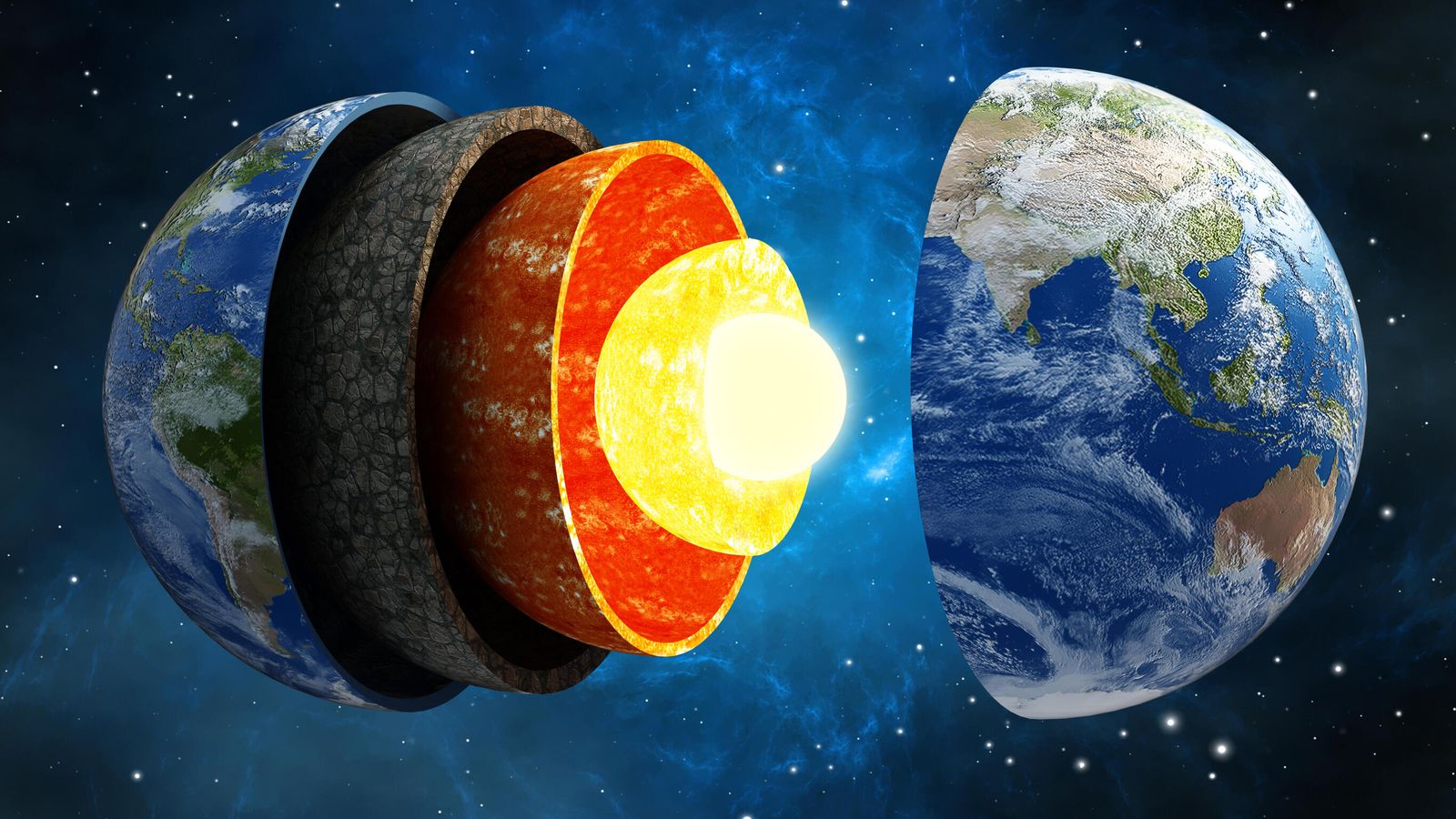
Scientists studying the dynamics of Earth’s inner core have discovered a surprising phenomenon: the planet’s inner core may have temporarily stopped spinning, part of a cycle that spans roughly seven decades. This revelation sheds new light on the complex behavior of Earth’s deep interior, which has profound implications for geophysics, magnetic field generation, and our understanding of the planet’s long-term evolution.
The inner core, a solid iron-nickel sphere about 1,220 kilometers in radius, is located at the center of Earth, surrounded by a fluid outer core. Its motion relative to the mantle influences the geodynamo, the process that generates Earth’s magnetic field. Observations suggesting a periodic slowing or halting of inner core rotation provide a new window into the interactions between Earth’s layers and the forces that shape our planet’s magnetic and geological activity.
The Structure and Motion of Earth’s Inner Core
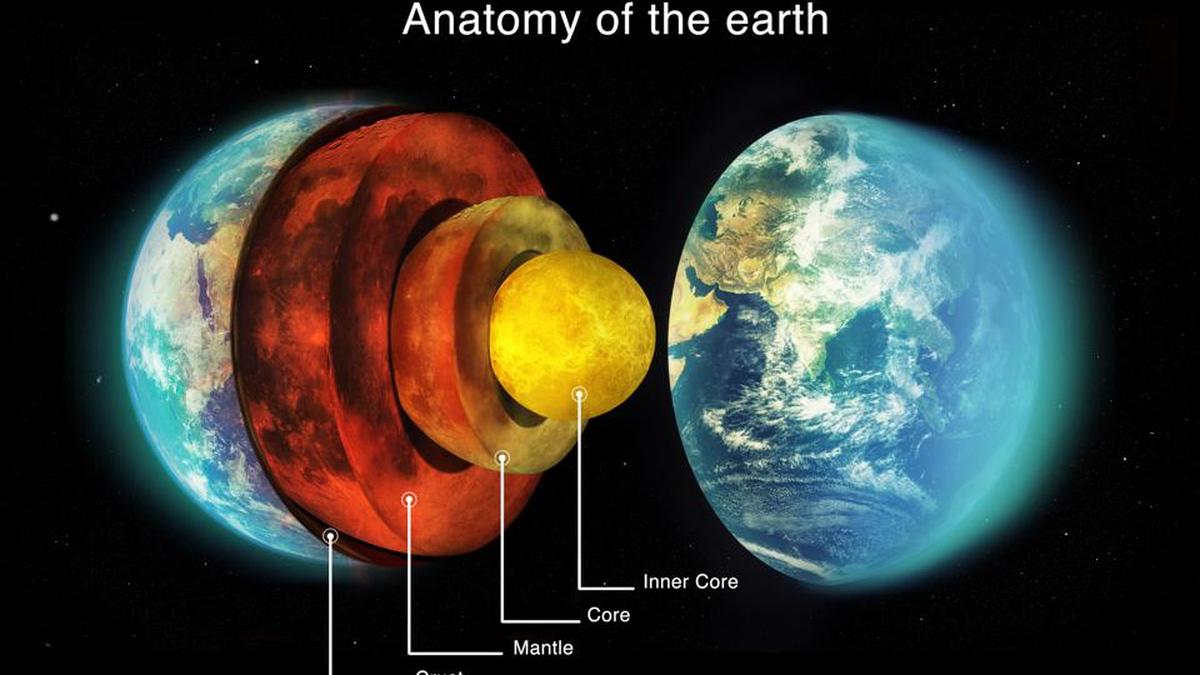
Earth’s interior is composed of several distinct layers:
-
Crust: The thin, outermost layer of solid rock.
-
Mantle: A thick layer of solid rock that flows slowly over time.
-
Outer Core: A molten layer of iron and nickel, generating Earth’s magnetic field through convection.
-
Inner Core: A solid sphere primarily of iron and nickel, about 5,100 km beneath the surface.
The inner core does not rotate at a constant rate relative to the surface. Over decades, it can rotate slightly faster or slower than the mantle, a phenomenon called super-rotation or sub-rotation. New research suggests that the inner core may temporarily stop spinning relative to the mantle, part of a larger seven-decade oscillatory cycle.
Evidence for the Inner Core’s Stopping
Seismologists have analyzed seismic waves generated by earthquakes, which travel through Earth’s interior and provide clues about the inner core’s motion. Differences in wave travel times from multiple earthquakes over decades reveal subtle changes in the inner core’s rotation.
Key findings include:
-
Seismic Travel Time Anomalies: Data collected between 1969 and 2025 indicate periods where waves suggest the inner core’s rotation rate slowed or effectively stopped relative to the mantle.
-
Cycle Length: Patterns suggest a roughly 70-year cycle of rotation speed fluctuations, including intervals of super-rotation, sub-rotation, and halting.
-
Geophysical Correlation: These observations correlate with changes in Earth’s magnetic field and variations in core-mantle interactions.
Mechanisms Behind the Inner Core’s Cycles
Several theories explain why the inner core may experience periodic halts:
1. Electromagnetic Coupling
The liquid outer core is electrically conductive and interacts with the magnetic field. Variations in magnetic forces can exert torques on the inner core, influencing its rotation relative to the mantle.
2. Viscous Drag
Friction between the inner core and the surrounding outer core fluid can slow down or temporarily stop the inner core’s rotation, especially if flow patterns in the outer core change over decades.
3. Mantle-Core Interactions
Large-scale mantle convection and density anomalies at the core-mantle boundary can alter torques on the inner core, contributing to cyclical rotation changes.
4. Gravitational Forces
Tidal interactions with the Moon and Sun, while minor, may slightly affect inner core rotation over long timescales.
Implications for Earth’s Magnetic Field
The inner core’s motion is closely linked to the geodynamo, the mechanism that generates Earth’s magnetic field. Temporary halts in rotation could influence:
-
Magnetic Field Strength: Fluctuations in the inner core’s rotation may lead to variations in field intensity at the surface.
-
Magnetic Field Orientation: Changes in core flow could affect the magnetic poles, contributing to observed drift and geomagnetic anomalies.
-
Geomagnetic Reversals: Long-term core dynamics may play a role in the rare but dramatic reversals of Earth’s magnetic poles.
Understanding the inner core’s behavior helps scientists model magnetic field evolution, crucial for navigation systems, satellite operations, and protecting Earth from solar radiation.
Evidence From Historical Observations
Historical seismic data from the 20th century provide clues about the inner core’s cyclical behavior:
-
1969–1996: Inner core appears to have rotated slightly faster than the mantle (super-rotation).
-
1996–2016: Slower rotation and periods of apparent halting observed.
-
2016–2025: Indications of resumed super-rotation, suggesting the continuation of a cyclical pattern.
This seven-decade periodicity aligns with models predicting oscillatory interactions between the inner core, outer core, and mantle.
Broader Implications for Geophysics
The discovery of a stopping inner core has wide-ranging consequences:
-
Earthquake Propagation: Understanding inner core motion improves models of seismic wave travel, aiding in earthquake research and early-warning systems.
-
Magnetic Field Forecasting: Better comprehension of core cycles may enhance predictions of geomagnetic fluctuations.
-
Planetary Comparisons: Studying Earth’s inner core dynamics offers insights for other planets with metallic cores, such as Mercury, Mars, and exoplanets with magnetic fields.
-
Long-Term Geological Processes: Inner core rotation influences heat transport, mantle convection, and the evolution of tectonic activity over geological timescales.
Read Also: Keep your face towards the sunshine and shadows will fall behind you
Challenges in Studying the Inner Core
Investigating the inner core is exceptionally difficult due to its extreme depth and inaccessibility. Scientists rely on indirect methods:
-
Seismic Waves: The primary tool for probing the core’s structure and motion.
-
Geodynamo Simulations: Computer models help predict how core dynamics affect magnetic fields.
-
Satellite Observations: Measuring fluctuations in the magnetic field provides indirect evidence of inner core behavior.
Despite technological advances, uncertainties remain about the precise mechanisms driving the inner core’s rotational cycles.
Future Research Directions
Ongoing and future studies aim to deepen our understanding of inner core dynamics:
-
High-Resolution Seismology: Using denser global seismic networks to track subtle changes in wave travel times.
-
Advanced Geodynamo Models: Simulating interactions between inner core rotation, outer core flow, and mantle convection.
-
Geomagnetic Monitoring: Long-term monitoring of magnetic field variations to correlate with inner core motion.
-
Comparative Planetology: Investigating whether similar cyclical phenomena occur in the cores of other terrestrial planets.
These approaches will refine our understanding of Earth’s deep interior and its role in shaping the planet’s surface environment.
Conclusion: A Dynamic Heart of the Planet
The discovery that Earth’s inner core may temporarily stop spinning as part of a seven-decade cycle highlights the dynamic complexity of our planet’s interior. Far from being a static, inert ball of iron and nickel, the inner core participates in a delicate dance with the outer core and mantle, influencing magnetic fields, seismic activity, and planetary evolution.
Understanding these cycles not only enriches fundamental geophysics but also provides practical benefits: improved forecasting of geomagnetic phenomena, better models for earthquake propagation, and insights into the behavior of other planetary bodies.
As seismic networks expand and computational models improve, scientists are poised to uncover even more about the hidden mechanics of Earth’s deep interior, offering a fascinating glimpse into the forces that shape the planet from its core outward.
Watch Also: https://www.youtube.com/@TravelsofTheWorld24











Leave a Reply