
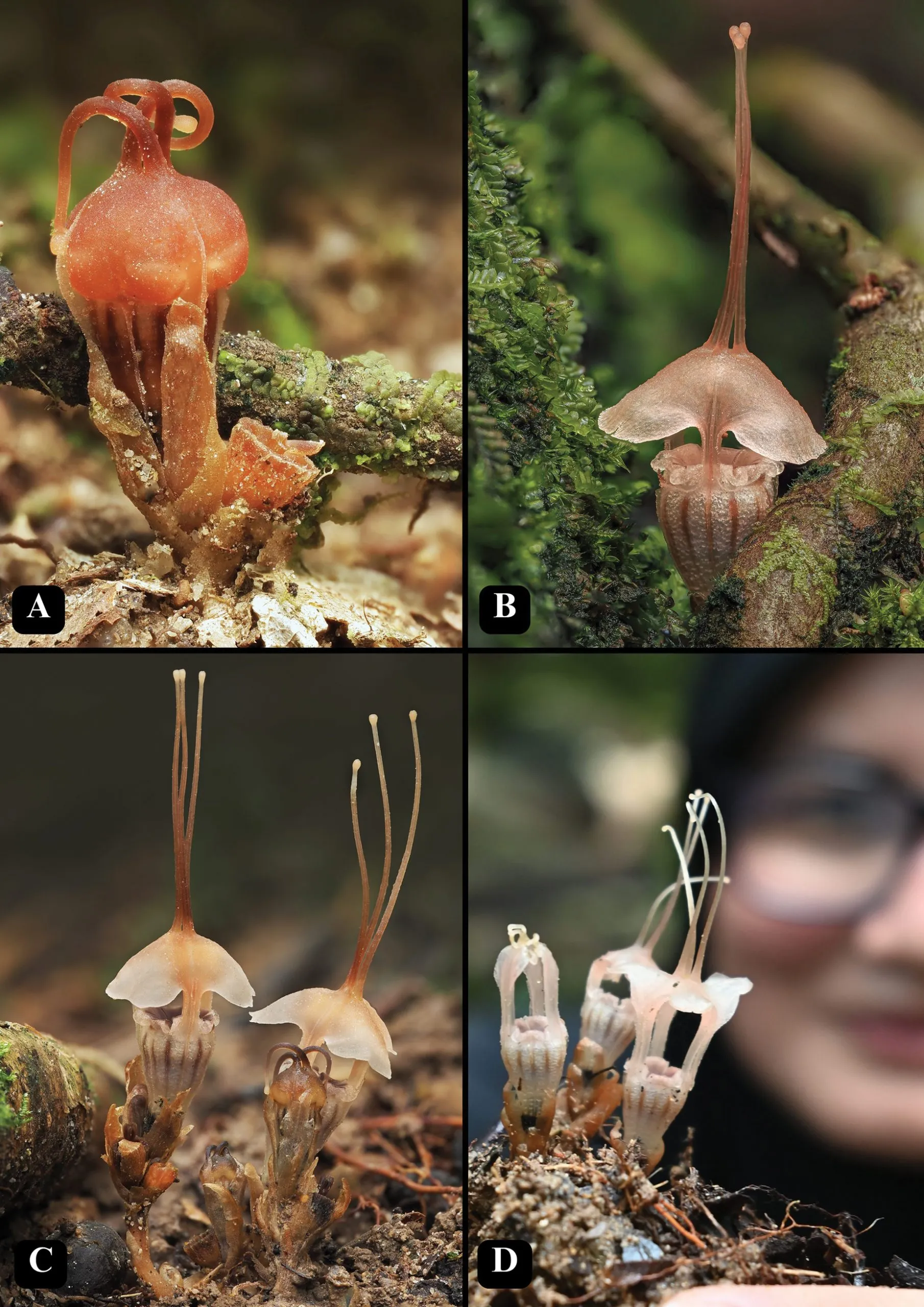
Scientists in Malaysia have described a newly‑discovered “fairy lantern” plant species named Thismia selangorensis. The discovery was published in 2025 in the journal PhytoKeys, and the species has immediately been classified as Critically Endangered under the criteria of the International Union for Conservation of Nature (IUCN), because researchers found fewer than 20 individuals in the wild.
The plant is tiny — about 10 cm (roughly 4 inches) tall — with a delicate peach‑to‑pink flower that emerges from the forest floor’s leaf litter. Its flower develops into a distinctive umbrella‑ or “mitre”-shaped structure topped by three slender, club‑shaped appendages.
The species belongs to the genus Thismia, a group of “fairy lanterns” — plants that are not green, do not photosynthesize, and instead obtain nutrients by parasitizing fungi in the soil (a lifestyle called mycoheterotrophy). As with other Thismia species, Thismia selangorensis spends most of its life hidden beneath leaf litter and soil, becoming visible only briefly when it flowers.
Where and How It Was Found
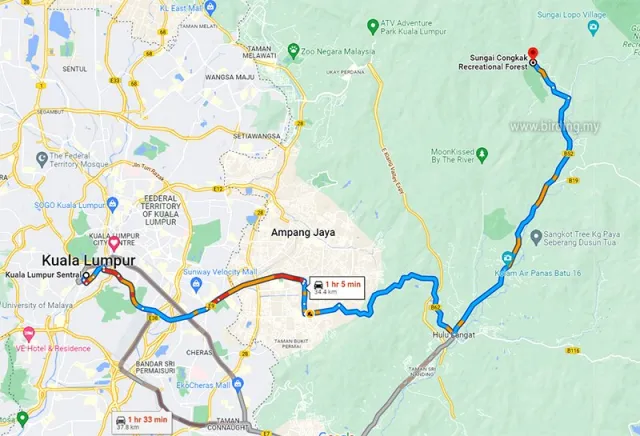
The only known specimens of Thismia selangorensis were discovered in the forest reserve area of Taman Eko Rimba Sungai Chongkak — a picnic, camping, and recreation forest in Selangor, Malaysia, relatively near Kuala Lumpur.
In November 2023, a naturalist named Tan Gim Siew spotted the plant during a routine visit: the tiny flower was growing among damp leaf litter next to the buttress roots of a riverside tree.
Subsequent surveys by botanists found no more than 20 individuals, all confined to an extremely restricted area — roughly a 4‑square‑kilometre patch.
Because of the species’ extremely small population and limited range, along with its fragile habitat next to picnic and riverbank zones, researchers warn that Thismia selangorensis is highly vulnerable to accidental destruction from foot traffic, flooding, or habitat disturbance.
What Makes Fairy Lanterns Special — and Vulnerable
The “fairy lantern” plants (Thismia) are extraordinary and unusual among flowering plants. Unlike ordinary plants, they:
-
Lack chlorophyll (so they don’t perform photosynthesis).
-
Depend entirely on a symbiotic/parasitic relationship with underground fungi to get their nutrients.
-
Live mostly underground or hidden beneath leaf litter and forest debris, and only produce visible flowers for short periods under very specific environmental conditions.
Because of these traits, fairy lanterns are hard to find, rarely seen, and highly sensitive to environmental disruption — they need stable, moist, undisturbed forest floors, rich leaf litter, fungal networks, and moderate humidity. Any disturbance — clearing, trampling, flooding, soil compaction — can easily wipe them out.
That combination of rarity, hidden life cycle, and ecological fragility makes each discovery precious — but also raises immediate concerns about long‑term survival.
Significance of the Discovery
-
Hidden Biodiversity is Alive — Even Near Human Habitats
The fact that Thismia selangorensis was found in a relatively accessible forest area — popular for recreation and near urban centers — highlights that undiscovered species still exist even in relatively frequented or “ordinary” forests. It challenges the assumption that unknown species only exist in remote or far‑flung wilderness. -
Raises Conservation Alarm Bells
Discovering a species that already has < 20 known individuals demonstrates how fragile some species are, and how easily we could lose them — possibly before many people even know they exist. The researchers explicitly recommend urgent conservation action, including habitat protection, limiting foot‑traffic around known sites, and further botanical surveys to discover whether more individuals exist. -
Expands Scientific Knowledge of Mycoheterotrophic Plants
Each new Thismia species adds to our understanding of a weird, little‑known survival strategy — of plants that skip photosynthesis entirely and live off fungal networks underground. This helps botanists understand fungal‑plant‑soil interactions, forest ecology, and evolution of plant lifestyles. -
Highlights Threats to Forest Floor Biodiversity
The discovery brings attention to a part of biodiversity — the forest floor’s cryptic, small, rare plants — that tends to be overlooked in conservation. While trees, mammals, and birds attract much attention, tiny hidden plants like Thismia may disappear without notice, especially in areas frequented by humans.
 Threats & Why This Plant Is Critically Endangered
-
Extremely small population size — fewer than 20 known individuals.
-
Very limited range — all individuals found appear confined to a small area (~4 km²) of one forest near a picnic/camping site.
-
Habitat vulnerability — forest floor rich in leaf litter and fungal networks, easily disturbed by foot traffic, soil compaction, flooding, or clearing. The site being a popular picnic/camping spot increases risk.
-
Cryptic nature and detection difficulty — because they stay hidden most of the time and only appear briefly when flowering, researchers may miss other populations; but it also means known populations might decline without anyone noticing.
Given these threats, the classification of Thismia selangorensis as Critically Endangered reflects a real and immediate risk of extinction.
What’s Next — Conservation & Research Needs
-
Protect the known habitat: Limit access to the specific forest area, control visitor activity and trampling, especially around the riverbank and root‑buttress zones where the plant grows.
-
Conduct broader surveys: Search in nearby forests or similar habitats to see if more populations exist elsewhere — maybe they’ve been overlooked because of the plant’s hidden lifestyle.
-
Monitor known individuals: Track their health, flowering patterns, survival over seasons, and potential threats (flooding, soil compaction, human disturbance).
-
Raise public awareness: Since the plant is in a recreational forest area, educating visitors and local communities about its existence and fragility can help protect it.
-
Research ecology & life history: Study its relationship with soil fungi, reproduction (pollinators — often fungi‑gnats), seasonal cycles, and ecological requirements. That knowledge could help in future conservation or even cultivation if needed.
Bigger Picture — What This Means for Biodiversity & Conservation
The discovery of Thismia selangorensis is a striking reminder that even in the 21st century, new species continue to be found — sometimes in surprisingly accessible places. It shows that Earth’s biodiversity is richer and more fragile than we often assume.
More importantly, it highlights the urgency of protecting less‑obvious, cryptic, underground or small‑plant biodiversity — not just charismatic animals or big trees. These plants may play essential roles in forest ecosystems (through fungal‑soil networks, nutrient cycles, microhabitats) — yet they remain under‑studied and under‑protected.
Moreover, it offers a call to rethink how we use and manage forested recreational areas: even “common” or “visited” forests may harbor rare, vulnerable species that deserve protection.
In short — Thismia selangorensis is more than a botanical curiosity. It’s a living warning sign: of biodiversity still hidden, of species hanging by a thread, and of the responsibility we carry to preserve what remains before it vanishes forever.
Read Also: The Race to 300 mph: Will Hennessey or Koenigsegg Break the Speed Record in 2025?
Watch Also: https://www.youtube.com/@TravelsofTheWorld24














Leave a Reply