
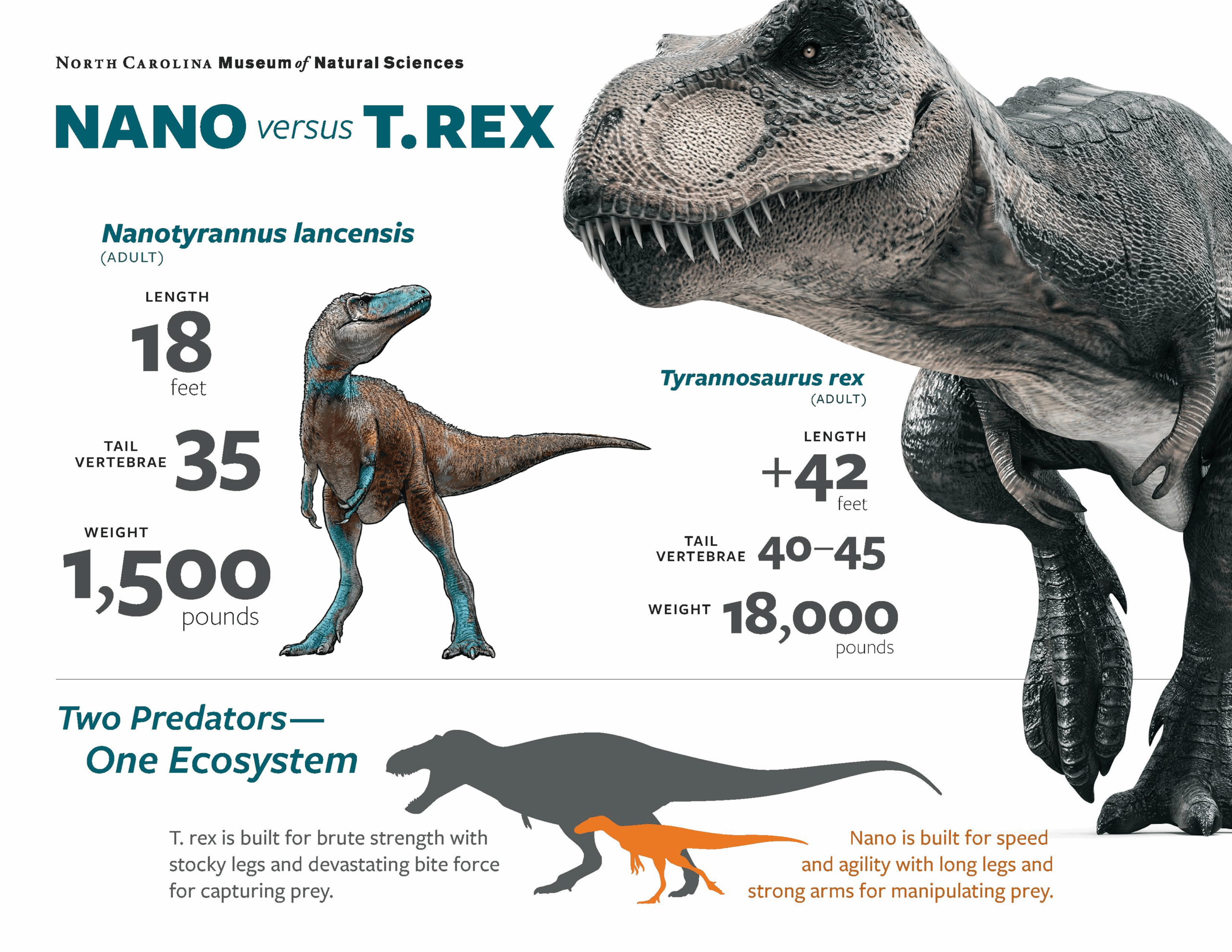
For decades, the fossil record has yielded a small tyrannosaur skull and a few fragmentary skeletons that some paleontologists assigned to a species called Nanotyrannus lancensis. Others argued that these remains simply represented juvenile or sub‑adult T. rex — a “teenage T. rex.” Because of that, the status of Nanotyrannus has been deeply controversial.
The heart of the debate has centered on whether the differences between the small tyrannosaur fossils and adult T. rex — such as size, proportions, tooth count, limb proportions, skull shape — reflect growth and age (juvenile vs adult) or genuine species‑level differences.
Until recently, many paleontologists leaned toward the “juvenile T. rex” hypothesis — partly because no definitively adult Nanotyrannus fossil existed, and small size alone is risky to use to define a species given how animals change during growth.
 What Changed — New Evidence in 2025
In 2025, two independent studies have presented compelling evidence that resolves the debate — with the conclusion that Nanotyrannus was a distinct species and not just a juvenile T. rex.
Key Evidence
-
Bone‑growth analysis of a throat bone (hyoid): Researchers studied the hyoid bone from the original Nanotyrannus skull (the “holotype”) and assessed its microscopic structure. Growth rings in the bone (analogous to tree rings) indicated that the individual was fully grown (or nearly so) at the time of death — not a rapidly growing adolescent.
-
Distinct anatomical features fixed early in development: The 2025 study analyzing the so-called “Dueling Dinosaurs” fossil — a small tyrannosaur entangled with another dinosaur — found multiple anatomical traits that differ from T. rex, and which would not change during growth. For example: a higher tooth count, different skull nerve/sinus pathways, different proportions of limbs, larger arms, and different tail structure.
-
Lack of transitional fossils: Over more than 200 tyrannosaur fossils reviewed by the authors, there are no specimens showing a mix of “juvenile” Nanotyrannus traits and “adult” T. rex traits; instead, fossils fall clearly into one morphology or the other. That suggests two discrete species rather than a growth continuum.
As a result, the 2025 discoveries have provided what many consider “definitive” evidence that Nanotyrannus is a valid, separate species.
What Nanotyrannus Was Like — A Different Kind of Tyrannosaur
According to the new data:
-
Nanotyrannus was much smaller than a full-grown T. rex — roughly half the length, and around one‑tenth the body mass.
-
It had longer arms, more teeth, different skull & sinus structures, and different proportions of neck, legs and tail.
-
Its build was more slender, agile, and lightweight compared to the bulky, massive T. rex — implying it hunted differently, perhaps preying on smaller or swifter animals, or occupying a different ecological niche.
In other words — rather than a juvenile T. rex still growing, Nanotyrannus appears to have been an adult predator in its own right, coexisting with T. rex in Late Cretaceous ecosystems.
 Why It Matters — What This Means for Dinosaur Science
More Diverse Predator Guilds
Recognizing Nanotyrannus as a valid species suggests that Late Cretaceous North America hosted more types of large theropod predators than previously thought. Rather than T. rex reigning unchallenged, ecosystems may have included a “tiered” predator guild — large tyrants like T. rex, plus more moderate‑sized, agile hunters like Nanotyrannus.
Rethinking Growth and Life History of T. rex
Many past studies used Nanotyrannus fossils as “juvenile T. rex” to model growth rates, ontogeny, and development of T. rex. With Nanotyrannus now separated out, those models may need revision. Researchers may need to find new reliably juvenile T. rex fossils — or re-evaluate earlier conclusions.
Caution in Paleontology — Small Specimens Aren’t Always Juveniles
The case of Nanotyrannus is a vivid example of how small size and “youthful” appearance in fossil dinosaurs does not necessarily mean the specimen is juvenile or immature. Growth, anatomy development, and species-level variation all must be carefully evaluated — ideally with histology (bone growth studies), detailed anatomy, and broad comparisons.
More Discoveries Likely Ahead
If Nanotyrannus was overlooked or misclassified for decades, it’s possible there are other “hidden” dinosaur species among fossils currently assigned to well-known species — especially if they’re only represented by small or fragmentary remains. This encourages renewed scrutiny of existing museum collections.
Remaining Cautions & Some Skepticism
While the 2025 papers are widely regarded as strong, a few paleontologists remain cautious. Some argue that not all small tyrannosaur fossils should automatically be assigned to Nanotyrannus — especially if morphological data is incomplete.
Additionally, naming a new species from a limited number of fossils always carries uncertainty. More finds — especially more complete skeletons (skull + limbs + tail) — would help strengthen confidence.
Nevertheless, the throat‑bone growth data and the distinctive anatomy of the “Dueling Dinosaurs” specimen make a strong case, and most of the recent press and paleontological community seem ready to accept Nanotyrannus as a valid species.
Read Also: The Race to 300 mph: Will Hennessey or Koenigsegg Break the Speed Record in 2025?
Watch Also: https://www.youtube.com/@TravelsofTheWorld24













Leave a Reply