
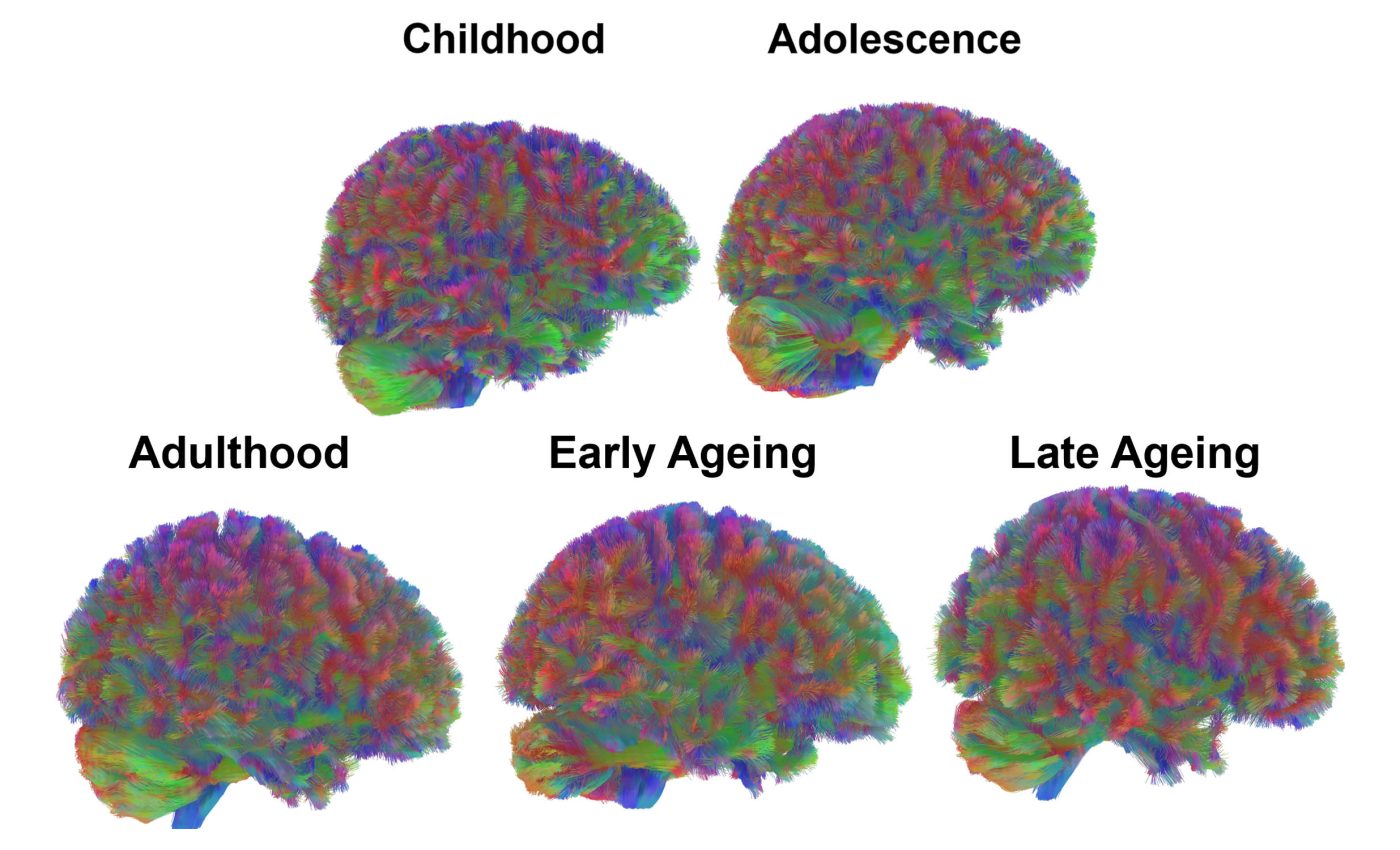
For a long time, scientists believed that human brain development followed a simple trajectory: rapid growth in childhood, full maturity by late adolescence, followed by slow decline in old age. Recent research, however, has revealed a far more nuanced picture. The human brain undergoes four major periods of structural reorganization across the lifespan, marked by distinct turning points at roughly ages 9, 32, 66, and 83. Each of these phases reflects significant changes in neural wiring, connectivity, and cognitive capacity. Understanding these changes not only reshapes our view of development and aging but also provides insight into learning, mental health, and cognitive resilience.
How the Study Was Conducted
Researchers from the University of Cambridge analyzed brain scans from nearly 4,000 individuals ranging from infancy to 90 years of age. Using diffusion magnetic resonance imaging (diffusion-MRI), they examined the brain’s structural network — how different regions of the brain are connected through white matter pathways. White matter forms the brain’s communication network, linking gray matter regions where processing occurs. By studying these networks, scientists could observe changes in connectivity and organization at different stages of life.
The Four Turning Points in Brain Reorganization
-
Around Age 9: Childhood to Late Childhood Transition
-
In early childhood, the brain is highly plastic, forming an overabundance of connections (synapses). Many of these are later pruned based on experience and use.
-
By age 9, the brain reaches a major structural milestone. Connections between different regions begin to reorganize, establishing more efficient networks.
-
This period marks a transition from the exuberant, flexible wiring of early childhood to more stable, efficient connections. Children develop greater coordination between different cognitive functions, such as attention, memory, and reasoning.
-
Essentially, age 9 represents the first major “rewiring” of the brain, preparing it for adolescence and more complex cognitive demands.
-
-
Around Age 32: Adolescence to Adulthood
-
Contrary to earlier beliefs that brain maturation ends in the late teens or early twenties, the study shows adolescence extends into the early thirties.
-
During this period, the brain’s white matter networks become more efficient, enabling faster communication between distant regions.
-
This reorganization leads to enhanced problem-solving abilities, improved decision-making, and more consistent personality traits.
-
Age 32 represents the most dramatic reconfiguration of brain wiring in the lifespan, establishing a pattern that will dominate much of adulthood.
-
-
Around Age 66: Early Aging
-
At this stage, the brain begins a second major reorganization associated with aging.
-
Structural changes include gradual decline in long-distance connectivity, reduced white matter integrity, and increased reliance on localized circuits.
-
Cognitive abilities such as processing speed, multitasking, and memory may begin to decline, though the brain compensates through reorganizing remaining connections.
-
This turning point highlights a transition from stable adulthood to early aging, showing that neural networks adapt even as degeneration begins.
-
-
Around Age 83: Late Aging
-
The final reorganization occurs in very late life.
-
Brain networks become more fragmented, and efficiency decreases further. The brain increasingly relies on specialized local circuits, as broader integration declines.
-
This stage is often associated with more pronounced cognitive decline and greater vulnerability to neurodegenerative diseases.
-
Despite these changes, the brain remains plastic, meaning lifestyle factors, mental stimulation, and social engagement can still influence cognitive resilience.
-
 Implications of the Findings
These four periods of brain reorganization have far-reaching implications for our understanding of human development and aging:
-
Redefining Maturity
-
The discovery that adolescence extends into the early thirties challenges conventional views of when people reach cognitive maturity. Decisions, problem-solving, and emotional regulation may continue to develop well into adulthood.
-
-
Targeting Interventions
-
Each turning point may represent a period of vulnerability or opportunity. Early interventions in childhood or adolescence can support optimal cognitive development, while later interventions in early or late aging can help maintain brain health.
-
-
Rethinking Aging
-
Brain aging is not a uniform, slow decline but a series of structured reorganizations. Understanding these phases can improve strategies to maintain cognitive function in older adults.
-
-
Life-Long Plasticity
-
Despite structural decline in later life, the brain remains adaptable. Education, physical exercise, social engagement, and mentally stimulating activities can continue to influence cognitive function even into the 80s.
-
-
Health and Lifestyle Connections
-
Insights into these brain phases can inform health policy, mental health care, and public understanding of cognitive aging. They highlight the importance of supporting learning and mental health across the lifespan.
-
Summary of Brain Phases
| Phase | Approximate Age | Key Features |
|---|---|---|
| Childhood | 0–9 | Rapid growth, synapse formation, pruning, first major rewiring |
| Adolescence/Youth | 9–32 | Efficiency in connectivity, delayed brain maturation, enhanced problem-solving |
| Adulthood | 32–66 | Stability in wiring, peak cognitive efficiency, maintenance of networks |
| Early Aging | 66–83 | Decline in connectivity, shift to localized circuits, adaptation to loss |
| Late Aging | 83+ | Fragmented networks, decreased efficiency, continued plasticity but higher vulnerability |
Why This Matters
The discovery of these four brain reorganizations shifts our understanding of human development:
-
Education: Recognizes that learning potential extends well beyond teenage years.
-
Workplace and Social Policy: Shows that adulthood is a dynamic period, not a static plateau.
-
Mental Health: Helps identify critical windows for intervention.
-
Aging: Offers insight into maintaining cognitive function and designing supportive environments for older adults.
Overall, these findings portray the human brain as dynamic, adaptive, and resilient, continuously reorganizing itself to meet life’s demands. Rather than a simple linear trajectory, brain development and aging follow a complex, structured series of transitions, each with unique cognitive, emotional, and behavioral implications.
This overview provides a comprehensive understanding of how the brain reorganizes itself at four major turning points throughout life, emphasizing both the remarkable plasticity of the brain and the structured nature of its development and aging.
Read Also: The Race to 300 mph: Will Hennessey or Koenigsegg Break the Speed Record in 2025?
Watch Also: https://www.youtube.com/@TravelsofTheWorld24













Leave a Reply