
In the world of finance, economics, and corporate management, the term agency costs comes up quite often. It is a key concept that explains the challenges that arise when one party (the principal) hires another party (the agent) to perform a task on their behalf. Whether it is a company hiring a manager, a shareholder trusting a CEO, or an investor relying on a financial advisor, agency relationships are everywhere. And with them come certain costs. Understanding agency costs is essential for businesses, investors, and even students of economics, because they directly influence company strategies, profits, governance policies, and overall organizational efficiency.
This article explains what agency costs are, the types of fees included, why they arise, and a clear example to help you understand the concept in reality.
Understanding Agency Costs
Agency costs are the costs that arise from conflicts of interest between principals and agents. The principal is the owner or party who delegates work, while the agent is the one who performs the work. Ideally, both should have the same goals—but in reality, their interests often differ.
For example, shareholders (principals) want maximum profit and long-term growth. Managers (agents), however, may want higher salaries, job security, personal benefits, or short-term achievements that make them look good. Because of this difference in objectives, shareholders must spend money to monitor, regulate, and motivate managers so that the company’s best interests are protected. These expenses are called agency costs.
Why Do Agency Costs Arise?
Agency costs occur due to:
1. Information Asymmetry
Agents usually have more information about day-to-day operations than the principals. For example, a CEO knows the company’s actual performance better than the shareholders. This information gap often leads to mistrust and the need for monitoring.
2. Misaligned Interests
Managers may prioritize personal goals such as bonuses, luxurious offices, or risk-free decisions, which may not always match shareholder goals.
3. Moral Hazard
Agents might take actions that the principals cannot observe. For example, a manager may take excessive risks hoping for high rewards, knowing shareholders bear the losses.
4. Self-Serving Behaviour
An agent might use company funds for perks, travel, or benefits that do not necessarily improve the business but serve individual comfort.
Types of Agency Costs
Agency costs are generally divided into three major categories:
1. Monitoring Costs
These are the expenses the principal pays to keep track of the agent’s actions. Monitoring ensures that the agent behaves in the principal’s best interest.
Examples include:
-
Audits and financial inspections
-
Hiring independent directors
-
Implementing internal controls
-
Performance measurement systems
-
Oversight committees
-
Surveillance and risk-management tools
-
Salary for external consultants and advisors
Monitoring costs are essential for reducing information asymmetry and preventing misuse of company resources.
2. Bonding Costs
Bonding costs are expenses incurred by the agent to guarantee that they will act in the principal’s interest. These costs arise when agents willingly take measures to assure shareholders or principals of their honesty and loyalty.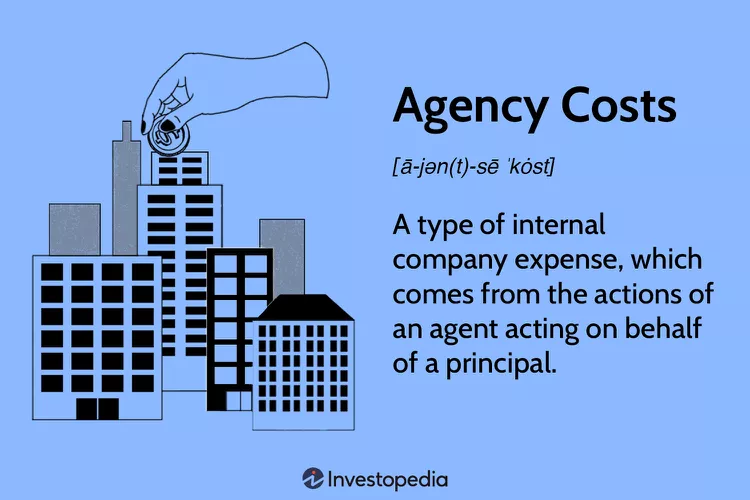
Examples include:
-
Performance-linked contracts
-
Professional liability insurance
-
Certification and training
-
Written promises and compliance procedures
-
Financial guarantees or security deposits
Bonding costs help build trust and reduce doubts between the parties.
3. Residual Loss
Even after monitoring and bonding efforts, some level of inefficiency or loss is unavoidable. This remaining loss due to imperfect alignment is known as residual loss.
Examples include:
-
Managers taking less profitable decisions to avoid risks
-
Missed business opportunities due to agent conservatism
-
Costs from delayed decisions
-
Reduced shareholder returns because of agent behaviour
Residual loss reflects the part of agency conflict that cannot be fully eliminated.
Included Fees Within Agency Costs
Agency costs are not limited to just monitoring or bonding. They include several types of direct and indirect fees. Some of the commonly included fees are:
1. Auditor Fees
Companies pay independent auditors to verify financial statements and ensure management is not hiding information.
2. Legal and Compliance Expenses
Hiring lawyers, implementing legal frameworks, filing mandatory regulatory documents—these are all part of agency costs.
3. Managerial Compensation
High salaries, bonuses, and incentives given to managers so they perform in shareholders’ interests are also included.
4. Board of Director Fees
Companies pay board members to supervise executives. This compensation is a major part of monitoring costs.
5. Consulting and Advisory Charges
External consultants help assess strategy, risk, or governance quality.
6. Cost of Performance Evaluation Systems
Tools like enterprise resource planning (ERP), project management dashboards, and reporting systems are often purchased to monitor management.
7. Insurance Costs
Professional liability insurance and guarantee bonds bought by agents are bonding costs.
8. Shareholder Activism Expenses
Shareholders may spend money to replace board members or influence company decisions.
Example of Agency Costs
To understand agency costs more clearly, consider this example:
Scenario
A large company, AlphaTech Ltd., is owned by thousands of shareholders. They hire a CEO, Mr. Kumar, to run the business and increase profits. However, Mr. Kumar has personal goals—he wants to increase his reputation, maintain a luxurious lifestyle, and gain job stability.
Read Also: The Race to 300 mph: Will Hennessey or Koenigsegg Break the Speed Record in 2025?
Agency Problems
-
Instead of focusing on long-term growth, the CEO invests heavily in marketing campaigns that make him look successful in the short term, even though these campaigns reduce long-term profits.
-
He approves expensive business trips and purchases a high-end office car for personal image enhancement.
-
He avoids taking bold decisions because failure could harm his reputation.
How Agency Costs Appear
To control the CEO’s behaviour, shareholders must incur various costs:
-
Auditing Expenses: Independent audits are conducted to verify if financial statements are accurate.
-
Board Supervision: The board holds frequent meetings, requiring director fees.
-
Performance-Based Pay: Shareholders design incentive structures so the CEO receives bonuses only when long-term profits rise.
-
Legal and Compliance Costs: New rules and controls are introduced to limit personal use of company resources.
After all this, some inefficiencies still remain—perhaps the CEO still avoids risky but profitable ventures. This remaining inefficiency is the residual loss.
Thus, all these expenses collectively make up the agency costs for AlphaTech Ltd.
How Companies Reduce Agency Costs
Businesses implement several strategies to minimize agency costs:
1. Stock-Based Compensation
Giving managers company shares aligns their personal gain with shareholder gain.
2. Better Corporate Governance
Strong boards, transparency rules, and ethical codes help limit misuse of power.
3. Regular Audits
Frequent audits discourage manipulation of information.
4. Clear Contracts
Well-structured contracts reduce misunderstandings and clarify expectations.
5. Incentive-Driven Compensation
Paying bonuses tied to long-term performance reduces short-term decision making.
6. Open Communication
Transparent communication channels reduce information asymmetry.
Conclusion
Agency costs are an unavoidable part of any principal-agent relationship. They arise when the goals of owners and managers differ, leading to expenses necessary for aligning interests, monitoring performance, and preventing misuse of authority. These costs include auditor fees, board compensation, legal expenses, performance incentives, and operational monitoring systems. Although companies use governance strategies to reduce these expenses, some residual loss always remains.
Understanding agency costs helps investors, entrepreneurs, and business managers make smarter decisions, design better contracts, and create more efficient organizational structures. In modern corporate environments, minimizing agency costs is not just a financial responsibility—it is a foundation for long-term success.
Watch Also: https://www.youtube.com/@TravelsofTheWorld24















Leave a Reply