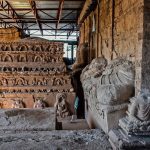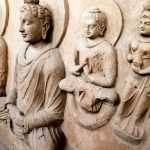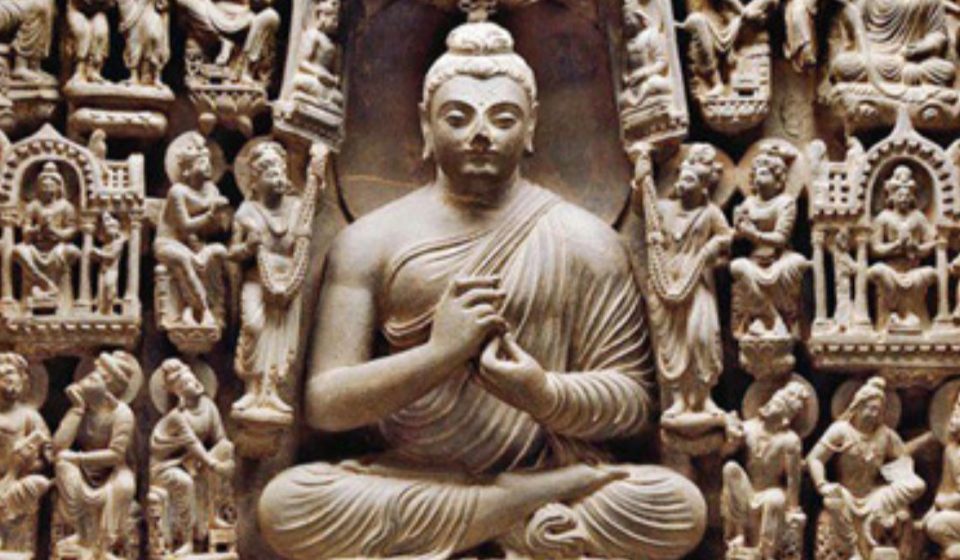

This photograph is unlike any other encountered in this series. There is no ancient ruin here, no museum case behind glass, no weathered hillside monument. Instead, two extraordinary Gandharan sculptures sit on the bare ground, freshly unwrapped, while a man in a pale green shirt carefully photographs them on his phone. This is a repatriation moment – the instant when stolen pieces of Gandhara’s broken artistic legacy, scattered for decades across foreign collections, finally return to the soil they were carved from.
A Statue’s Long Detour Through Canberra One particularly well-documented case captures exactly this kind of journey, and it likely connects to images like this one. An Australian family that had a 2,000-year-old Buddha statue in their possession for over five decades returned it to the government of Pakistan. Romy Dingle, who returned the artefact, obtained it through his father, who had served as a diplomat for Australia in Islamabad. His father once went on a road trip with his wife, who picked up the statue at a roadside stall, and that is how it ended up in Canberra.
Dingle returned the statue to the Pakistani High Commission along with two other objects. ” The statue dates back 1,900 years, originating from the northern region of Pakistan known as Gandhara. What’s striking about this particular account is how casually the original removal happened. The statue was brought to Australia by an artefacts collector during the 1970s, and as the report on the transaction notes, during that decade in Pakistan, when the object was carried out of the country, the paperwork required wasn’t particularly difficult to obtain.
A roadside stall, a diplomatic posting, an easy export process – and just like that, a sacred image carved nearly two thousand years ago, in a workshop somewhere in ancient Gandhara, spent the next fifty years sitting in an Australian living room. A Region Built for Looting Long Before It Was Built for Tourism To understand why so many Gandharan artifacts ended up scattered across private collections worldwide, you have to understand the specific vulnerability of the sites already explored throughout this series. The ancient region of Gandhara, Swat, and Taxila is thickly dotted with Buddhist archaeological sites dating from the 1st to the 5th century CE. These sites are situated in far-flung mountainous areas and are subject to clandestine excavations; cultural heritage artifacts recovered by antique hunters are then taken to international antique markets through illicit means.
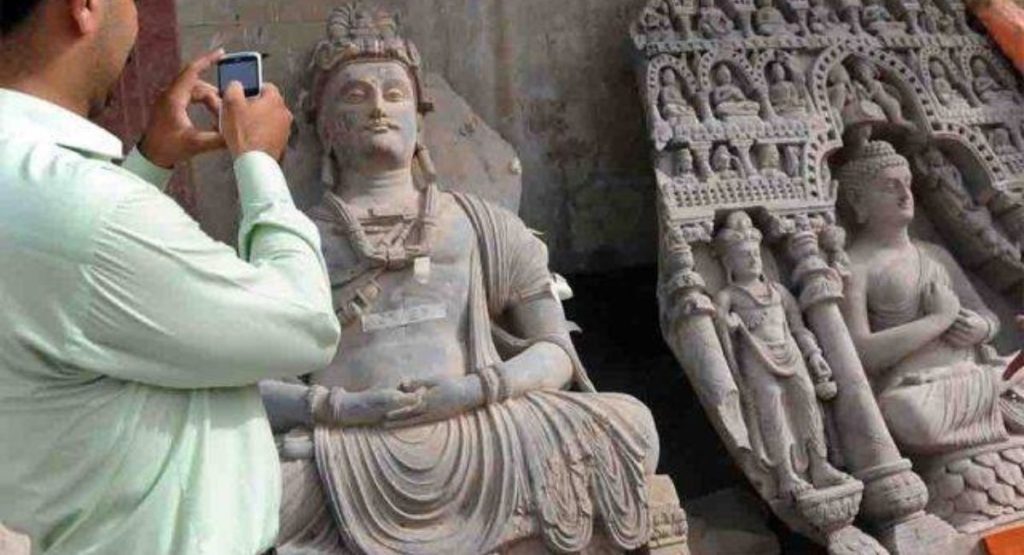
This is the dark underside of everything celebrated elsewhere in this series – the remote hilltop position of Jamal Garhi, the quiet isolation of Bhamala above the Haro River, the scattered, still partially unexcavated grid of Sirkap. The very qualities that made these sites spiritually appropriate for ancient monasteries – distance, remoteness, separation from bustling city life – also made them perilously easy for looters to plunder undetected, long after the monks who built them had vanished. A Trade That Runs Through Decades, Not Years The two sculptures pictured here – a seated, crowned Bodhisattva figure on the left, richly adorned with jewelry and an elaborate headdress, and a carved relief panel on the right depicting rows of seated Buddhas and Bodhisattva figures arranged in tiered niches – represent exactly the kind of high-value Gandharan material that has fueled an illicit trade running for half a century. According to Dr.
Mark Allon, Chair of the Department of Indian Subcontinent Studies at the University of Sydney, there has been a huge market for Gandharan art originating from the Afghanistan and Pakistan region ever since the British first documented the Buddhist heritage of that area. The scale of organized criminal activity behind this trade, once properly investigated, turned out to be staggering. Traffickers Zahid Parvez and Zeeshan Butt utilized their family businesses located across the world – Islamabad, Bangkok, Hong Kong, and Dubai – to supply the international art market with stolen antiques from countries including Afghanistan, Pakistan, and India. The Gandharan statues at the center of one major case were stolen from Pakistan and smuggled into New York County during the 1990s.
Read more at: https://www.discovernewsdaily24.com/taxila-museum-two-thousand-years-in-a-single-garden/
The Investigation That Cracked It Open What eventually unraveled decades of quiet smuggling was painstaking criminal investigative work, not archaeological detective work. A Department of Homeland Security investigation, combined with the work of an Indian-American art dealer’s case, exposed a conspiracy and theft that had gone on for over three decades before it was finally cracked, thousands of miles away from Pakistan, in the United States. 4 million, to Pakistan, following an investigation into Indian-American art dealer Subhash Kapoor and other criminal proceedings. ” The Kapoor case alone has yielded a remarkable cumulative total over time.
4 million were also repatriated, with some pieces displayed at the ceremony itself. Footprints, Dolls, and a Buddha Named Maitreya. Among the documented returns are objects spanning a remarkable range of Gandharan and earlier Pakistani heritage. Among the 192 items returned in one shipment were a Gandhara statue depicting Maitreya, an enlightened future Buddha, and Mehrgarh dolls between roughly 4,500 and 5,500 years old. Another especially significant single object made its own complicated journey home: the Buddhapada, or footprints of the Buddha, dating to the Kushan period, were stolen from an unknown archaeological site in the Gandhara region in the 1980s and smuggled to the US.
1 million, which now fills the central display space at the Islamabad Museum. That particular return came wrapped in considerable diplomatic ceremony and ongoing recognition. ” A Heritage That Was Sometimes Simply Destroyed Repatriation, painful and complicated as it often is, is at least a story with a hopeful ending – a stolen object eventually finding its way home. Not every chapter of Gandhara’s recent history has been so fortunate.
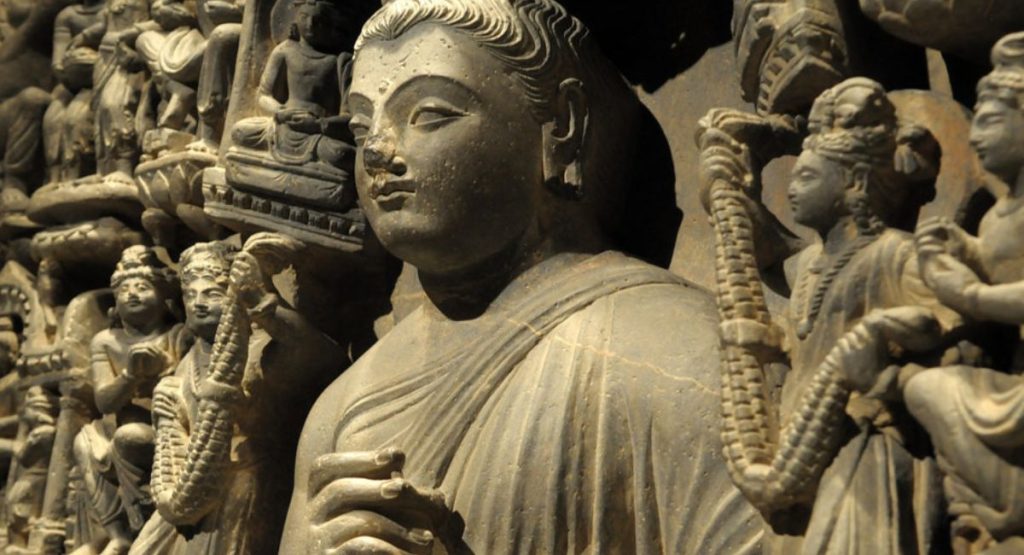
The Buddha of Swat, carved on a cliff in the seventh century in the Pakistani Swat valley – once the ancient Uddiyana Kingdom, one of the most significant centers of Gandhara civilization – was dynamited by the Pakistani Taliban in 2007. ” That particular monument has since been painstakingly restored and now stands as a deliberate symbol of resilience, but the episode is a sobering reminder of just how fragile this entire artistic inheritance has remained, even in living memory, even after surviving two thousand years of earthquakes, invasions, and slow burial. A Fitting Place to Pause This photograph, with its bare ground and unceremonious staging, captures something genuinely moving about the long arc of this entire series. We began at a standing Buddha quietly presiding over a modern Pakistani garden, moved through museum cases of severed heads and scattered hands, walked the staircases of Dharmarajika and the terraced courts of Jamal Garhi, and traveled as far as Sarnath’s votive stupa fields and Kushinagar’s golden reclining figure.
Every one of those sites survived because it stayed in the ground long enough for careful archaeologists to find it intact, or at least find its broken pieces close enough together to reconstruct. This photograph shows the other possible fate – the one where a sacred image is lifted out of context, sold, smuggled, displayed as decoration in a foreign home or gallery for decades, severed not just physically but legally and culturally from the soil and civilization that gave it meaning. The man crouched here, carefully photographing these returned pieces on his phone, is documenting something that every previous image in this series ultimately depends upon: the slow, ongoing, often quietly heroic work of bringing Gandhara’s scattered legacy back together, one rescued statue at a time.
See Also: https://www.youtube.com/watch?v=iyU4cZor_Gg