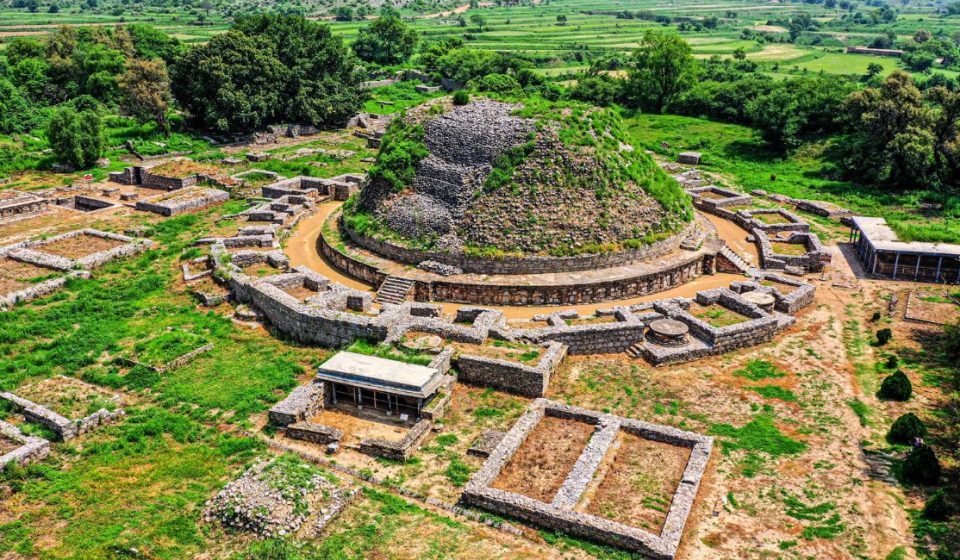

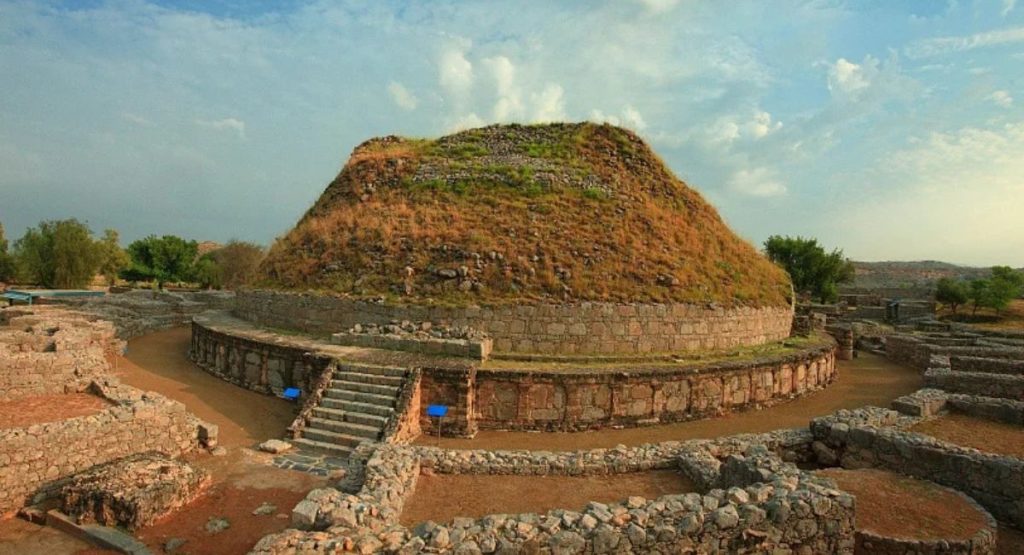
The Dharmarajika at Golden Hour – The Same Stupa, A Different Light. This photograph of the Dharmarajika Stupa presents an entirely different mood than the earlier image that began this series. Whereas the staircase had once been the imposing focal point in bright daylight with the raw rubble core of the mound directly above, like stone that simply couldn’t quite heal, now soft golden afternoon light washes the whole landscape. The stupa’s immense bulk seems to be swallowed by grass and scrub, with nature gently reconquering what archaeologists recently uncovered as naked stone. The monument, the place, the same one; the perspective and the feeling are radically different.
How We Recognise This Building This is unmistakably the Dharmarajika stupa we’ve just explored, and yet this angle allows us to perceive certain features that weren’t visible to us in the tight frame on the staircase with which we just concluded our work. It was known as the Chir Tope. The construction consists of a raised, circular terrace around a central monument. Small chapels encircled the central mound, whose base was a stepped terrace.
The staircase on the far side gave access to this terrace. In the photograph, we’re able to see on both the left and right sides that the rounded terrace walls curve away. Around its base are visible low walls-they are actually foundations, the circular outlines of small, individual chapels that once surrounded the stupa. Just as we had established earlier when examining the chapel found on the grounds of the shrine to Sirkap, as well as Jaulian’s impressive wall of Buddha images, these chapels once held single devotional sculptures of various sizes and poses, like this small chapelry along the terraced skirt.
Height/Diameter: The details of the structure are somewhat inconsistently reported due to the partially collapsed state, but the general numbers are clear. Some sources say its height was fourteen meters, and the diameter was thirty-five meters (which is what appears most frequently); another provides slightly larger dimensions of 15 meters high and 50 meters in diameter. Either way, it’s clear this was – is – the thing’s got mass; a truly gigantic grass-and-stone mound at its original creation, gleaming white on the valley floor before the passage of centuries. The Stupa’s anatomy underneath the Grass. What makes this view particularly interesting is that it reveals so much about the internal structure in a way that the close-up shot focusing on the staircase does not.
The circle which goes around the central stupa is used for pradakshina (processional walking around a holy monument). The largeanda (which can be loosely interpreted as a dome, although its overall shape is more that of a mound of rubble from our current perspective) has sustained damage, though the plinth which holds the anda up, its medhi, is fairly well intact. The anda is made of stone, whereas the harmika of the stupa, the railing which once topped off the mound, is completely missing. It’s amazing how knowing some of the archaeological terminology can turn what appears to simply be an overgrown heap of stone into a legibly organised place of ancient worship: the curved, dressed stone form on the lower, more or less circular level is the medhi plinth.
Read more at: https://www.discovernewsdaily24.com/taxila-museum-two-thousand-years-in-a-single-garden/
The grassy, rounded mound above is the damaged and; the space on the apex of the mound where there is only the sky above indicates the lost harmika, the small railing which, as the architects of Buddhist architecture explain, “stood on top of the mound with Buddha images on its sides, symbolically marking the central axis between the earth and sky”. Why Grass Matters As We Consider This Photo. There’s something profoundly telling in the simple observation that Dharmarajika is not covered, but living. You don’t have Buddhas protected behind bullet-proof glass in museum cases, or for that matter, have they built a protective steel-roof over the great wall of Jaulian’s Buddhas, only the vast Punjab sky for a ceiling; and yet the largest stupa of all in the region is afforded no such luxury. Dharmarajika is given no roof, no glass, no climate control, but, rather the endless interaction with living things and with nature, which has gone on here for two millennia and will presumably continue to go on.
 Why this grass shouldn’t in any way suggest neglect is due to the simple, practical facts of life. A large outdoor monument like this is never really preserved, but maintained. As I see it the grass acts like a protective covering on the heap; on the one hand, preventing soil erosion; binding the stones with roots, so to speak, just as when it was built, for they had to use rammed stone-and-earth fill. It becomes then just another layer in the protective cover which has always been there, with the exception perhaps of those centuries when it must have looked like stone.
It’s just another cover – like that offered by the great roof, which would have capped the stupa when it stood fully built in its heyday. A Quieter, More Landscape-like Reverence. One doesn’t even necessarily have to know what’s within this monument in this particular photograph. In this image of a grassy, grass-covered mound on an open afternoon field under a pale yellow sky, surrounded by a few scattered trees at its perimeter and what seem to be open, less frequently walked grass trails radiating away from it toward the distance – that, in itself, tells enough of the story. The monastery complex that once stood in association with this stupa, just a kilometre out of town in according to the Buddha’s directions-‘not too near’ or ‘too far’ from neighbouring settlements-could indeed be imaginably approached on a warm afternoon and spent in contemplative solitude.
With the knowledge now acquired in our exploration of this site and others, and especially with the awareness of the ancient, world-spanning presence of the Buddha’s bodily remains within the mound, it is possible now to see this entire grassy hillside not simply as the remains of some ancient monument but rather as a kind of living, slow, almost passive embodiment of sustained devotion, stretching back nearly two and a half thousand years, continuously evolving from the days it was built by a great emperor to commemorate an enlightened man to the way it now stands here, an ancient piece of ground settling again into a new form – now both hill and the historical and religious marker it originally represented to many peoples over many centuries.
See Also: https://www.youtube.com/watch?v=iyU4cZor_Gg