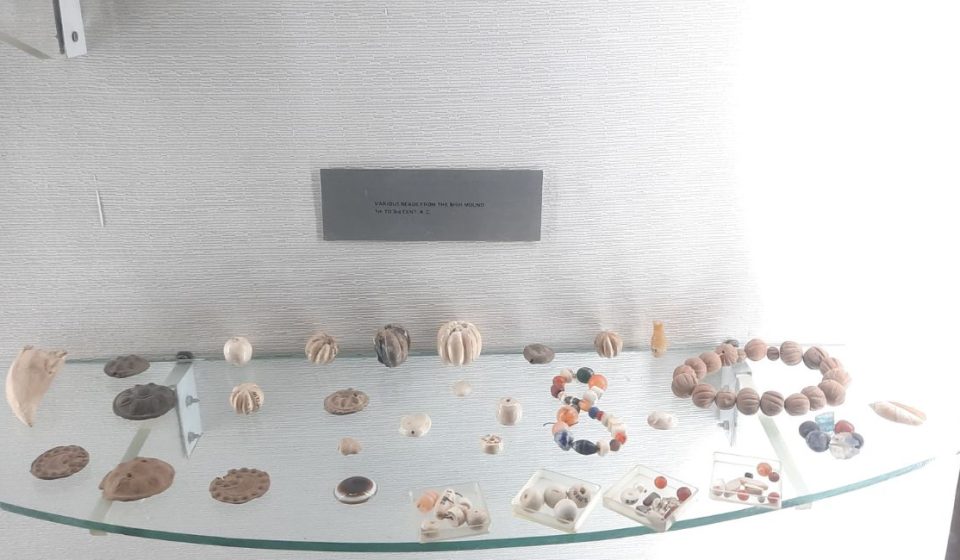

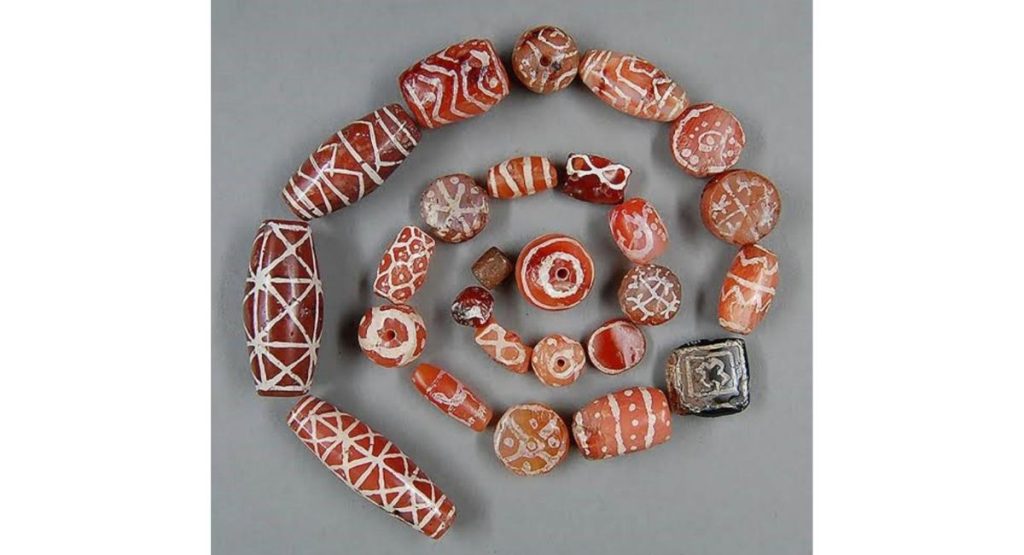
Toys, Tools, and Trade: The Texture of Everyday Life at Taxila. This case in the Taxila Museum is, in many ways, the most quietly democratic display encountered in this entire series. There are no Buddha statues, no relics, no famous archaeologists’ names attached to this shelf, only a small label reading “Etched Beads of Agate and Cornelian,” surrounded by a scattering of terracotta animal figurines, stone arrowheads, small carved tools, and dozens of multicolored beads sorted into little plastic trays. It is, on its surface, the least dramatic case in the museum. It may also be the one that tells us the most about what ordinary daily life in ancient Taxila actually felt like.
A Technique Older Than Taxila Itself The label’s specific mention of “etched” agate and cornelian beads points to a manufacturing technique with an extraordinarily long pedigree, one that predates the city of Taxila by well over two thousand years. Etched carnelian beads, sometimes called bleached carnelian beads, are a type of ancient decorative bead made from carnelian with an etched design in white, probably manufactured by the Indus Valley Civilization during the third millennium BCE. They were made according to a technique of alkaline etching developed by the Harappans, and vast quantities of these beads were found in archaeological sites of the Indus Valley civilization. The basic chemistry behind these designs has been reconstructed by modern conservators.
These beads are made from carnelian, a variety of quartz, and the white designs on their surface gave them the common name of etched carnelian beads. Early trade with Mesopotamia probably sparked their local production, and they then spread across the world, with archaeological examples found in places as distant as China, Iran, Iraq, Syria, Ukraine, and Russia. The traditional etching agent has been described in ethnographic studies as a sticky paste composed of a washing soda solution and a plant juice, most commonly from Capparis Aphylla, a bush growing in dry or arid areas of Africa, Iran, Pakistan, and India. That same Capparis bush, in other words, may still be growing somewhere in the hills surrounding Taxila today, its sap once central to a craft tradition stretching back to the world of Mohenjo-daro.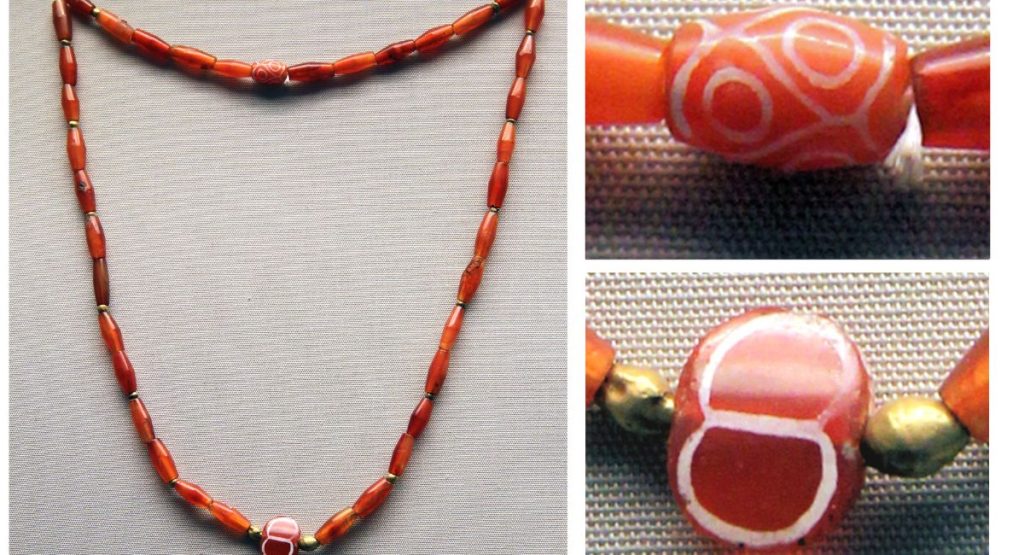
Taxila’s Own Place in the Story By the time these particular beads were being made, buried, and eventually excavated at Taxila, the technique had traveled and evolved for two millennia, but Taxila itself had become a significant production and trading hub in its own right. Bleach-decorated carnelian and black agate beads from domestic contexts at Taxila in Punjab and Barikot in Khyber Pakhtunkhwa are broadly dated between the 4th century BCE and the 1st century CE. Crucially, these beads weren’t confined to one part of the city; researchers studying the type have catalogued examples specifically from the different excavated zones already explored throughout this series: white-on-black agate beads from Taxila Bhir Mound and Taxila Sirkap, and white-on-red carnelian beads from the same two sites. The sheer quantity recovered gives some sense of how common these objects actually were in daily ancient life, rather than being rare luxury items reserved only for elites.
Read more at: https://www.discovernewsdaily24.com/rock-not-metal-the-true-state-of-the-antikythera-fragments/
Nine bleached beads were found at Sirkap, all but one from Saka and Parthian contexts of the 1st century BC and 1st century AD, and another sixteen were recovered from the Bhir Mound, where half came from a stratum dated to the 3rd century BC. Scholars studying the wider regional pattern have concluded that these beads were likely Kushan products, originating or traded from a city such as Taxila, meaning the very beads displayed in this case may represent objects that traveled outward from Taxila’s workshops to markets and households across a much wider swath of ancient Central and South Asia. Connecting Threads Across the Subcontinent. What this case ultimately documents is not an isolated local craft, but Taxila’s deep integration into trading and cultural networks stretching across the wider region. Morphological and technological features of the beads from Bhir Mound and Sirkap point to close similarities with examples from North India, indicating the introduction of stone bead traditions from North India during the late first millennium BCE and early first millennium CE.
Researchers studying this material argue that Taxila’s true significance lies precisely in this connective role: the strategic position and dynamic nature of the sites of Taxila connected not only with North India but also with different parts of South Asia and Central Asia. These beads, in other words, sit at exactly the same crossroads already explored throughout this entire series-the same crossroads that brought Greek sculptors and Buddhist monks together to invent the Gandharan Buddha image, the same crossroads that carried Hellenistic jewelry-making techniques into Sirkap’s silver workshops. Here, that crossroads expresses itself in small, brightly colored stones, worn perhaps as personal adornment, traded across vast distances, valued for their beauty long before, and long after, any Buddhist monastery rose on the surrounding hills.
 Beyond Beads:
A Glimpse of Ordinary Life The rest of the case, scattered loosely around the central bead trays, rounds out this picture of everyday ancient life with unusual intimacy. The small terracotta animal figurines-modeled into recognizable horse, bull, and ram-like forms-almost certainly served as children’s toys or votive offerings rather than formal religious icons, the kind of inexpensive, mass-produced object that rarely survives in good condition precisely because it was never treated as precious. The row of stone arrowheads laid out in careful sequence speaks to hunting or conflict, the practical, sometimes violent realities of life in a city that, as established in the earlier piece on Sirkap’s locks and keys, also had to worry constantly about security and defense. Even the beads themselves were sometimes connected to the most sacred contexts already explored in this series.
In addition to sacred bone relics, deposits at sites like Dharmarajika contained non-human items interpreted as donor offerings, including trade goods such as carnelian beads, agate, and rock crystal. The very same kind of etched bead displayed casually on this museum shelf may, in other contexts, have been deliberately placed inside a sacred reliquary alongside fragments of the Buddha’s own body, underscoring just how thin the line could be, in ancient Taxila, between an everyday personal ornament and a treasured devotional offering. A Case Without a Single Hero. Unlike the standing Buddha, the Dharmarajika stupa, or even the corroded keys of Sirkap, this case has no single dramatic centerpiece, no famous excavator’s name attached, no UNESCO plaque commemorating it. It is simply a quiet accumulation of small, ordinary things-beads a person might have worn around their neck on an unremarkable afternoon, a child’s toy animal left behind in the dust, an arrowhead lost or discarded centuries before any Greek sculptor ever carved a Buddha’s face.
And perhaps that is exactly its value:
After walking through stupas, monasteries, and museum cases full of broken religious imagery, this shelf offers something simpler and, in its own way, more moving, direct, unglamorous proof that real people, with real children and real daily routines, once filled the streets of this valley with ordinary life.\
See Also: https://www.youtube.com/watch?v=iyU4cZor_Gg