
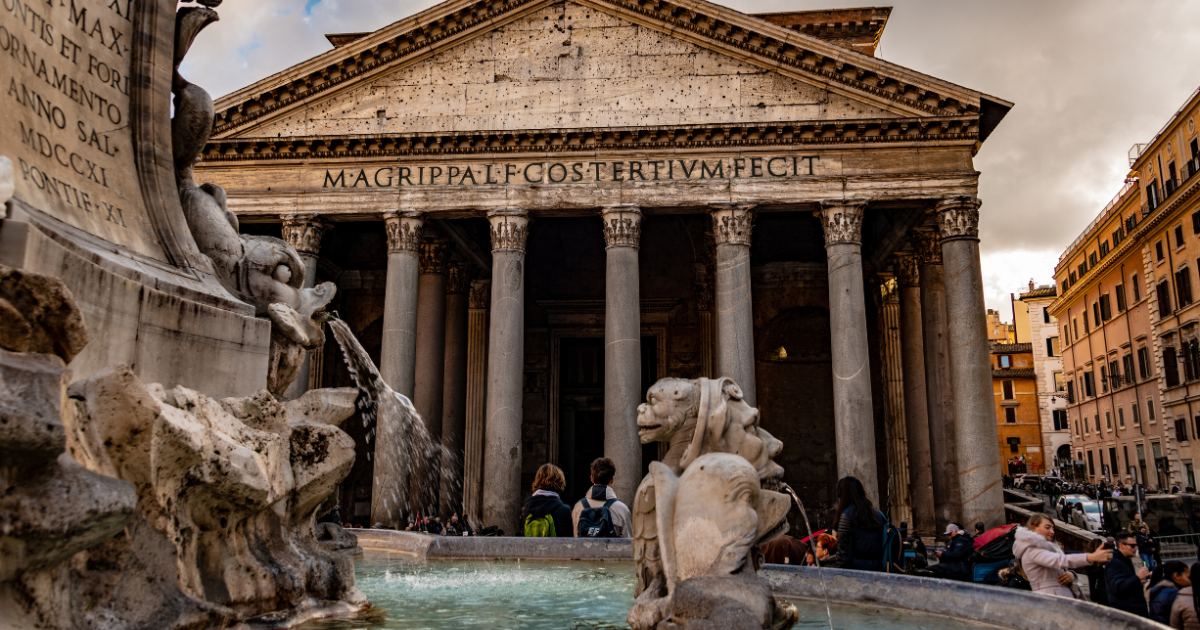
The Pantheon is one of the best-preserved ancient buildings in Rome and a masterpiece of Roman architecture. Originally built as a temple to honor all the Roman gods, it has stood for nearly 2,000 years, remarkable for its size, engineering, and beauty. Today, it functions as a church, a tourist attraction, and a symbol of the enduring genius of Roman architecture.
The Pantheon is located in the historic center of Rome, surrounded by piazzas, fountains, and cobblestone streets. Its massive dome, classical portico, and elegant design make it a central feature of the city’s skyline and a must-see for visitors.
Historical Background
The Pantheon we see today was rebuilt around 118–125 AD during the reign of Emperor Hadrian. It replaced an earlier structure built by Marcus Agrippa in 27 BC, whose name is still inscribed on the front: “M. AGRIPPA L. F. COS TERTIUM FECIT” (“Marcus Agrippa, son of Lucius, made [this building] when consul for the third time”).
The building was designed as a temple to honor all the gods of ancient Rome, reflecting the religious and political significance of the time. Its innovative design and structural engineering have made it a model for architects throughout history.
Architecture and Design
The Pantheon is famous for its large portico with massive Corinthian columns made of Egyptian granite. The entrance leads to a circular rotunda topped by a massive dome, which remains the largest unreinforced concrete dome in the world.
The dome’s diameter and height are both about 43.3 meters (142 feet), creating a perfect hemisphere. At the center of the dome is an oculus, a circular opening that lets natural light into the interior and symbolizes a connection to the heavens. Rain that falls through the oculus drains through a slightly sloped floor and hidden channels.
The walls of the Pantheon are made of concrete and brick, with thickness tapering toward the top to reduce weight. Coffered panels on the interior of the dome reduce weight while creating a visually striking pattern.
Interior and Decoration
Inside, the Pantheon features a circular open space surrounded by niches that once held statues of Roman gods. Today, it contains Christian altars, tombs of kings and artists, including Raphael, and other historical figures.
The floor is made of marble with geometric patterns, and the interior walls are richly decorated with marble and stucco. The combination of natural light from the oculus and the decorative elements creates a sense of awe and harmony.
The Pantheon’s design emphasizes proportion, symmetry, and balance. The open space under the dome, uninterrupted by supporting columns in the center, demonstrates the advanced engineering of ancient Rome.
Engineering Marvel
The Pantheon’s dome is an engineering marvel, built using layers of concrete with varying density. Lighter materials like pumice were used at the top to reduce weight. The coffered design not only lightens the structure but also adds a decorative effect.
The oculus serves both as a light source and a structural element, reducing weight at the center of the dome. The building has survived earthquakes, centuries of weather, and changes in use, proving the skill of Roman engineers.
Religious Significance
Originally a pagan temple, the Pantheon was converted into a Christian church in 609 AD by Pope Boniface IV, dedicated to St. Mary and the Martyrs. This conversion helped preserve the building through the centuries, as it remained in active use.
Today, it is an active church with religious services and celebrations, particularly on Christian feast days. The Pantheon’s continued use as a religious space bridges ancient and modern traditions, maintaining its spiritual and cultural relevance.
Cultural and Historical Impact
The Pantheon has influenced architecture for centuries. Its dome inspired buildings such as the United States Capitol, St. Peter’s Basilica, and countless churches, museums, and government buildings worldwide.
Artists, architects, and engineers have studied the Pantheon to understand Roman techniques, proportion, and structural innovation. Its preservation allows people to experience a direct connection to the ancient world.
Visiting the Pantheon
Visitors to the Pantheon can enter freely and explore the rotunda, see the tombs, and admire the dome and oculus. Its central location makes it easy to combine with other Roman landmarks such as Piazza Navona and the Trevi Fountain.
The Pantheon is a place to appreciate history, architecture, and art. Walking inside, visitors can feel the scale of ancient Rome and the ingenuity that allowed such a building to endure through millennia.
Preservation
Over the centuries, the Pantheon has been restored and maintained to preserve its structure and beauty. Conservation work focuses on protecting the dome, marble, and decorative elements while maintaining the historical integrity of the building.
Its status as a cultural and religious landmark ensures ongoing attention and care, allowing future generations to experience its grandeur.
Final Thoughts
Pantheon is a testament to the skill, vision, and artistry of ancient Roman architects and engineers. Its harmonious design, massive dome, and historic significance make it one of the greatest architectural achievements in history.
From its origins as a temple to Roman gods to its current role as a Christian church and tourist attraction, the Pantheon has remained a living symbol of Rome’s enduring legacy. Its influence on architecture and its cultural importance continue to inspire people around the world.
Read Also: Keep your face towards the sunshine and shadows will fall behind you
Watch Also: https://www.youtube.com/@TravelsofTheWorld24









Leave a Reply