
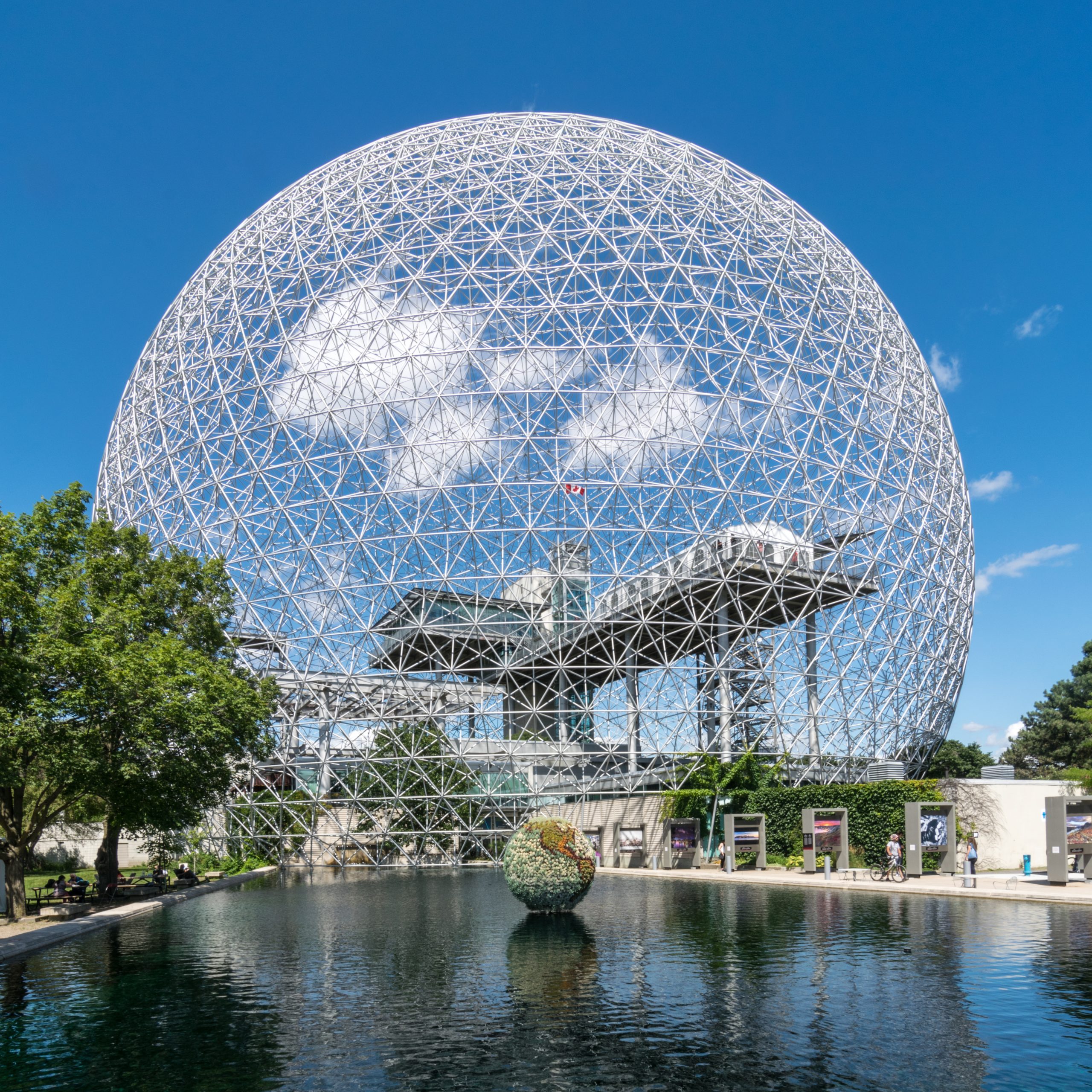
The Montreal Biosphère is one of the most unusual and eye-catching buildings in Canada. It looks like a giant silver globe made of a delicate metal web, rising above the trees and water. From far away, it almost feels like something from the future. But this structure is not just beautiful — it tells an important story about nature, science, and how humans live on Earth.
The Biosphère stands in the city of Montreal, on a peaceful island in the middle of the Saint Lawrence River. Today it works as an environmental museum where visitors learn about climate, water, wildlife, and the planet. But its story began long before it became a museum.
Built for a World Event
The structure was originally created for Expo 67, a huge international exhibition that celebrated innovation, culture, and the future. Countries from all over the world built pavilions to show their ideas and achievements.
The Biosphère served as the pavilion for the United States. It was designed by the famous architect and inventor Buckminster Fuller, who was known for his bold and visionary thinking. Fuller believed architecture should be efficient, light, and in harmony with nature.
Instead of building a heavy concrete structure, he designed a geodesic dome — a sphere made from many small triangular pieces. This shape is extremely strong but uses very little material. It spreads weight evenly, making the structure stable and lightweight at the same time.
When it opened in 1967, visitors were amazed. The dome looked futuristic, elegant, and completely different from traditional buildings.
A Perfect Balance of Strength and Lightness
One of the most fascinating things about the Biosphère is how little material it uses compared to its size. The metal frame creates a huge enclosed space while remaining almost transparent.
Sunlight passes through the structure, wind flows around it, and the sky is always visible behind it. This makes the dome feel connected to nature rather than separated from it.
The design follows a simple idea: do more with less.
Fuller believed that good design should save resources while still being useful and beautiful. His dome became one of the most famous examples of this philosophy.
A Fire That Changed Everything
For many years after Expo 67, the structure remained mostly unused. Then, in 1976, a major fire broke out during renovation work. The outer plastic covering of the dome burned away, leaving only the metal skeleton.
Surprisingly, the steel frame survived. Even after intense heat, the structure stayed standing. This showed just how strong the geodesic design really was.
After the fire, the dome remained open to the air. Instead of rebuilding the original covering, the city eventually decided to transform the structure into something new.
Reborn as an Environmental Museum
In the 1990s, the government of Canada turned the dome into a museum focused on environmental issues. It reopened as the Montreal Biosphère, dedicated to teaching people about the Earth and how to protect it.
Today the museum is operated by Environment and Climate Change Canada. Its goal is to help visitors understand the challenges facing our planet and inspire them to take action.
Inside the dome, you will not find traditional art galleries or historical displays. Instead, there are interactive exhibitions about nature, science, and sustainability.
Location in a Beautiful Natural Setting
The Biosphère stands on Île Sainte-Hélène, a green island park that offers walking paths, gardens, and views of the river. This peaceful setting makes the experience even more special.
Visitors often spend time outside the building as well as inside. The open space around the dome allows people to see it from many angles. Reflections in the water, changing weather, and shifting light make the structure look different throughout the day.
In winter, snow turns the dome into a sparkling white sculpture. In summer, it contrasts beautifully with green trees and blue skies.
Learning Through Interactive Exhibits
Inside the Biosphère, the focus is on education through experience. Exhibits are designed to be engaging and easy to understand for visitors of all ages.
Topics usually include:
-
Climate change
-
Air quality
-
Water systems
-
Biodiversity
-
Renewable energy
-
Human impact on nature
Many displays are interactive. Visitors can touch models, watch simulations, and explore multimedia presentations. This hands-on approach makes complex environmental topics feel more real and personal.
Children especially enjoy the museum because it feels more like exploration than school learning.
The Dome as a Climate Teacher
Interestingly, the building itself teaches lessons about climate. Because the dome is mostly open, it reacts to weather conditions. Sun, wind, rain, and temperature changes all affect the interior environment.
Architects added shading systems and ventilation features to control heat and light. This demonstrates how buildings can adapt to natural forces instead of fighting against them.
The Biosphère shows that architecture can work with nature rather than dominate it.
A Symbol of Environmental Awareness
Over time, the dome has become a symbol of environmental responsibility in Canada. Its transformation from a temporary exhibition pavilion into a sustainability museum reflects changing global priorities.
In the 1960s, the focus was on technological progress and futuristic design. Today, the emphasis is on protecting the planet and living sustainably.
The same structure now represents both ideas — human creativity and environmental care.
Why the Shape Matters
The spherical form is not just visually striking; it also has practical advantages.
A sphere encloses the largest volume using the least surface area. This means it requires less material and loses less heat compared to other shapes. The triangular pattern distributes stress evenly, making the structure extremely strong.
These qualities make geodesic domes useful for many purposes, including:
-
Greenhouses
-
Emergency shelters
-
Sports arenas
-
Exhibition halls
-
Research stations
Fuller hoped such structures could help solve housing shortages around the world.
Nighttime Beauty
At night, the Biosphère becomes even more magical. Lighting installed around the structure makes the metal grid glow softly against the dark sky.
Sometimes colored lights are used for special events, turning the dome into a luminous landmark visible from far away. Reflections on the water create a double image that feels almost dreamlike.
Photographers and visitors often come in the evening just to enjoy this view.
A Popular Tourist Attraction
Today the Biosphère is one of Montreal’s most recognizable landmarks. Tourists visit not only for the museum but also for the architecture and scenic surroundings.
People often combine a trip to the dome with cycling, picnicking, or exploring the island park. The relaxed atmosphere makes it a great escape from busy city streets.
For architecture lovers, it is a must-see example of innovative design from the 20th century.
Influence on Modern Design
The Biosphère has inspired generations of architects and engineers. Its efficient structure and futuristic appearance helped popularize geodesic domes worldwide.
Even today, many modern sustainable buildings use ideas first explored by Fuller. Lightweight materials, energy efficiency, and harmony with nature remain central themes in contemporary architecture.
The dome shows that visionary ideas from decades ago can still feel fresh and relevant.
A Bridge Between Past and Future
What makes the Montreal Biosphère truly special is how it connects different eras. It began as a symbol of futuristic optimism in the 1960s, survived disaster, and was reborn as a center for environmental education.
Few buildings have such a dramatic life story.
Standing beneath the dome, visitors experience both history and hope — a reminder of what humans can create and what we must protect.
Final Thoughts
The Montreal Biosphère is far more than a striking piece of architecture. It is a living symbol of innovation, resilience, and environmental awareness.
Its airy structure shows how design can be strong without being heavy. Its transformation into a museum shows how old buildings can gain new purpose. And its message encourages people to think about their relationship with the Earth.
Whether you visit for the science exhibits, the beautiful setting, or the incredible design, the experience leaves a lasting impression. The dome quietly reminds us that our planet is also a kind of biosphere — a delicate system that supports life and needs care.
In a world facing environmental challenges, this shimmering sphere stands as both a warning and a source of inspiration. It proves that creativity and responsibility can exist together, shaping a future that is not only advanced but also sustainable.
Read Also: Keep your face towards the sunshine and shadows will fall behind you
Watch Also: https://www.youtube.com/@TravelsofTheWorld24






Leave a Reply