
Islamic tradition says the Kaaba was first built by Prophet Ibrahim (Abraham) and his son Ismail (Ishmael) as a house dedicated to the worship of one God. Over the centuries, it became central to Arabian religious life.
Before Islam, the Kaaba held idols representing the gods of different tribes. When Prophet Muhammad established Islam in the 7th century, he removed these idols and restored the Kaaba as a place of worship for one God. Since then, it has remained the most sacred site in Islam.
The building has been renovated several times over the centuries due to floods, fire, and wear, but it has always kept its central spiritual significance.
Location and Structure
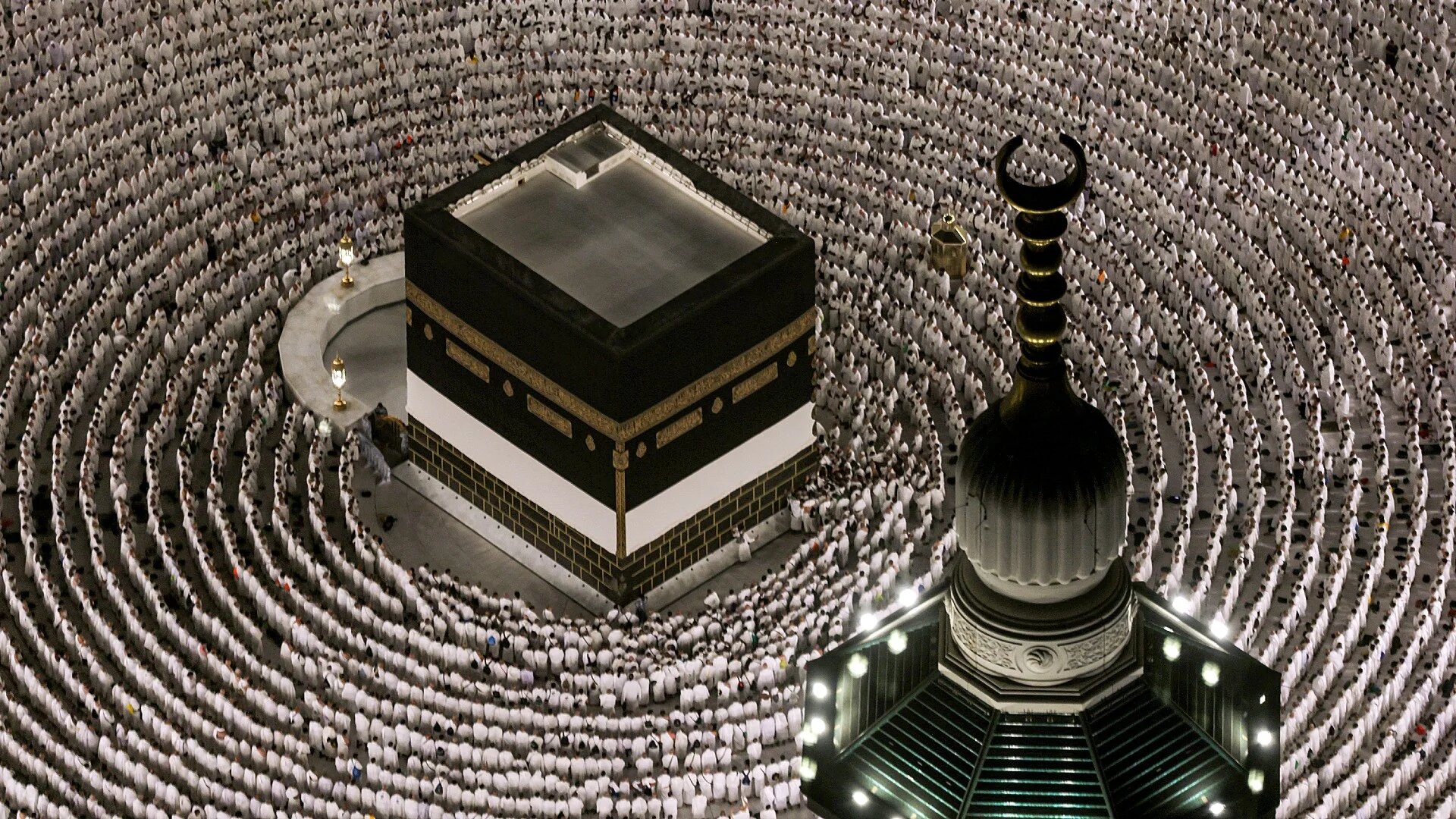
The Kaaba sits in the middle of Masjid al-Haram, surrounded by wide courtyards for pilgrims. It is cube-shaped, about 13 meters high, with sides roughly 12 by 10 meters.
The Black Stone (Hajar al-Aswad)
One of the most important features of the Kaaba is the Black Stone, set into its eastern corner. Pilgrims try to touch or kiss it during Hajj or Umrah as an act of devotion. Islamic tradition says the stone came from heaven. Touching or kissing it is not mandatory but is considered a blessed act.
The Kiswah
The Kaaba is covered with a black silk cloth called the Kiswah, embroidered with gold Quranic verses. This cloth is replaced every year during the Hajj season. Its golden calligraphy stands out against the black fabric, making the Kaaba visually striking and spiritually significant.
The Door and Corners
The Kaaba has a golden door on the northeast side. Its four corners are roughly aligned with the cardinal directions. The northwest corner holds the Black Stone. The interior of the Kaaba is empty except for a few lamps and a small staircase.
Religious Significance
The Kaaba is central to many aspects of Islamic life:
-
Qibla (Direction of Prayer): All Muslims face the Kaaba for daily prayers, no matter where they are in the world.
-
Hajj Pilgrimage: Millions of Muslims visit Mecca every year for Hajj, performing rituals around the Kaaba, including Tawaf, the act of walking seven times around it.
-
Umrah: Muslims can perform Umrah, a smaller pilgrimage, at any time of the year, which also involves Tawaf around the Kaaba.
The Kaaba represents unity. Every Muslim, regardless of nationality, language, or background, prays in the same direction, showing equality and devotion to God.
Life Around the Kaaba
The area around the Kaaba becomes crowded, especially during Hajj. Pilgrims wear simple white garments called Ihram, emphasizing equality and humility. The rituals around the Kaaba include:
-
Walking seven times around it (Tawaf)
-
Touching or pointing toward the Black Stone
-
Praying in the open courtyards
The mosque surrounding the Kaaba, Masjid al-Haram, can accommodate millions of people. Its design allows pilgrims to move safely despite huge crowds.
Architectural Features
Though it looks simple, the Kaaba’s design is symbolic:
-
Cube Shape: Represents stability and unity.
-
Stone Walls: Made of granite from nearby hills.
-
Corners and Alignment: Aligned with the cardinal directions, emphasizing precision and order.
Its simplicity is part of its beauty and spiritual significance.
Preservation and Renovation
The Kaaba has been maintained carefully for centuries. Floods and natural wear sometimes damaged it, but Muslim leaders always restored it. Modern engineering ensures safety for millions of pilgrims visiting each year.
The Kiswah is replaced annually, and renovation work preserves both the structure and its spiritual significance.
Cultural and Global Influence
The Kaaba has influenced Islamic culture worldwide. It appears in mosques, artwork, coins, and flags across Muslim countries. It is also a symbol of faith for over a billion Muslims, representing devotion, unity, and history.
Visiting the Kaaba is considered a spiritual journey. Pilgrims feel connected to centuries of history, prophets, and fellow believers from around the world.
Interesting Facts
-
The Kaaba is covered by a black silk Kiswah with gold embroidery.
-
Pilgrims walk seven times around it during Hajj and Umrah.
-
The Black Stone is believed to have come from heaven.
-
It is the Qibla — direction of Muslim prayer worldwide.
-
Millions visit every year, especially during Hajj.
-
The Kaaba has been renovated multiple times but kept its original significance.
-
Pilgrims wear simple white garments called Ihram to emphasize equality.
The Kaaba Today
The Kaaba continues to be the spiritual center of Islam. Pilgrims from all over the world come to Mecca to pray, perform Tawaf, and experience the connection to God.
Even though it is a small building, its significance is immense. People stand before it in awe, reflecting on faith, history, and unity.
Symbol of Faith and Unity
The Kaaba is a powerful symbol of the oneness of God and the unity of Muslims worldwide. Every prayer, every pilgrimage, and every act of devotion around it strengthens the sense of shared faith.
Its simple shape, ancient history, and spiritual meaning make it the most revered site in the Islamic world.
Conclusion
The Kaaba in Mecca is more than a building. It is the heart of Islamic worship, a symbol of unity, and a connection to centuries of faith.
Standing before it, millions of Muslims experience a deep sense of devotion. Its simplicity, history, and spiritual significance make it one of the most important and visited religious landmarks in the world.
The Kaaba reminds believers of their shared faith, their devotion to God, and the importance of tradition and unity across time and space. It is a place where history, religion, and spirituality meet, creating a sacred center for the Muslim world.
Read Also:Reykjavik’s Harpa: A Landmark of Design and Performance
Watch Also:www.youtube.com/@bollywoodshorts2124



Leave a Reply