
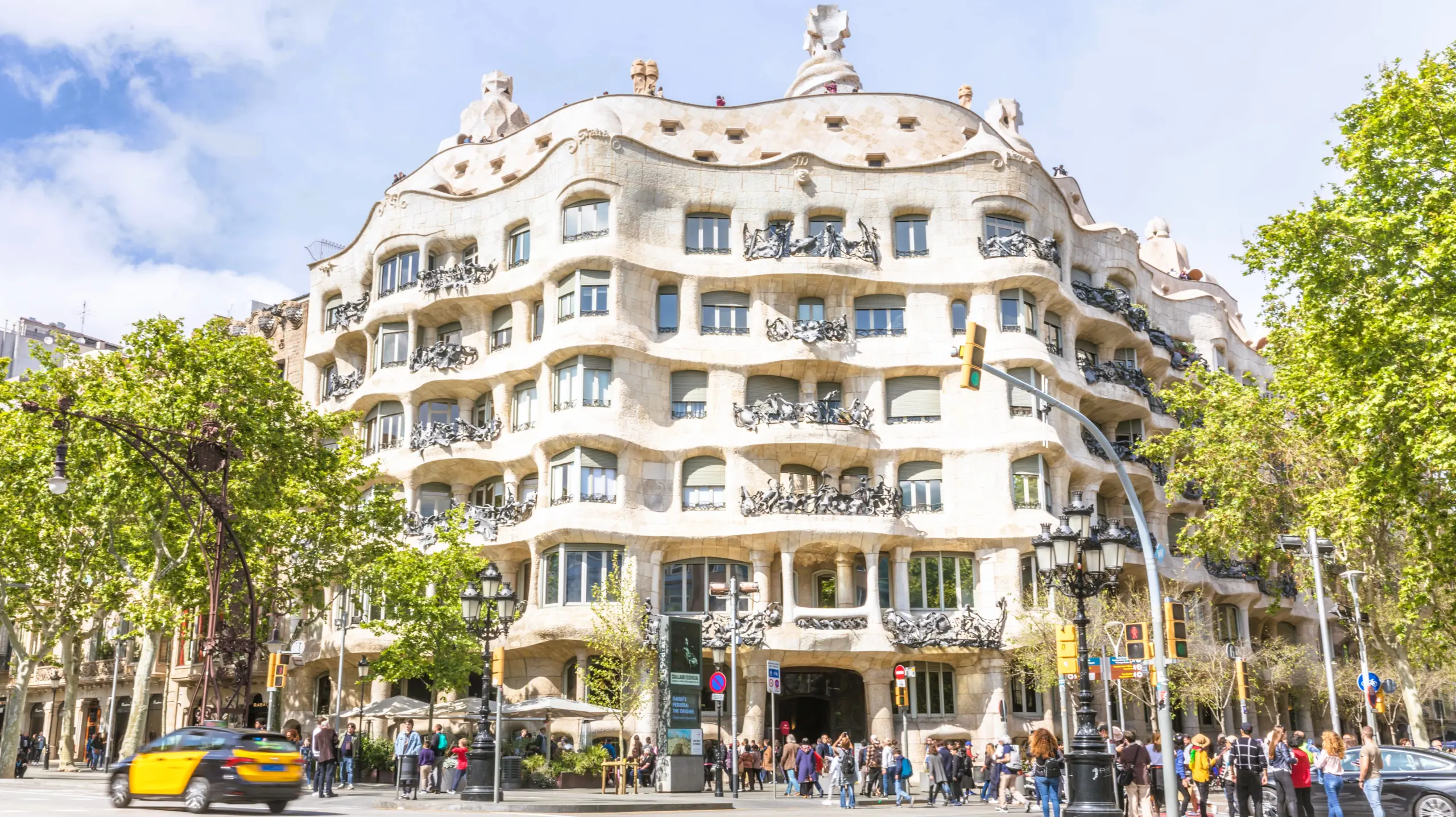
Imagine walking through the colorful streets of Barcelona and suddenly seeing a building that looks like it was carved by the sea or shaped by waves. Its walls are curvy, like flowing cloth or wind‑tossed sand. There are no sharp corners at the front, and the balconies look like iron art growing out of the walls. This building is so unusual that many people stop and stare when they first see it.
This is La Pedrera, one of the most famous buildings in Spain and one of the greatest works by the architect Antoni Gaudí. Its official name is Casa Milà, but most people call it La Pedrera, which means “The Stone Quarry” in Spanish. The name comes from how rough and natural the stone walls look — as if they were pulled straight from nature.
In this long write‑up, I’ll take you through what La Pedrera is, its history, who built it, what makes it special, what you can see inside, why people love it, and what it means to the city of Barcelona — all in very simple, friendly words.
Where Is La Pedrera?
La Pedrera stands on a wide street called Passeig de Gràcia in Barcelona, Spain. Passeig de Gràcia is one of the most beautiful and important avenues in the city. It has shops, cafes, hotels, and many interesting buildings. But La Pedrera stands out more than almost anything around it because of its unique shape.
Barcelona itself is a lively, colorful city beside the Mediterranean Sea. It’s warm in summer, bright in winter, and filled with art, music, history, and food. Many people visit Barcelona to see the works of Gaudí, and La Pedrera is one of the top attractions.
Who Was Antoni Gaudí?
Before we talk more about the building, let’s meet the man who designed it.
Antoni Gaudí was a Spanish architect who lived in the late 1800s and early 1900s. He didn’t design buildings like most architects. Instead of straight, regular lines, he loved curves inspired by nature — waves, bones, trees, and plants. Gaudí believed that nature was the best teacher, and he tried to use shapes and forms from the natural world in his work.
Some of Gaudí’s buildings look like they belong in a dream or a fairy tale. Most people describe his work as organic, meaning it looks alive or flowing, not rigid or artificial.
La Pedrera is one of his greatest creations, and it shows his imagination at its strongest.
When and Why Was La Pedrera Built?
La Pedrera was built in the early 1900s — between 1906 and 1912. A wealthy couple named Roser Segimon and Pere Milà hired Gaudí to design their new home. At that time, many rich families in Barcelona were building grand homes, but they wanted something different, something unique.
Gaudí took the project, and instead of giving them a normal building, he gave them something extraordinary.
The family did not live in the entire building alone. The idea was to make a large house with several apartments, so parts of it could be rented out. So La Pedrera is both a private home and a place where many people could live or work.
What Makes La Pedrera Special?
La Pedrera is special for many reasons — and even ordinary words feel a bit too small to describe it. But let’s break it down:
1. The Curvy Stone Walls
The front of the building looks like waves on the sea. Instead of flat walls with right angles, Gaudí used smooth, flowing curves that make the whole façade look alive. It feels like the stone is moving, breathing, or shifting in the wind.
That’s why people said it looked like a quarry, or a rock formation found in nature — and that is how it got the name La Pedrera.
2. Iron Balconies That Look Like Art
The balconies on the building are not standard metal railings. They are like sculptures — twisting and turning shapes that look almost like seaweed or vines. Each balcony is different, and they were handmade by local ironworkers following Gaudí’s wild imagination.
3. No Straight Lines — Almost Anywhere
Inside and outside, there are very few straight lines. Most walls, ceilings, and floors have curves. The windows are not rectangular in the usual sense. The rooms feel flowing and organic. It’s almost like walking inside a sculpture rather than a normal building.
4. A Rooftop That Feels Like Another World
The roof terrace of La Pedrera is one of the most magical parts. Instead of being flat, it has chimneys and ventilation towers that look like sculptures. Some look like warriors with helmets, others like abstract shapes that seem alive.
From the rooftop, you can see wide views of Barcelona, and many people say it feels like being on another planet.
5. Light and Air Everywhere
Gaudí believed that natural light and fresh air were important. So he designed interior patios (open spaces inside the building) that bring light to all parts of the house. Even apartments in the middle get sunshine and breeze.
What Can You See Inside La Pedrera?
Today, La Pedrera is open to visitors, and there are several things you can explore:
The Courtyards
When you enter La Pedrera, you see tall courtyards inside the building. These are open spaces that let sunshine reach all floors. The walls inside the courtyards are curved too — they are not plain like most buildings. Walking inside feels warm and welcoming.
The Apartments
Some of the apartments are restored to show how people lived a long time ago. You see furniture, decorations, and rooms arranged as families might have used them in the early 1900s. This gives you a sense of life back then.
The Roof Terrace
As mentioned, the rooftop is one of the most famous parts. People walk around among the chimneys and towers, taking photos and enjoying the views. The shapes on the roof are so strange and beautiful that many art lovers spend a long time just looking at them.
The Espai Gaudí (Gaudí Space)
This is a special area that shows how Gaudí worked. You can see models, drawings, and explanations of his ideas. It’s very interesting because Gaudí often designed buildings using models and nature‑inspired shapes instead of traditional plans on paper.
Why Do People Love La Pedrera?
La Pedrera is more than just a building. People love it because:
-
It feels alive. The curves make it feel like a living thing, not just stone and metal.
-
It’s creative. Gaudí didn’t follow rules — he made his own.
-
It surprises you. Every time you look at a wall or balcony, you find something new.
-
It connects art and life. It is a home but also a piece of art that people admire from all over the world.
Many visitors say that La Pedrera feels like a place from a dream — not ordinary at all, but beautiful and inspiring.
The Architecture and the Natural World
One of the reasons La Pedrera feels so unique is because Gaudí was inspired by nature. He believed that nature’s forms were perfect and that architecture should learn from nature’s curves and lines. That’s why the walls look like waves, the windows are round, and the roof shapes are so organic.
Gaudí often studied bones, plants, seashells, and landscapes to understand how curves work in real life. Then he used that knowledge to design buildings that feel natural even though they are made by human hands.
This approach was new and unusual at the time — and even today, many architects find it inspiring.
History: A Building Through Time
Let’s look at the timeline of La Pedrera:
1906–1912 — Construction
Work began in 1906, and despite difficulties, the building was completed in 1912. During this time, Gaudí worked closely with artisans — stone carvers, ironworkers, painters, and builders — to bring his idea to life.
After Completion
After 1912, families and tenants lived in the apartments. It was not just a museum — it was a real home and place of business.
Mid‑1900s — Historic Recognition
As decades passed, people began to realize how special La Pedrera was. By the mid‑1900s, many considered it a masterpiece of modern architecture.
1984 — World Heritage Site
In 1984, UNESCO named La Pedrera a World Heritage Site. That means it is recognized around the world as a place of great cultural and artistic value. UNESCO protects such places so future generations can enjoy and learn from them.
Today
Today, La Pedrera is fully open to visitors, with exhibitions, tours, and events. Many people come to see it every year — tourists, architects, students, and anyone who loves art and beauty.
Fun Facts About La Pedrera
Here are some interesting things you might enjoy:
-
No Straight Lines: Gaudí used very few straight lines, believing nature did not use them either.
-
Organic Inspiration: Many shapes are inspired by waves, plants, and bone structures.
-
Electricity was New: When it was built, electricity was new in Barcelona. Gaudí integrated it in smart ways.
-
Roof Sculptures: The rooftop chimneys are famous and often photographed.
-
Later Restorations: Some parts of the building have been restored carefully to keep the original style.
Visiting La Pedrera Today
If you travel to Barcelona, La Pedrera is one of the top places to visit. Here’s what visitors often do:
Day Tour
You walk through the entrance, explore the courtyards, visit the apartments, and climb to the rooftop. Guides explain the history and important details.
Night Visits
La Pedrera sometimes offers night tours with music and lights that make the building feel even more magical.
Temporary Exhibitions
Inside, there are rooms for special art or design exhibitions that change over time.
Audio Guides
Most visitors use audio guides in different languages, so you can understand the stories as you walk through the building.
Why La Pedrera Matters
La Pedrera is not just a beautiful building. It matters because:
-
It shows how architecture can be art.
-
It connects nature and human creativity.
-
It inspires artists and builders around the world.
-
It represents a unique moment in history when one person dreamed differently.
-
It brings visitors from all cultures to learn and appreciate something rare.
In a world where many buildings look similar, La Pedrera stands out as a reminder that beauty can change how we see life and space.
Summary: Why La Pedrera Is Amazing
Let’s finish with a simple recap:
-
La Pedrera is one of the most unique buildings in the world.
-
It was designed by Antoni Gaudí and built between 1906 and 1912.
-
Its natural curves, iron balconies, and rooftop sculptures make it unlike any other building.
-
Inside, light, space, and organic forms create a feeling of wonder.
-
It became a World Heritage Site and a symbol of creativity.
-
People love it for its beauty, uniqueness, and connection to nature.
When you stand in front of La Pedrera for the first time, it feels like you are seeing something alive — something that shifts and moves with the light. That is why millions of people come from all over the world to see it and share its story.
Read Also:Reykjavik’s Harpa: A Landmark of Design and Performance
Watch Also:www.youtube.com/@bollywoodshorts2124






Leave a Reply