
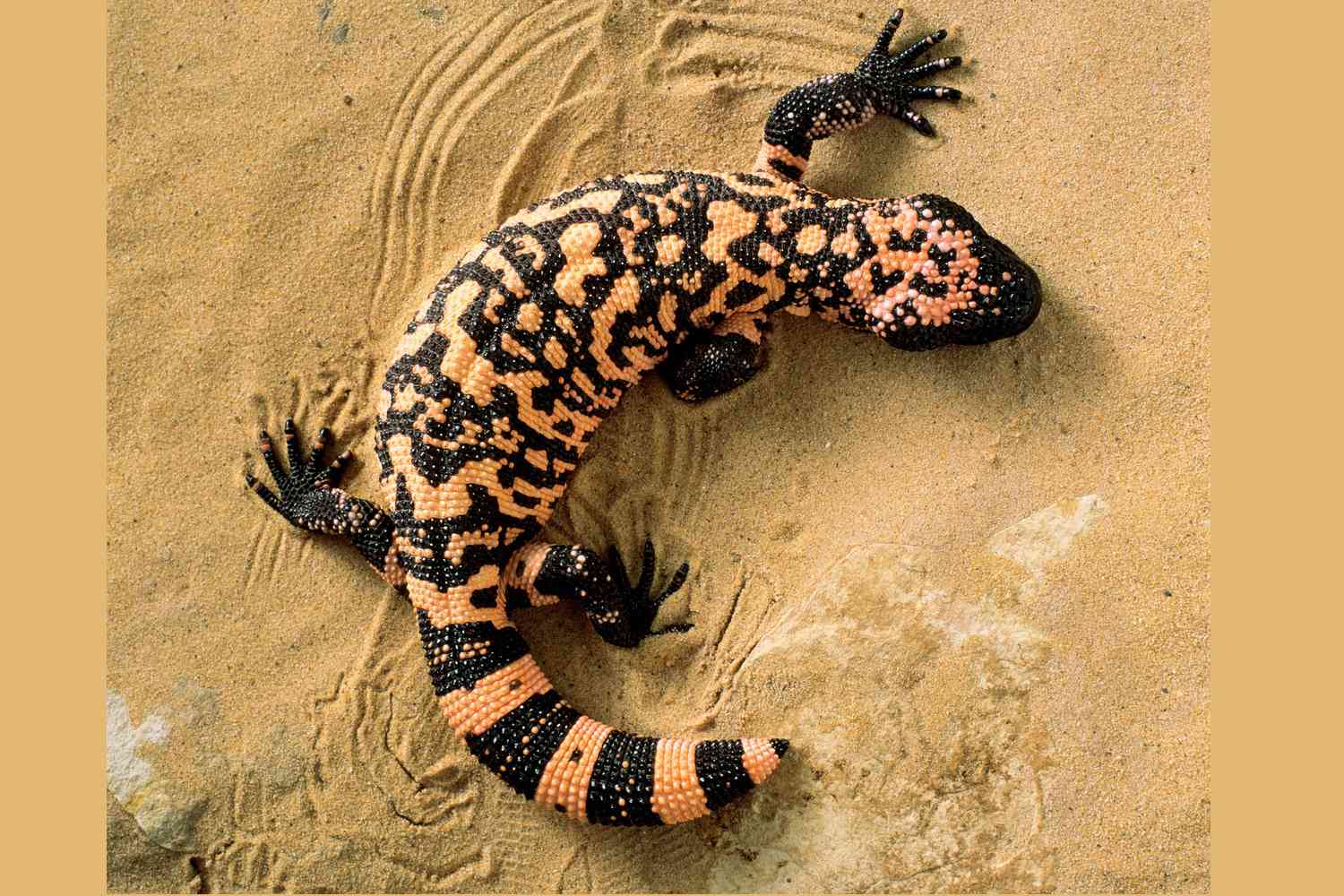
The Gila Monster is one of the most fascinating lizards in the world. It is one of the few venomous lizards, making it unique among reptiles. Named after the Gila River in the southwestern United States, this lizard lives mainly in deserts and semi-arid regions of the southwestern U.S. and northwestern Mexico. Despite its fearsome reputation, the Gila Monster is slow-moving, shy, and plays an important role in its ecosystem.
Appearance
Gila Monsters are large, heavy-bodied lizards. Adults usually grow between 18 and 24 inches long, though some can reach up to 2 feet. They have thick tails that store fat, which helps them survive when food is scarce. Their bodies are covered with rough, bead-like scales in bright patterns of black, orange, pink, or yellow. These patterns help them camouflage among rocks and desert plants.
One of the most unique features of the Gila Monster is its venom. They have grooved teeth in the lower jaw that deliver venom into prey. Unlike snakes, Gila Monsters chew to work the venom into the wound. They also have a large, muscular jaw that allows them to grip and hold onto prey firmly.
Gila Monsters have a short, blunt snout and small eyes. Their legs are strong but not built for speed, so they rely on camouflage and venom for protection rather than running from predators.
Species and Distribution
The Gila Monster (Heloderma suspectum) is the only species found in the United States, though it has a close relative, the Mexican beaded lizard, in Mexico. There are two subspecies of the Gila Monster:
-
Reticulated Gila Monster: Found in southern Arizona, parts of California, and Sonora, Mexico.
-
Banded Gila Monster: Found mainly in western New Mexico.
Gila Monsters live in deserts, rocky hills, scrublands, and dry river valleys. They prefer areas with plenty of cover, like rocks, burrows, or bushes, where they can hide from predators and extreme heat.
Diet
Gila Monsters are carnivorous and primarily feed on eggs, small mammals, birds, and insects. Eggs are a major part of their diet, including those of birds, reptiles, and small mammals. They use their strong jaws to break open eggs and consume the contents.
Gila Monsters are slow hunters. They often wait for prey to come close before striking. Their venom helps subdue prey and begin the digestion process. Although venomous, Gila Monsters are not aggressive hunters; they rely on patience and stealth.
They can survive for long periods without food. Their ability to store fat in their tails allows them to go months without eating, especially during the hot summer when they stay in burrows to avoid extreme temperatures.
Behavior
Gila Monsters are mostly nocturnal during the hottest months, becoming more active during cooler periods, such as early morning, evening, and nighttime. They are solitary animals and spend much of their lives hidden underground or under rocks.
When threatened, Gila Monsters will hiss, lunge, or bite. Their venomous bite can cause pain and swelling, but it is rarely fatal to humans. Unlike snakes, they cannot strike repeatedly—they rely on a firm bite and venom to defend themselves.
Gila Monsters are slow and deliberate in their movements. They cannot run quickly, so they depend on camouflage, venom, and burrows to stay safe.
Reproduction
Gila Monsters reproduce once a year. Mating usually occurs in the spring, after emerging from winter dormancy, called brumation. Females lay eggs in burrows or underground nests during early summer. A clutch typically contains 4–12 eggs.
Incubation lasts about 5–6 months, and the eggs hatch in late summer or early fall. Hatchlings are independent from birth and must hunt and survive on their own. Mothers do not care for their young, so survival depends on instinct and the ability to find shelter and food.
Venom
The Gila Monster’s venom is one of its most famous features. It is not used to kill large predators but to immobilize prey and assist in digestion. Venom is delivered through grooves in their teeth, and they must chew to inject it effectively.
Gila Monster venom contains proteins that affect blood pressure, clotting, and nerve function. Interestingly, scientists have studied Gila Monster venom for medical purposes. One medicine, exenatide, used to treat type 2 diabetes, was developed from compounds found in the venom.
Predators and Threats
Adult Gila Monsters have few natural predators due to their venom and tough, colorful skin. Young lizards are more vulnerable and may fall prey to hawks, coyotes, foxes, and larger reptiles.
Humans are a significant threat. Gila Monsters are sometimes killed out of fear, and habitat loss from urbanization and agriculture reduces their living space. However, they are protected in many areas under U.S. law, and collecting them from the wild is illegal without permits.
Importance in Nature
Gila Monsters are important for desert ecosystems. They help control populations of small mammals, insects, and reptiles by preying on them. Their digging and movement also help aerate the soil, which benefits plants and other animals.
By consuming eggs, they influence the populations of other species, maintaining balance in the ecosystem. Their presence indicates a healthy desert environment.
Relationship with Humans
Humans have long been fascinated by Gila Monsters due to their bright colors, venom, and rarity. While their bite is painful, they are generally shy and avoid humans. Education and awareness programs help reduce fear and promote coexistence.
Gila Monsters are also popular in wildlife documentaries and photography due to their unique appearance and behaviors. Researchers study them to understand venom, adaptation to arid environments, and conservation needs.
Interesting Facts
-
Venomous Lizard: One of only a few venomous lizard species in the world.
-
Bright Colors: Their colorful skin acts as a warning to predators.
-
Fat Storage: They store fat in their tails to survive long periods without food.
-
Slow Movers: They rely on camouflage and venom, not speed, for protection.
-
Nocturnal: Most active at night or during cooler parts of the day.
-
Long Lifespan: Can live up to 20–30 years in the wild.
-
Medical Research: Venom has helped develop diabetes medicine.
-
Egg-Eaters: They consume eggs from birds, reptiles, and small mammals.
Observing Gila Monsters
Observing Gila Monsters should be done with caution and respect. They are slow and mostly hidden, so spotting one is exciting. Wildlife reserves in the southwestern U.S. offer opportunities to see them safely. Researchers use cameras, telescopes, and protective gear to study them without disturbance.
Watching a Gila Monster dig, hunt, or move through the desert teaches about survival, adaptation, and the delicate balance of desert ecosystems. Their calm and deliberate movements are fascinating to study.
Conservation
Gila Monsters are classified as “Near Threatened” in some regions due to habitat loss and illegal collection. Protecting their desert habitats, enforcing wildlife laws, and educating the public are essential for their survival.
Conservation ensures that these rare, venomous lizards continue to thrive in the wild, helping maintain desert ecosystems and inspiring future generations to respect and protect wildlife.
Summary
The Gila Monster is one of the most remarkable lizards in the world. Its venom, colorful appearance, and unique behaviors make it a true desert marvel. Gila Monsters are slow-moving, nocturnal, and rely on camouflage, venom, and burrows to survive.
They eat eggs, small mammals, birds, and insects, helping control populations in their ecosystem. Their venom has important medical uses, and they are a symbol of the fascinating adaptations of desert life.
Despite being venomous, Gila Monsters are shy and avoid humans. Protecting their habitats and reducing human conflict is essential to their survival. By observing and learning about Gila Monsters, we gain insight into the complexity and resilience of life in the desert.
Gila Monsters remind us that even slow-moving creatures can be powerful, important, and fascinating. Their presence helps maintain a balanced ecosystem and inspires admiration for the diversity of life on Earth.
Read Also: Keep your face towards the sunshine and shadows will fall behind you
Watch Also: https://www.youtube.com/@TravelsofTheWorld24





Leave a Reply