
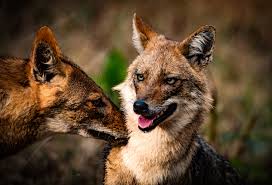
The jackal is a smart and alert wild animal. It looks a little like a small wolf or a big fox, but it has its own special identity. Jackals are known for their intelligence, quick movement, and ability to survive in different environments. They are not as large or powerful as wolves, but they are very clever and adaptable.
Jackals have lived in the wild for thousands of years. They appear in many stories and old traditions, often shown as tricky and wise animals. In this article, we will learn everything about jackals in very simple words. We will talk about their home, body, food, behavior, family life, and why they are important in nature.
Where Jackals Live
Jackals are found in Africa, Asia, and parts of Europe. They can live in many types of places. Some live in open grasslands, some in deserts, and others in forests or near villages.
In Africa, the black-backed jackal and side-striped jackal are common. In Asia and parts of Europe, the golden jackal is more common. The golden jackal is also found in countries like India, Pakistan, and Nepal.
Jackals are very adaptable. This means they can survive in different environments. They can even live close to human areas if there is enough food.
Physical Appearance
Jackals are medium-sized animals. They are smaller than wolves but larger than foxes. Their body is slim, and they have long legs. Their ears are pointed, and their tail is bushy.
Their fur color depends on the type of jackal. Golden jackals usually have yellowish-brown fur. Black-backed jackals have a dark stripe or patch on their back. Side-striped jackals have light stripes on their sides.
An adult jackal usually weighs between 6 to 15 kilograms. They are light and fast. Their sharp teeth help them eat meat, and their strong sense of smell helps them find food easily.
Types of Jackals
There are mainly three types of jackals:
-
Golden Jackal
-
Black-backed Jackal
-
Side-striped Jackal
The golden jackal is the most widely spread. It can survive in both wild forests and near villages. The black-backed jackal is known for its bold behavior. The side-striped jackal is usually more shy and quiet.
Even though they are different in some ways, all jackals share similar habits.
Behavior and Social Life
Jackals are very smart and careful animals. They are usually active during the early morning and late evening. In hot areas, they may rest during the day and move around at night.
Jackals often live in pairs. A male and female may stay together for many years. They work as a team to hunt and protect their territory. Sometimes small family groups live together.
They mark their territory using scent. This tells other jackals to stay away. If another jackal enters their area, they may fight or chase it away.
Jackals communicate using sounds. Their howling is very famous. At night, you can hear their loud calls. These sounds help them stay in contact with each other.
Food and Hunting
Jackals are not picky eaters. They are omnivores, which means they eat both meat and plants. They eat small animals like rabbits, rats, birds, and reptiles. They also eat insects, fruits, and even leftover food.
Sometimes jackals hunt alone. Other times, they hunt in pairs. They are not as strong as wolves, so they usually hunt smaller animals. They may also eat dead animals. This helps keep the environment clean.
Their sharp sense of smell and good hearing help them find food easily. They are patient hunters and move quietly before attacking.
Relationship with Other Animals
Jackals sometimes follow larger predators like lions or tigers. When the bigger animal finishes eating, jackals may eat the leftover meat. This is called scavenging.
They must be careful, though. Large predators can also attack jackals. Jackals survive by being smart and avoiding direct fights with bigger animals.
In some places, jackals may compete with foxes or stray dogs for food.
Family Life and Babies
Jackals usually breed once a year. The female gives birth to about 2 to 6 pups. The babies are born in a den, which may be a hole in the ground or an old burrow made by another animal.
Both parents take care of the pups. The father helps bring food while the mother protects and feeds them. This teamwork increases the survival chances of the babies.
Young jackals grow quickly. After a few weeks, they begin to explore outside the den. They learn hunting skills by watching their parents.
Enemies and Threats
Jackals have some natural enemies. Large animals like leopards, eagles, and wolves may attack them. However, their biggest threat is humans.
Many people see jackals as pests because they may attack chickens or small farm animals. Because of this, they are sometimes hunted or poisoned.
Habitat loss is another problem. As forests and grasslands are destroyed, jackals lose their homes.
Even though they are adaptable, human activities still affect their population in many areas.
Importance in Nature
Jackals play an important role in nature. By eating dead animals, they help clean the environment. This reduces the spread of disease.
They also control the number of small animals like rats and insects. This helps farmers because too many rats can damage crops.
Every animal has a role in nature, and jackals are no different. They help keep the ecosystem balanced.
Jackals in Stories and Culture
Jackals appear in many old stories and myths. In ancient Egypt, a god named Anubis had the head of a jackal. He was linked to the afterlife.
In African and Asian stories, jackals are often shown as clever and tricky animals. Sometimes they are heroes, and sometimes they are troublemakers.
Their clever image has made them popular in folklore.
Lifespan
In the wild, jackals usually live around 8 to 10 years. In protected areas or zoos, they may live longer because they are safe from predators and have regular food.
Their lifespan depends on safety, food, and environment.
Fun Facts About Jackals
Here are some interesting facts about jackals:
-
Jackals can run up to 16 kilometers per hour.
-
They form strong pair bonds.
-
They have very sharp hearing.
-
Their howling can be heard from far away.
-
They can survive in deserts and forests.
-
They sometimes pretend to be dead to escape danger.
Conservation
Most jackal species are not currently endangered, but in some areas, their numbers are decreasing. Protecting natural habitats is important for their survival.
Education can also help. When people understand that jackals are useful for the environment, they may be less likely to harm them.
Wildlife protection laws in many countries help reduce illegal hunting.
Conclusion
The jackal is a clever and adaptable animal. It may not be as powerful as a lion or as famous as a wolf, but it has its own strength. Its intelligence, teamwork, and ability to survive in different environments make it special.
Jackals live in Africa, Asia, and parts of Europe. They eat both meat and plants, hunt small animals, and help clean the environment by eating dead animals.
Even though they face dangers from predators and humans, jackals continue to survive because of their smart behavior and strong family bonds.
The jackal teaches us that survival is not only about strength. It is also about intelligence, teamwork, and the ability to adapt. It is truly one of the most interesting animals in the wild.
Read Also: Keep your face towards the sunshine and shadows will fall behind you
Watch Also: https://www.youtube.com/@TravelsofTheWorld24





Leave a Reply