
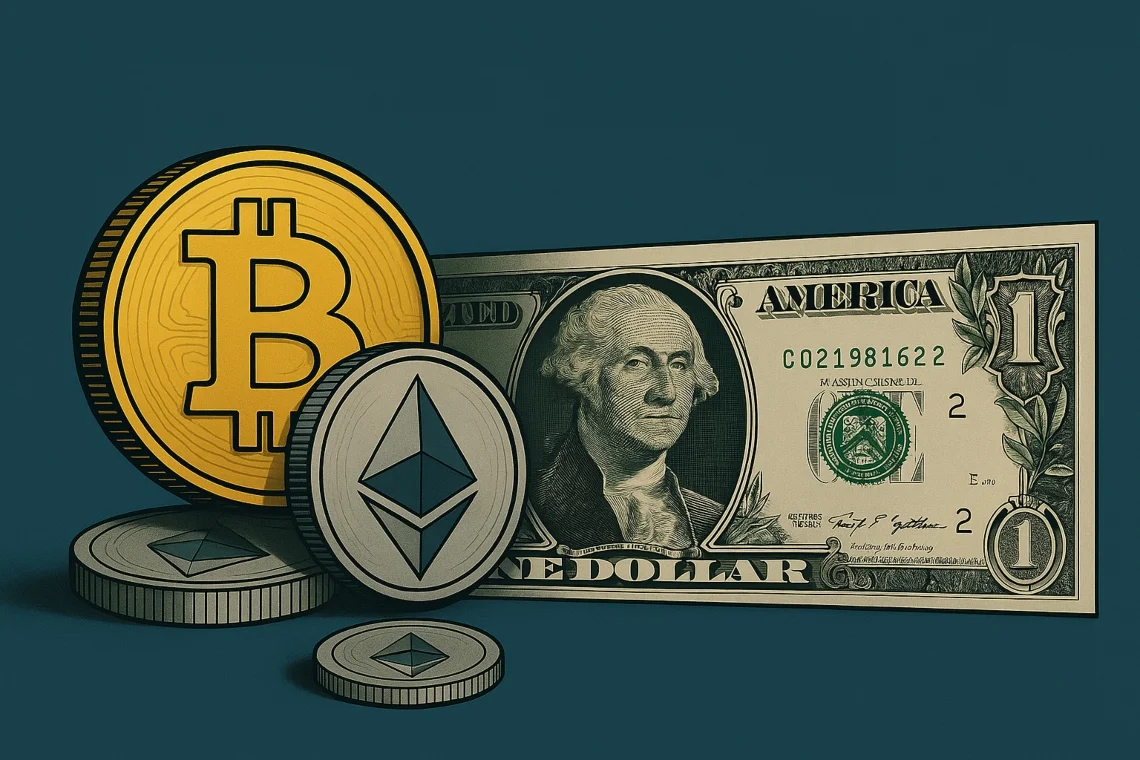
Digital Currency Rising: Will Crypto Dethrone the Dollar?
For decades, the U.S. dollar (USD) has held an unparalleled position as the world’s dominant reserve currency. From pricing global commodities to anchoring international trade and central bank reserves, the dollar’s influence is a cornerstone of modern finance. However, the emergence of cryptocurrencies—decentralized, digital, and borderless financial assets—has raised critical questions about the future of global monetary power. Bitcoin, Ethereum, stablecoins, and central bank digital currencies (CBDCs) have demonstrated the potential to disrupt conventional financial systems, offering alternatives that challenge the U.S. dollar’s supremacy. This essay explores the current financial landscape, examines the capabilities and limitations of cryptocurrencies, and evaluates whether they can realistically supplant the dollar in the global system.
1. The U.S. Dollar’s Role in the Global Economy
The U.S. dollar’s dominance is supported by multiple factors:
a. Reserve Currency Status
Central banks across the world hold substantial USD assets, especially U.S. Treasury securities, to stabilize their own economies and manage international trade. The dollar accounts for roughly 59% of global foreign exchange reserves, reflecting the trust placed in it by governments and institutions.
b. Global Trade and Pricing
Many international commodities, including oil, gold, and agricultural products, are denominated in dollars. This “petrodollar” system creates a consistent global demand for USD.
c. Financial Infrastructure and Liquidity
The U.S. financial system provides deep, liquid markets that allow large-scale transactions, including sovereign debt issuance, derivatives trading, and interbank lending. These infrastructures reinforce the dollar’s convenience and reliability.
d. Safe-Haven Asset
During economic or geopolitical crises, investors flock to U.S. dollars and Treasuries, highlighting the currency’s perceived stability.
These structural advantages make the U.S. dollar difficult to challenge, requiring an alternative that offers comparable liquidity, acceptance, and trust.
2. The Rise of Cryptocurrencies
Cryptocurrencies first emerged in 2009 with the launch of Bitcoin, introducing a peer-to-peer, decentralized digital currency that operated independently of central banks. Key characteristics of cryptocurrencies include:
-
Decentralization: No single entity controls supply or transactions.
-
Borderless Transfers: Cryptocurrencies can be sent globally without intermediaries.
-
Digital Scarcity: Many cryptos, like Bitcoin, have fixed maximum supplies.
-
Programmable Assets: Platforms like Ethereum enable smart contracts and decentralized applications.
Beyond Bitcoin, cryptocurrencies have diversified into categories such as stablecoins, pegged to fiat currencies, and CBDCs, issued by governments in digital form.
3. Cryptocurrencies as Alternatives to the U.S. Dollar
Cryptocurrencies have several characteristics that position them as potential alternatives to the dollar:
a. Store of Value
Bitcoin, often called “digital gold,” functions as a store of value due to its limited supply. Investors view it as a hedge against inflation, currency debasement, and macroeconomic instability.
b. Medium of Exchange
Cryptocurrencies facilitate global transactions without the need for banks or intermediaries. Cross-border remittances, e-commerce, and international trade increasingly experiment with crypto payments.
c. Financial Inclusion
Cryptocurrencies provide access to financial services in regions where traditional banking infrastructure is weak or unreliable, offering opportunities for unbanked populations.
d. Hedge Against Political Influence
Unlike fiat currencies, decentralized cryptocurrencies are resistant to manipulation by governments or central banks, potentially insulating users from economic sanctions or political instability.
4. The Role of Stablecoins and CBDCs
While decentralized cryptocurrencies like Bitcoin are often volatile, stablecoins and CBDCs aim to provide price stability while retaining some benefits of digital assets:
-
Stablecoins (e.g., USDT, USDC) are pegged to the U.S. dollar or other fiat currencies, facilitating digital payments and reducing volatility. They can enable businesses to transact globally without traditional banking systems.
-
Central Bank Digital Currencies (CBDCs) are government-backed digital money, designed to complement or replace physical cash. Countries such as China with its digital yuan (e-CNY) and several others are piloting CBDCs, which could offer controlled digital alternatives to the dollar.
While stablecoins are private-sector solutions, CBDCs demonstrate that governments recognize the potential need to modernize the monetary system.
5. Factors Supporting Cryptocurrency Adoption Over the Dollar
Several trends suggest that cryptocurrencies could increasingly challenge the dollar:
a. Technological Innovation
Blockchain and distributed ledger technologies enable faster, cheaper, and more transparent global transactions than traditional banking systems.
b. Decentralization and Autonomy
Cryptocurrencies allow users to hold value independently of governments and central banks, appealing to populations in countries with high inflation or capital controls.
c. Increasing Institutional Interest
Corporations, hedge funds, and even sovereign wealth funds are investing in cryptocurrencies, legitimizing their role as financial assets and expanding market liquidity.
d. Digital Economy Growth
The global shift toward digital commerce, online remittances, and e-commerce payments favors the adoption of digital currencies over physical cash or traditional bank transfers.
6. Challenges to Cryptocurrencies Replacing the Dollar
Despite potential, cryptocurrencies face substantial barriers to supplanting the U.S. dollar:
a. Volatility
Bitcoin and other decentralized cryptocurrencies experience extreme price swings, which make them unreliable for daily commerce and as a stable store of value.
b. Limited Global Acceptance
While adoption is growing, most global trade, sovereign debt, and commodities are still denominated in USD. Widespread acceptance of crypto would require systemic changes in accounting, regulatory frameworks, and contracts.
c. Regulatory Hurdles
Governments are cautious about cryptocurrencies due to risks of money laundering, tax evasion, and financial instability. Potential restrictions or bans could limit adoption.
d. Monetary Policy Constraints
Cryptocurrencies cannot be controlled by central banks. Governments rely on monetary policy to manage inflation, employment, and economic growth, and giving up control over a national or global reserve currency could have serious macroeconomic implications.
e. Infrastructure and Security Concerns
Digital currency infrastructure must address cybersecurity threats, transaction scalability, and fraud. Failures could undermine trust in cryptocurrencies as safe alternatives to fiat money.
7. Comparative Analysis: Dollar vs. Cryptocurrencies
| Feature | U.S. Dollar | Bitcoin / Cryptocurrency | Assessment |
|---|---|---|---|
| Stability | High | Moderate to Low | Dollar remains more stable for global trade |
| Acceptance | Global | Growing, but limited | Cryptos accepted mainly in digital markets |
| Supply Control | Central Bank | Fixed (Bitcoin) / Algorithmic | Crypto provides scarcity, but lacks policy flexibility |
| Transaction Speed | Bank-dependent | Instant (digital) | Cryptos faster for cross-border transfers |
| Regulation | Well-established | Evolving, fragmented | Regulatory clarity is a key barrier |
| Store of Value | Strong | Growing interest | Bitcoin increasingly viewed as digital gold |
This comparison suggests cryptocurrencies can complement but not fully replace the dollar under current conditions.
8. Case Studies of Dollar Displacement Attempts
a. Petro-Yuan and Regional Alternatives
China and other countries have attempted to reduce dollar dependency through RMB-denominated oil contracts and regional currency swaps. Adoption has been incremental but signals geopolitical interest in alternatives.
b. Bitcoin in Economically Unstable Countries
Countries like Venezuela and Zimbabwe have experienced hyperinflation, leading citizens to adopt cryptocurrencies as a hedge against their collapsing fiat currencies. While adoption is significant locally, it does not yet translate into global reserve currency replacement.
c. Stablecoin Adoption for Cross-Border Payments
Companies and financial institutions increasingly use stablecoins for international transactions, bypassing traditional bank settlements. These innovations challenge the dollar’s transactional dominance but do not displace it in reserves or trade invoicing.
9. Geopolitical Implications
Cryptocurrencies have the potential to reshape global power structures:
-
Reduced Dollar Hegemony: Widespread crypto adoption could decrease demand for USD reserves.
-
Decentralized Financial Power: Financial control may shift from governments and central banks to global digital networks.
-
Policy Challenges: Governments may struggle to implement capital controls or enforce sanctions in a crypto-driven economy.
-
Competition Between CBDCs: Nations introducing digital currencies could compete with the USD for influence without requiring decentralized crypto adoption.
10. A Realistic Path Forward
While the idea of cryptocurrencies fully replacing the U.S. dollar is intriguing, a hybrid monetary future seems more plausible:
-
Multipolar Reserve System: The dollar continues as a primary reserve currency but coexists with regional currencies, stablecoins, and CBDCs.
-
Bitcoin as Digital Gold: Bitcoin may serve as a global store of value rather than a transactional currency.
-
CBDCs for Daily Transactions: National digital currencies may handle domestic and cross-border payments efficiently.
-
Integration of Cryptos in Financial Infrastructure: Institutional adoption and blockchain-based settlements increase the role of crypto in the global financial system without fully displacing fiat currencies.
This approach balances innovation with stability, allowing cryptocurrencies to complement rather than overthrow the dollar entirely.
11. Conclusion
The rise of cryptocurrencies marks a transformative moment in global finance, introducing alternatives to traditional fiat systems and challenging the U.S. dollar’s unassailable dominance. Decentralized cryptocurrencies, stablecoins, and CBDCs each offer unique benefits: speed, borderless transactions, scarcity, and autonomy from centralized monetary authorities. Yet significant barriers remain, including volatility, regulatory constraints, limited acceptance, and the necessity of monetary policy tools.
Rather than a wholesale replacement, a coexistence model appears more likely. Cryptocurrencies may increasingly complement the dollar by providing alternative stores of value, improving cross-border transaction efficiency, and enabling financial inclusion. Bitcoin may serve as digital gold, stablecoins could facilitate corporate and retail transactions, and CBDCs may modernize national monetary systems—all while the U.S. dollar retains its central reserve status.
In sum, cryptocurrencies possess disruptive potential, but the overthrow of the U.S. dollar in the near-to-medium term remains improbable. The more realistic scenario is a hybrid financial ecosystem, where digital assets coexist with fiat currencies, reshaping the contours of global monetary power rather than supplanting it outright. Understanding this evolving landscape is crucial for investors, policymakers, and financial institutions navigating a future increasingly influenced by digital finance.
Read Also: Keep your face towards the sunshine and shadows will fall behind you
Watch Also: https://www.youtube.com/@TravelsofTheWorld24














Leave a Reply