
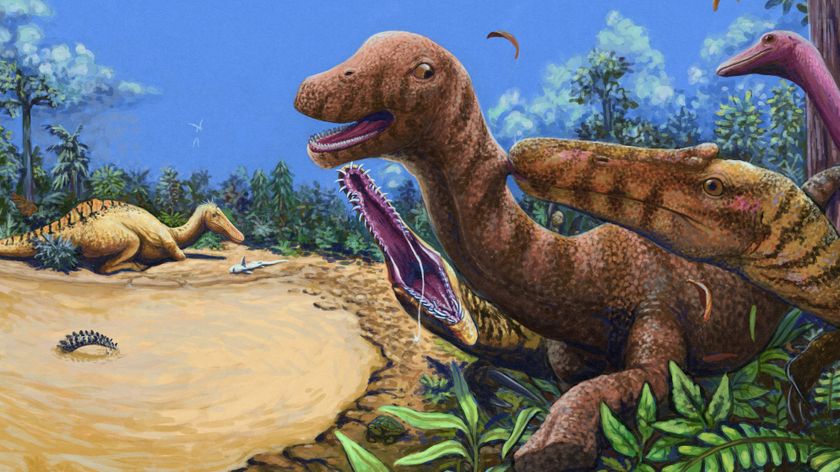
For nearly 100 years, a massive dinosaur fossil sat quietly in museum collections, its true identity obscured by time, incomplete records, and the limits of early paleontology. First unearthed in the early 20th century and casually nicknamed the “cow of the Cretaceous” because of its immense size and plant-grazing lifestyle, the creature was long assumed to belong to a known group of duck-billed dinosaurs. Now, after decades of re-examination and modern scientific analysis, researchers have confirmed that this prehistoric giant represents an entirely new species of hadrosaur, rewriting a small but important chapter of dinosaur history.
This discovery highlights an often-overlooked truth in paleontology: many of the most significant breakthroughs do not come from new digs in remote deserts, but from old fossils re-examined with fresh eyes.
A Fossil Lost in Plain Sight
The story begins in the 1920s, when fossil hunters working in North America uncovered a remarkably large set of dinosaur bones embedded in Late Cretaceous rock layers. The skeleton was incomplete but impressive, consisting of portions of the skull, vertebrae, limb bones, and pelvis. At the time, paleontology was still a developing science. Many dinosaur species were being described rapidly, often based on fragmentary remains, and classification standards were far less rigorous than they are today.
Early researchers identified the fossil as a duck-billed dinosaur, or hadrosaur—an already well-known group of large, herbivorous dinosaurs that dominated the Northern Hemisphere during the final 30 million years of the Age of Dinosaurs. Because the specimen did not appear dramatically different from known hadrosaurs, it was cataloged, labeled, and largely forgotten.
Over the decades, the bones were occasionally referenced in academic literature, but no one questioned their original classification in any serious way. The fossil became a footnote—interesting, but not exceptional.
Why “Cow of the Cretaceous”?
The nickname “cow of the Cretaceous” was never an official scientific term, but it captured the imagination of early paleontologists. Hadrosaurs are often compared to modern grazing animals because of their:
-
Large, barrel-shaped bodies
-
Specialized teeth for chewing tough vegetation
-
Likely herd behavior
-
Enormous appetite for plant matter
This particular dinosaur stood out for its exceptional size, even among hadrosaurs. Estimates suggest it may have reached 40 feet (12 meters) in length and weighed several tons. Like cows on a prehistoric scale, it likely spent much of its life feeding, migrating, and shaping its ecosystem through sheer consumption of plants.
Modern Science Reopens an Old Case
The fossil’s transformation from overlooked specimen to new species began only recently, when paleontologists decided to re-examine hadrosaur fossils using modern analytical techniques. Advances in comparative anatomy, 3D scanning, and evolutionary modeling have revolutionized how scientists interpret old remains.
During a detailed reassessment, researchers noticed subtle—but consistent—differences in the bones:
-
Unique skull proportions
-
Distinctive jaw and tooth battery structures
-
Differences in limb bone shape and muscle attachment points
-
Unusual vertebral features not seen in closely related species
These differences were too consistent to be explained by age, individual variation, or fossil damage. Instead, they pointed to a previously unrecognized evolutionary lineage.
After careful comparison with dozens of known hadrosaur species, the team concluded that the fossil represented an entirely new duck-billed dinosaur species—one that had gone unnoticed for almost a century.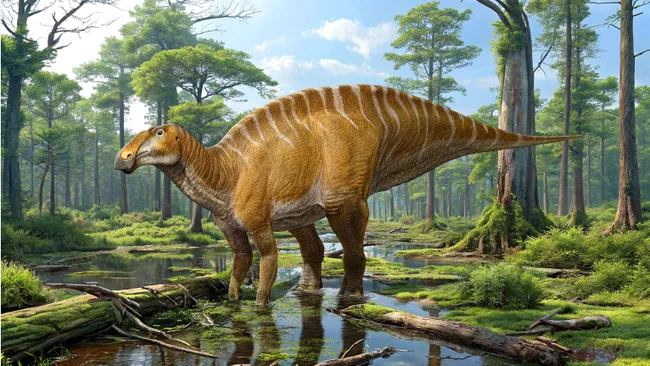
Meet a New Duck-Billed Dinosaur
While the dinosaur’s official scientific name follows strict taxonomic rules, its significance goes far beyond nomenclature. The newly identified species helps clarify the diversity and adaptability of hadrosaurs during the Late Cretaceous period.
Duck-billed dinosaurs were among the most successful herbivores ever to walk the Earth. They lived across North America, Asia, and parts of Europe, thriving in environments that ranged from coastal plains to river deltas and forested floodplains.
This new species appears to have been especially well adapted for:
-
High-volume feeding, with dense tooth batteries capable of grinding fibrous plants
-
Long-distance movement, suggested by robust leg bones
-
Group living, inferred from similarities to related herd-forming hadrosaurs
Its discovery adds yet another branch to the already complex hadrosaur family tree.
A Window Into the Late Cretaceous World
The Late Cretaceous period, roughly 100 to 66 million years ago, was a time of extraordinary ecological richness. Flowering plants were spreading rapidly, reshaping landscapes and fueling the evolution of large herbivores.
This newly identified dinosaur lived alongside:
-
Tyrannosaurid predators
-
Horned dinosaurs like Triceratops
-
Armored ankylosaurs
-
Smaller feathered dinosaurs and early birds
As a massive herbivore, it would have played a crucial role in its ecosystem—trampling vegetation, dispersing seeds, and serving as prey for large carnivores. Its size alone would have made it a valuable resource for predators, scavengers, and decomposers.
Understanding its anatomy and lifestyle helps scientists reconstruct ancient food webs and ecosystem dynamics with greater accuracy.
Why This Discovery Matters
At first glance, identifying a new dinosaur species from an old fossil may seem like a minor adjustment. In reality, it has broad implications for paleontology.
1. Hidden Diversity
The discovery suggests that dinosaur diversity—especially among common groups like hadrosaurs—may be significantly underestimated. Many museum specimens collected decades ago may represent undiscovered species waiting to be recognized.
2. Evolutionary Relationships
Each new species helps clarify how dinosaurs evolved, migrated, and adapted. Subtle anatomical differences can reveal previously unknown evolutionary branches and migration patterns.
3. The Value of Museum Collections
This case underscores the importance of museums not just as display spaces, but as active research centers. Fossils collected long ago continue to yield new insights when studied with modern tools.
Why It Took So Long
One of the most common questions surrounding such discoveries is: Why wasn’t this identified earlier?
The answer lies in a combination of factors:
-
Early paleontologists had fewer comparative specimens
-
Many species were named quickly, sometimes from fragmentary remains
-
Subtle anatomical differences were harder to detect without modern imaging
-
Scientific priorities often focused on new discoveries rather than re-examining old ones
As paleontology matures, researchers increasingly recognize the value of revisiting historical collections.
Rethinking Duck-Billed Dinosaurs
Duck-billed dinosaurs were once thought to be relatively uniform—big, plant-eating dinosaurs with similar lifestyles. Over the past few decades, that view has changed dramatically.
Scientists now know that hadrosaurs were:
-
Highly diverse
-
Ecologically specialized
-
Capable of complex social behaviors
-
Possibly vocal, using hollow crests to communicate
The identification of this new species adds further depth to that picture, reinforcing the idea that hadrosaurs were not just abundant, but evolutionarily innovative.
A Reminder That Science Is Never Finished
Perhaps the most compelling aspect of this discovery is what it says about science itself. Knowledge is not static. Even fossils that have been studied for generations can still surprise us.
This giant “cow of the Cretaceous” reminds us that:
-
Discovery does not always require new excavation
-
Old evidence can yield new answers
-
Scientific understanding evolves with technology and perspective
As museums continue to digitize collections and researchers apply new analytical methods, more long-forgotten fossils may finally reveal their true identities.
The Legacy of a Prehistoric Giant
Nearly 100 years after its discovery, this massive herbivore has finally stepped out of obscurity. No longer just a misidentified specimen or a casual nickname, it now stands as a distinct species, with a rightful place in the story of dinosaur evolution.
In life, it was likely a slow-moving but unstoppable presence—a living engine of plant consumption, shaping the Cretaceous landscape one mouthful at a time. In death, it waited patiently for science to catch up.
Its story is a testament to patience, persistence, and the enduring power of curiosity—qualities that continue to drive paleontology forward, one fossil at a time.
Read Also: Keep your face towards the sunshine and shadows will fall behind you
Watch Also: https://www.youtube.com/@TravelsofTheWorld24






Leave a Reply