
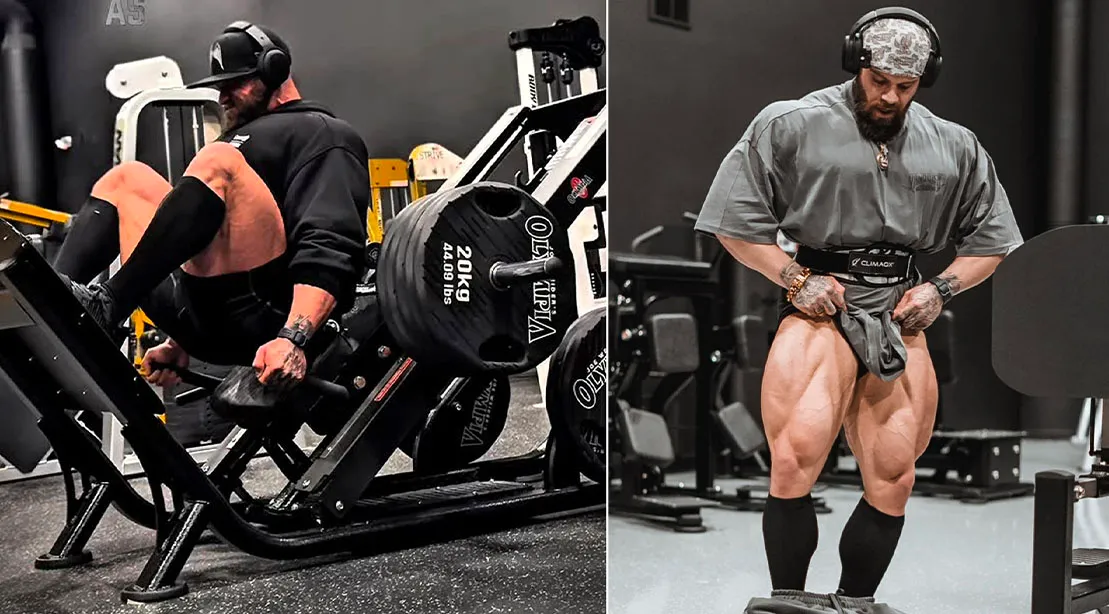
As the countdown to the 2026 Arnold Classic begins, all eyes are on one of the most exciting and disciplined competitors in the modern bodybuilding era—Mike Sommerfeld. Known for his razor-sharp conditioning, balanced proportions, and relentless work ethic, Sommerfeld continues to prove that elite physiques aren’t always built with overly complicated routines. In fact, his latest leg workout revelation shows just how powerful simplicity and execution can be.
Rather than overwhelming his training with countless movements, Sommerfeld relies on a minimalist four-exercise leg day—a session designed to stimulate maximum growth, strength, and symmetry while preserving recovery. As the Arnold Classic approaches, this streamlined approach highlights a philosophy many lifters overlook: quality beats quantity.
In this article, we break down Mike Sommerfeld’s leg training strategy, examine each exercise in detail, explore why this routine works at the elite level, and uncover the mindset that separates champions from the rest.
Mike Sommerfeld: Precision Over Excess
Mike Sommerfeld has built his reputation not just on size, but on structural balance and conditioning—two qualities that judges consistently reward at top-tier competitions like the Arnold Classic. While many athletes chase volume and complexity, Sommerfeld focuses on movement mastery, progressive overload, and muscle connection.
His legs, in particular, stand out for their:
-
Deep quad separation
-
Full, sweeping outer thighs
-
Dense hamstrings
-
Balanced development from front to back
This level of detail doesn’t come from endless exercise variations. Instead, it’s the result of repeating the fundamentals with extreme precision.
Why a 4-Exercise Leg Workout Works
At first glance, a four-exercise leg day might seem too simple for a professional bodybuilder preparing for one of the most prestigious competitions in the world. But simplicity, when paired with intensity, can be devastatingly effective.
The Key Advantages
-
Reduced joint stress during long prep phases
-
Improved recovery, allowing consistent progress
-
Greater focus on each movement
-
Maximum effort in every working set
Sommerfeld’s routine targets the entire lower body—quads, hamstrings, glutes, and adductors—without unnecessary overlap.
Exercise 1: Barbell Back Squat
The Foundation of Mass and Strength
No leg routine would be complete without squats, and for Sommerfeld, the barbell back squat remains non-negotiable.
Why He Uses It
Squats engage nearly every muscle in the lower body while also demanding core stability and neurological coordination. Sommerfeld uses them as his primary mass-builder, especially during the early phases of prep.
Execution Focus
-
Controlled descent
-
Explosive drive upward
-
Full depth without sacrificing form
Typical Setup
-
Sets: 4–5
-
Reps: 6–10
-
Rest: 2–3 minutes
Rather than ego lifting, Sommerfeld prioritizes tension through the quads and glutes, ensuring each rep contributes to growth rather than fatigue alone.
Exercise 2: Hack Squat
Quad Detail and Separation
Following heavy squats, Sommerfeld transitions to the hack squat, a movement prized for its ability to isolate the quads while minimizing lower-back involvement.
Why It’s Essential
The hack squat allows him to:
-
Maintain constant quad tension
-
Emphasize the teardrop (vastus medialis)
-
Push intensity safely after free-weight fatigue
Technique Notes
-
Feet slightly forward
-
Heels planted
-
Slow negatives with a deep stretch
Typical Setup
-
Sets: 3–4
-
Reps: 8–12
-
Intensity Technique: Final set drop set
This exercise plays a major role in achieving the etched quad lines that Sommerfeld brings to the stage.
Exercise 3: Romanian Deadlift (RDL)
Hamstring Thickness and Posterior Strength
For hamstrings, Sommerfeld keeps it brutally effective with Romanian deadlifts. This movement builds dense, hanging hamstrings that complete the lower-body look from the side and back.
Why RDLs Matter
RDLs emphasize:
-
Hamstring length and thickness
-
Glute engagement
-
Hip hinge strength
Key Form Cues
-
Soft knees
-
Neutral spine
-
Bar close to the legs
-
Stretch, not bounce, at the bottom
Typical Setup
-
Sets: 3–4
-
Reps: 8–10
-
Tempo: Slow eccentric (3–4 seconds)
Sommerfeld often describes RDLs as a non-negotiable for anyone serious about leg aesthetics.
Exercise 4: Seated Leg Curl
Isolation for Complete Hamstring Development
To finish the workout, Sommerfeld turns to the seated leg curl, a movement that isolates the hamstrings in a fully stretched position.
Why Seated Over Lying
The seated version places the hamstrings under tension at both the hip and knee joints, leading to:
-
Greater muscle activation
-
Improved detail and separation
-
Reduced lower-back fatigue
Typical Setup
-
Sets: 3–4
-
Reps: 10–15
-
Pause: 1–2 seconds at peak contraction
This final movement ensures the hamstrings are completely exhausted before the session ends.
Training Intensity: The Sommerfeld Difference
What truly separates Mike Sommerfeld from the average lifter isn’t exercise selection—it’s how he trains.
Key Intensity Principles
-
Every working set is taken near failure
-
No wasted reps
-
Strict form over heavy weight
-
Mental focus on the target muscle
Rather than chasing exhaustion, Sommerfeld chases stimulus—the kind that forces adaptation without sabotaging recovery.
Recovery and Frequency
Sommerfeld typically trains legs once per week during heavy prep phases. This allows:
-
Full muscular recovery
-
Joint preservation
-
Strong performance on leg day
Outside the gym, recovery is supported by:
-
Structured sleep
-
Mobility work
-
Strategic deloads
-
Nutrition timed around training
Nutrition’s Role in Leg Growth
Training alone doesn’t build championship legs. Sommerfeld aligns his nutrition with his leg workouts to maximize results.
Key Nutritional Strategies
-
High-carb intake on leg day
-
Intra-workout carbohydrates
-
Adequate sodium for muscle fullness
-
Sufficient protein for repair
This approach ensures that each leg session is fueled for performance, not just survival.
Mental Preparation for the Arnold Classic
As the 2026 Arnold Classic approaches, Sommerfeld’s mindset becomes sharper with each week.
His Mental Focus Includes:
-
Visualizing stage performance
-
Tracking training precision, not just weight
-
Remaining patient during prep
-
Trusting the process
For Sommerfeld, leg day isn’t just physical—it’s psychological. Every rep brings him closer to the version of himself he intends to present under the bright lights of the Arnold stage.
What Lifters Can Learn from This Routine
Mike Sommerfeld’s four-exercise leg day offers valuable lessons for lifters at every level:
-
You don’t need endless exercises to grow
-
Mastering basics delivers elite results
-
Recovery is just as important as effort
-
Consistency beats novelty
Whether you’re a competitive bodybuilder or a dedicated gym enthusiast, this routine proves that simplicity, when executed with intent, is powerful.
Final Thoughts
As Mike Sommerfeld prepares for the 2026 Arnold Classic, his leg training reflects the mindset of a true professional—focused, efficient, and brutally effective. His four-exercise leg day is not about shortcuts; it’s about precision, intensity, and respect for the fundamentals.
In a world flooded with complex routines and flashy techniques, Sommerfeld’s approach is a reminder that greatness often comes from doing less—but doing it better.
If the condition and balance he’s known for continue to improve, fans and judges alike can expect to see one of the most refined leg presentations of his career when he steps onto the Arnold Classic stage.
Read Also: Keep your face towards the sunshine and shadows will fall behind you
Watch Also: https://www.youtube.com/@TravelsofTheWorld24





Leave a Reply