
Humanity has long looked to the stars, imagining what lies beyond our solar system. For decades, scientists, writers, and enthusiasts have debated the nature of extraterrestrial life: Will it be microbial, intelligent, or even interstellar travelers capable of reaching Earth? According to some experts in astrobiology and communication theory, the first alien civilization we encounter is likely to be extremely loud—in both a literal and metaphorical sense. But what does that mean, and why should we expect a boisterous cosmic neighbor?
SETI and the Search for Alien Signals
The Search for Extraterrestrial Intelligence (SETI) has been scanning the cosmos for decades, primarily looking for electromagnetic signals—radio waves or laser pulses—that could indicate intelligent life.
-
The Loudness Hypothesis: Many researchers theorize that the first civilizations we detect will broadcast energy-intensive signals, making them easier to notice across light-years of space.
-
Radio and Laser Beacons: Advanced civilizations may use powerful beacons to announce their presence, analogous to humanity’s own attempts with Arecibo and other interstellar messages.
-
Intentional vs. Accidental: “Loud” signals might be deliberate attempts at communication—or simply the byproduct of energy use, industrial activity, or planetary engineering.
In short, if alien civilizations are trying to be noticed—or are simply advanced enough to generate strong emissions—we’re likely to detect the loudest ones first.
Why Loud Aliens Are More Likely to Be Detected
There are several reasons the first civilization we encounter might be “loud”:
-
Detection Bias: Our instruments are limited. Civilizations that emit strong, high-energy signals are easier to spot than quiet or low-energy civilizations.
-
Technological Maturity: Civilizations capable of interstellar communication or detectable engineering are inherently “loud” because their activities require significant energy output.
-
Survivability Signals: A civilization broadcasting its presence may also be asserting territorial or defensive intentions, producing detectable energy emissions in the process.
In essence, the universe may be teeming with quieter civilizations, but our first contact is likely to be with a civilization that is literally and figuratively impossible to ignore.
Examples of “Loud” Civilization Indicators
Astrophysicists have identified several types of signals or markers that could indicate a loud alien civilization:
-
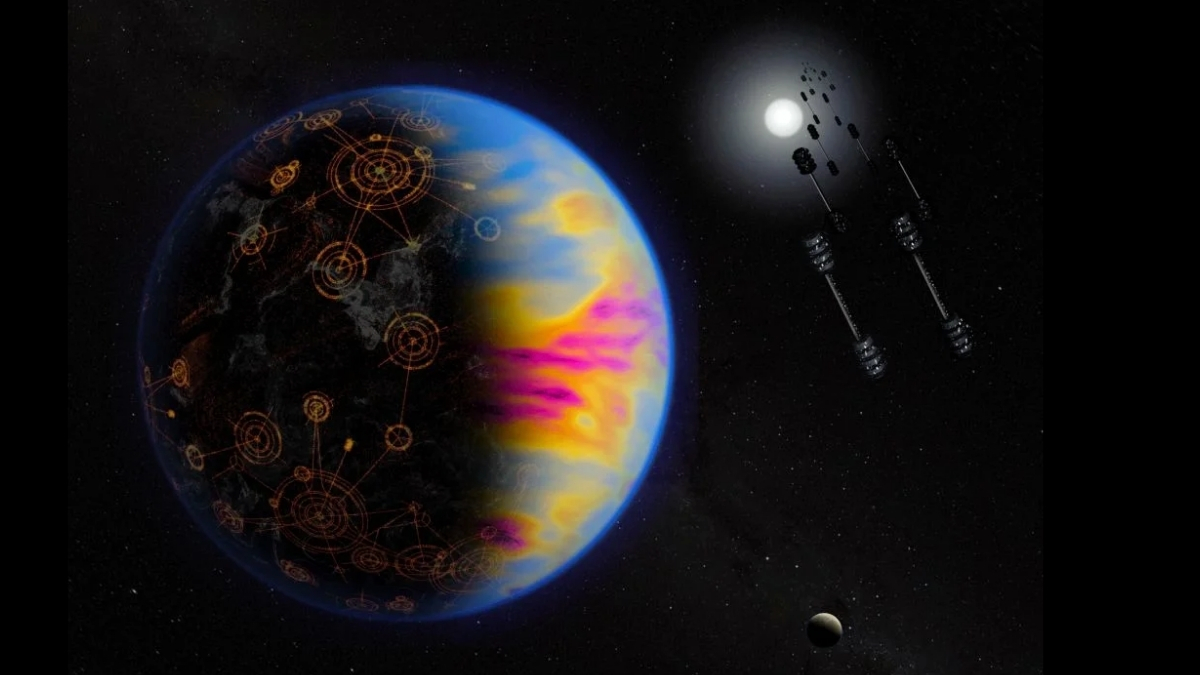
Dyson Spheres or Megastructures: Structures that capture stellar energy could alter the light of their star, making the civilization detectable across vast distances.
-
High-Power Radio or Laser Signals: Intentional messages, interstellar broadcasts, or even accidental emissions could be picked up by telescopes.
-
Planetary Engineering: Terraforming projects may leave atmospheric or orbital anomalies detectable from Earth.
These indicators suggest that if extraterrestrial intelligence exists, we are more likely to detect civilizations that are energetically visible and highly active, rather than quiet or isolated.
Read Also: Keep your face towards the sunshine and shadows will fall behind you
The Fermi Paradox and Loud Aliens
The concept of loud alien civilizations ties into the Fermi Paradox: If the universe is so vast, why haven’t we detected intelligent life yet?
-
One explanation is that quiet civilizations exist, but they are too subtle for our instruments.
-
Another possibility is that only loud civilizations stand out, and we are waiting for one to make its presence known.
-
The “loudness” of a civilization might also be a survival necessity: to thrive in the galaxy, some species may have evolved to emit detectable energy to establish dominance or communication networks.
Thus, the Fermi Paradox might not indicate the absence of life—it may simply reflect our detection limitations and bias toward loud signals.
Could Loud Aliens Be Dangerous?
The prospect of encountering a loud civilization raises questions about risk and safety:
-
Attention Risk: Broadcasting loudly might draw unwanted attention from other advanced civilizations.
-
Resource Competition: Energetically loud civilizations may also consume or monopolize resources, potentially clashing with emerging spacefaring societies like humanity.
-
Communication Misinterpretation: Loud signals could be misinterpreted, leading to confusion or unintended conflict.
While loud aliens aren’t inherently hostile, the very energy and scale of their presence could pose challenges for first contact.
Lessons from Human Analogues
Humans provide a useful analogy:
-
Cities as Loud Civilizations: Our brightest cities, radio broadcasts, and satellites make Earth detectable from afar.
-
Industrial Noise: Our energy use produces signals that could be interpreted as “loud” by extraterrestrials scanning for intelligent life.
-
Social and Cultural Noise: Beyond technology, civilizations may announce themselves through artificial megastructures or planetary modifications, which are detectable across interstellar distances.
By studying ourselves, we can predict the types of signals that might indicate intelligent extraterrestrial life and prepare for contact.
Why Silence Is Not Golden in Space
While quiet civilizations may exist, their stealth limits our detection ability:
-
Quiet civilizations may never interact with us, leaving humans unaware of their existence.
-
Energy-efficient societies might actively minimize emissions, remaining invisible across light-years.
-
Detection favors the bold: Like the loud civilizations in SETI models, those who produce detectable signals are more likely to be our first cosmic neighbors.
This implies that humanity’s first encounter is likely to be with a civilization that is impossible to ignore, either by design or consequence.

Potential Forms of Loud Communication
Loud aliens could communicate in several surprising ways:
-
Electromagnetic Broadcasts: Traditional radio, laser, or X-ray signals detectable from light-years away.
-
Astrophysical Engineering: Megastructures that alter a star’s luminosity or spectrum.
-
Planetary Signals: Terraforming projects that change atmospheric composition in detectable ways.
-
Interstellar Beacons: Deliberate signals designed to announce presence to other civilizations.
All of these possibilities emphasize that first contact may be more spectacular and attention-grabbing than the subtle signals often imagined in fiction.
The Role of SETI and Future Detection
SETI and related programs are preparing for the possibility of loud civilizations:
-
Advanced Detection Arrays: Next-generation telescopes can detect high-energy signals across multiple wavelengths, improving our chances of spotting a loud civilization.
-
Data Analysis: AI and machine learning help identify anomalous signals that may indicate intelligent origin.
-
International Cooperation: Detecting a loud civilization requires global collaboration to verify and respond appropriately.
The combination of technology, global coordination, and theoretical modeling makes humanity ready for the day a loud civilization announces itself.
Philosophical Implications of Loud Aliens
Encountering a loud civilization would force humanity to confront existential and philosophical questions:
-
Are We Alone? Loud signals would confirm intelligent life beyond Earth, reshaping our worldview.
-
Cultural Impact: The presence of a boisterous alien society could challenge religion, ethics, and human identity.
-
Interstellar Diplomacy: First contact would require careful negotiation, as miscommunication could be catastrophic.
A loud civilization is more than a scientific curiosity—it’s a profound mirror reflecting humanity’s place in the cosmos.
Preparing for a Loud Encounter
Experts suggest several strategies to prepare for potential first contact:
-
Monitoring and Analysis: Continuously scan for anomalous signals across all electromagnetic spectra.
-
Simulation Exercises: Develop scenarios for first contact with loud civilizations, including communication protocols and risk assessment.
-
Ethical Guidelines: Establish international consensus on how to respond to alien signals, balancing curiosity with caution.
-
Public Engagement: Educate the public to prevent panic and misinformation in the event of a detection.
By taking these steps, humanity can be ready when a loud civilization makes itself known.
Could Loud Aliens Be Our Teachers?
Not all loud civilizations are threatening. Many may be benevolent or neutral, using loud communication to share knowledge:
-
Technological Guidance: Advanced civilizations might provide blueprints for sustainable energy, interstellar travel, or medicine.
-
Cultural Exchange: Loud communication could enable artistic or philosophical sharing across galaxies.
-
Scientific Collaboration: Detectable signals might allow humanity to participate in galactic networks of knowledge.
In this sense, “loud” could be an opportunity as well as a challenge—a way to accelerate human advancement.
Conclusion: Expect the Loud and Spectacular
The universe is vast, and intelligent life, if it exists, may be rare. But when we finally detect a civilization beyond Earth, the evidence suggests it will be impossible to ignore. Whether through high-energy signals, planetary engineering, or megastructures, the first aliens we encounter are likely to be extremely loud, both literally and figuratively.
-
Humanity’s first contact will likely be energetically visible, attention-grabbing, and culturally profound.
-
Quiet civilizations may exist, but they are harder to detect, giving loud civilizations the “first impression advantage.”
-
Preparing scientifically, ethically, and culturally ensures we can respond to a spectacular first encounter with intelligence, curiosity, and caution.
In the end, when we finally hear the universe’s first “hello,” it will be bold, unmistakable, and unforgettable—a cosmic announcement that we are not alone, and that our galaxy may be more boisterous than we ever imagined.
Watch Also: https://www.youtube.com/@TravelsofTheWorld24















Leave a Reply