

Initially termed UFOs (Unidentified Flying Objects), these mysterious sightings have recently been rebranded by governments and researchers as UAPs (Unidentified Anomalous Phenomena), reflecting a shift from speculative cultural fascination to serious scientific and security-oriented investigation. The transition from UFOs to UAPs reflects both an evolution in understanding and a broader societal interest in what lies beyond conventional knowledge.
In this article, we trace the modern history of these phenomena, exploring the early reports, government inquiries, recent developments, and the public’s enduring fascination with aerial anomalies.
The Early Years: UFOs in the 1940s and 1950s
Kenneth Arnold and the “Flying Saucer”
The modern UFO era began in 1947 when pilot Kenneth Arnold reported seeing nine crescent-shaped objects near Mount Rainier, Washington, moving at extraordinary speeds. Arnold described their motion as “like a saucer skipping across water,” inspiring the now-famous term flying saucer. The media coverage ignited widespread curiosity and a flood of similar reports across the United States.
The Roswell Incident
Later in 1947, an object crashed near Roswell, New Mexico, initially reported by the military as a “flying disc.” The statement was quickly retracted, identifying the debris as a high-altitude balloon from a secret program. Despite the explanation, Roswell became emblematic of UFO lore and has remained central to popular culture and conspiracy theories.
Government Investigations
Project Sign, Grudge, and Blue Book
The U.S. military undertook systematic studies to understand these sightings:
-
Project Sign (1947–1949): An initial inquiry aiming to determine whether UFOs posed a threat or evidence of advanced foreign technology.
-
Project Grudge (1949–1952): Took a skeptical approach, often attributing sightings to misidentifications or hysteria.
-
Project Blue Book (1952–1969): The most comprehensive investigation, analyzing thousands of reports. Concluding that most sightings were explainable, Blue Book ended after determining UFOs posed no national security threat.
Despite these conclusions, UFO interest persisted, often relegated to pop culture and fringe communities.
The Shift from UFOs to UAPs
The term UFO became culturally loaded, associated with aliens and conspiracy theories. In contrast, UAP (Unidentified Anomalous Phenomena) signals a more neutral, scientific, and security-focused approach. This terminology shift reflects:
-
Scientific Caution: Avoiding premature claims about extraterrestrial origin.
-
Focus on Anomalies: Investigating phenomena based on observed characteristics rather than speculation.
-
Legitimization: Encouraging policymakers and researchers to study unexplained aerial objects without stigma.
21st Century Investigations
Advanced Aerospace Threat Identification Program (AATIP)
From 2007–2012, the U.S. Department of Defense funded AATIP to investigate UAP encounters, primarily those observed by military pilots. Videos showing “Tic Tac”-shaped objects performing extraordinary maneuvers captured widespread attention.
UAP Task Force and AARO
In 2020, the UAP Task Force was established to centralize reports and improve data collection. In 2022, it evolved into the All-domain Anomaly Resolution Office (AARO), tasked with investigating UAPs across air, sea, space, and cyber domains. By 2024, over 1,600 reports had been processed, with a small subset remaining unexplained.
Public Hearings and Transparency
In 2022, the U.S. Congress held hearings on UAPs, marking the first public session in decades. Military officials testified about the potential flight safety risks posed by UAPs and the need for systematic data collection. While no evidence of extraterrestrial technology was presented, the hearings legitimized the study of UAPs in national security contexts.
Notable UAP Cases
-
Tic Tac UFOs (2004, 2023): Objects observed by Navy pilots off the California coast performing unconventional maneuvers.
-
Mosul Orb Video: Surveillance footage showing an orb moving erratically at high altitude, released via FOIA requests in 2025.
These incidents remain unexplained but have fueled scientific and public curiosity.
Global Sightings and Historical Context
UAP sightings are not limited to the United States. Examples include:
-
Westall Incident (1966, Australia): Over 200 students and teachers reportedly observed metallic objects.
-
Historical myths describing gods or flying chariots suggest long-standing human fascination with mysterious aerial phenomena.
International researchers are increasingly applying scientific and historical methods to study UAP reports, combining historical records with modern observation techniques.
Scientific Analysis and Skepticism
The scientific community generally emphasizes evidence-based evaluation:
-
Atmospheric Phenomena: Some sightings result from weather events or optical illusions.
-
Sensor Errors: Advanced radar and camera systems may misinterpret objects.
-
Extraterrestrial Hypotheses: No confirmed evidence exists to suggest alien technology has visited Earth.
The majority of UAPs are likely natural or man-made phenomena, with unexplained cases remaining rare.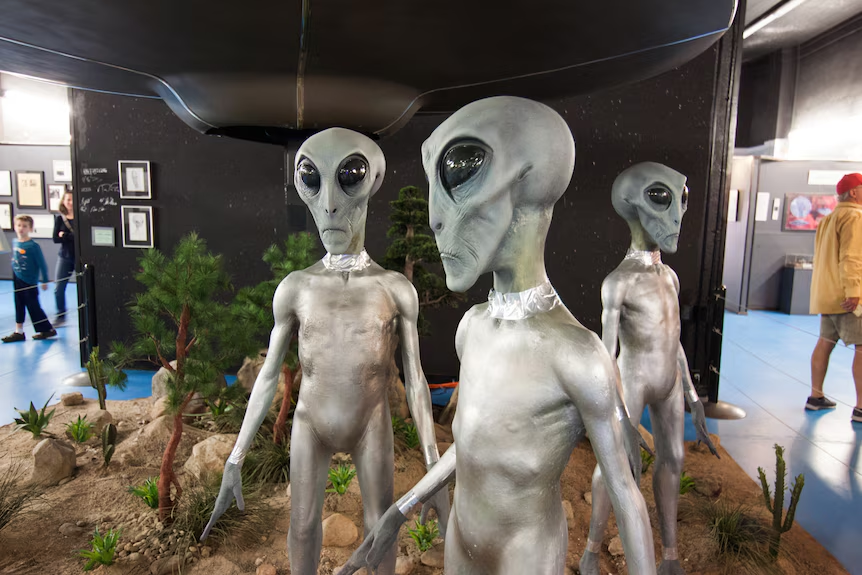
Public Fascination and Media Influence
Interest in UAPs has grown, partly due to:
-
Documentaries and Shows: Programs like The Phenomenon and Unidentified: Inside America’s UFO Investigation bring these topics to mainstream audiences.
-
Media Coverage: News reports on government hearings and declassified footage amplify public awareness.
-
Science Fiction Influence: Popular media integrates UFO and alien motifs, shaping expectations and curiosity.
By 2025, surveys suggest nearly half of Americans believe in extraterrestrial visitation at some point, reflecting a shift in public perception.
UAPs and National Security
The serious consideration of UAPs often centers on aviation and defense concerns. Unidentified objects in controlled airspace could:
-
Endanger commercial or military aircraft
-
Represent potential foreign surveillance or advanced technology
-
Require systematic monitoring to mitigate safety risks
This pragmatic approach frames UAP study as a national security issue, separate from extraterrestrial speculation.
Challenges and Future Directions
-
Data Quality: Many sightings are poorly documented.
-
Consistency: Variability in reporting and instrumentation complicates analysis.
-
Scientific Acceptance: Without reproducible evidence, mainstream science remains cautious.
Nonetheless, structured data collection, government offices like AARO, and interdisciplinary research are expanding understanding and setting standards for evaluating anomalies.
Conclusion
From Kenneth Arnold’s flying saucers in 1947 to the modern UAP investigations, humanity’s fascination with the unknown skies continues. The evolution from UFO to UAP reflects a shift toward neutral, scientific, and security-oriented approaches while maintaining public curiosity. Although no definitive evidence confirms extraterrestrial visitation, unexplained aerial phenomena remain a compelling area of study — bridging history, science, and the enduring human desire to understand what lies beyond.
Read Also: Keep your face towards the sunshine and shadows will fall behind you
Watch Also: https://www.youtube.com/@TravelsofTheWorld24














Leave a Reply