

A single photograph was all it took to ignite the internet. Shared widely across social media platforms, the image appeared to show a mysterious, disc-shaped object hovering above Capitol Hill in Washington, D.C. Within hours, the photo went viral, fueling intense speculation about UFOs, extraterrestrial technology, and secret government programs—especially coming just days after high-profile congressional hearings on alleged “alien” spacecraft programs.
While experts urge caution and stress the lack of verified evidence, the timing of the image has turned it into a cultural flashpoint, reigniting debates about unidentified flying objects, government transparency, and public trust.
A Photo That Set Social Media Ablaze
The viral image, reportedly taken by a tourist near the National Mall, shows a metallic-looking object suspended in the sky above the U.S. Capitol building. The photo is grainy, taken from a distance, yet clear enough to spark wild interpretations.
Within minutes of being posted, users began circulating the image with captions claiming it was proof of alien surveillance or a government cover-up. Hashtags related to UFOs, alien disclosure, and Capitol Hill quickly trended across platforms like X, TikTok, Instagram, and Reddit.
For many, the photo felt like confirmation of long-held suspicions. For others, it was an obvious case of digital manipulation or misidentification. Regardless of perspective, the image struck a nerve—and the internet reacted accordingly.
Context Matters: The Congressional Hearings
The frenzy surrounding the photo cannot be separated from recent congressional hearings focused on Unidentified Aerial Phenomena (UAPs). Lawmakers questioned defense officials and whistleblowers about alleged secret programs investigating unexplained objects and, in some claims, recovered non-human technology.
Although no verifiable evidence of alien spacecraft was presented during the hearings, the testimonies captured global attention. Clips from the sessions spread rapidly online, often stripped of nuance and framed as proof that the government was hiding extraterrestrial encounters.
Against this backdrop, the Capitol Hill UFO image seemed almost too convenient, reinforcing the belief among some that “disclosure” was finally happening.
What Authorities Have Said So Far
Government officials were quick to respond, stating there was no confirmed UFO activity over Capitol Hill at the time the photo was taken. Security agencies emphasized that Washington, D.C. has one of the most heavily monitored airspaces in the world.
According to officials, any unidentified object near sensitive government buildings would trigger immediate investigation and response. No such incident was reported, leading authorities to suggest the object could be a drone, weather balloon, aircraft reflection, or a digitally altered image.
Despite these explanations, skepticism remains high among believers who argue that official denials are part of a long-standing pattern of secrecy.
Experts Weigh In: Science vs Speculation
Aviation experts and astronomers have analyzed the image and raised multiple red flags. The lack of scale, motion data, and corroborating footage makes it impossible to draw meaningful conclusions.
Experts note that still images are particularly unreliable when identifying aerial phenomena. Without information on speed, altitude, or trajectory, even mundane objects can appear extraordinary.
Several analysts also pointed out visual inconsistencies suggesting the image may have been edited or enhanced. In the age of AI-generated imagery, experts warn that even convincing visuals should be treated with caution.
The Role of Artificial Intelligence
Artificial intelligence has transformed how easily convincing fake images can be created. With widely available AI tools, users can generate realistic images of UFOs over famous landmarks in minutes.
This technological reality has intensified public confusion. Many viewers lack the skills to differentiate between real photographs and AI-generated visuals, especially when images align with existing beliefs or emotions.
As a result, the Capitol Hill UFO photo has become a case study in how AI can amplify misinformation, even without malicious intent.
Why the Public Is So Ready to Believe
Psychologists say the public’s reaction reveals more about human behavior than extraterrestrial activity. Humans are naturally drawn to mystery, especially during times of uncertainty.
Recent years have been marked by global crises—pandemics, economic instability, political polarization, and climate anxiety. In such environments, extraordinary explanations can feel emotionally satisfying.
Belief in hidden alien technology also offers a sense of narrative clarity: the idea that powerful forces are operating behind the scenes, making sense of a chaotic world.
Social Media Algorithms and the Amplification Effect
Social media platforms are designed to reward engagement, not accuracy. Posts that provoke shock, fear, or wonder spread faster than measured explanations.
The Capitol Hill UFO image benefited from this system. As engagement increased, algorithms pushed the content to more users, creating a self-reinforcing cycle of visibility and belief.
Fact-checks and debunking posts, while present, struggled to gain equal traction. By the time corrections appeared, millions had already seen—and emotionally reacted to—the image.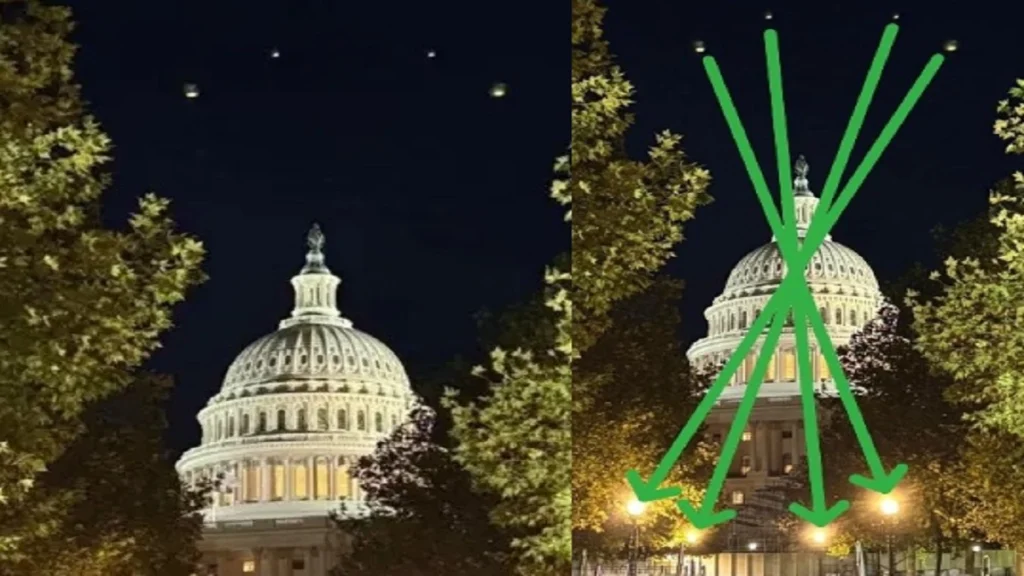
A Familiar Pattern in UFO Culture
Researchers note that the Capitol Hill incident follows a familiar pattern seen in past UFO scares. A dramatic claim emerges, often supported by ambiguous evidence. The story spreads rapidly, driven by media attention and online communities.
Official denials are interpreted as confirmation of secrecy. Over time, interest fades—until the next viral moment reignites the cycle.
This pattern has repeated itself for decades, but digital platforms have dramatically accelerated its speed and scale.
Media Responsibility and Sensational Headlines
Some media outlets contributed to the frenzy by using provocative headlines that emphasized mystery over verification. Phrases like “UFO spotted near Capitol” or “possible alien craft” attracted readers but often lacked critical context.
Media analysts argue that such coverage blurs the line between reporting and entertainment. When reputable outlets treat unverified claims casually, they legitimize speculation and fuel public confusion.
Responsible journalism, experts stress, requires skepticism, expert consultation, and clear distinction between fact and hypothesis.
The Broader Impact on Public Trust
Incidents like the Capitol Hill UFO photo have broader implications beyond alien speculation. They contribute to declining trust in institutions, science, and media.
When people feel they cannot rely on official explanations or visual evidence, they retreat into belief systems shaped by emotion and community reinforcement rather than facts.
This erosion of shared reality poses challenges for democratic discourse, public safety, and science communication.
Separating Curiosity from Credulity
Scientists emphasize that curiosity about extraterrestrial life is not irrational. In fact, many researchers believe microbial life may exist elsewhere in the universe.
However, curiosity must be guided by evidence. There is currently no verified proof that intelligent alien spacecraft are visiting Earth or hovering over government buildings.
Maintaining this distinction is essential to preserving scientific integrity while still encouraging wonder and exploration.
What This Moment Reveals About Society
The viral Capitol Hill UFO image reveals more about modern society than about aliens. It highlights how quickly misinformation can spread, how technology can blur reality, and how trust gaps leave space for speculation.
It also underscores the urgent need for media literacy. Understanding how images can be manipulated, how algorithms shape perception, and how confirmation bias works is essential in the digital age.
Conclusion: A Frenzy Fueled by Timing and Technology
The viral image of a supposed UFO over Capitol Hill may eventually be debunked or forgotten. But the reaction it sparked will not be.
Coming on the heels of congressional hearings about alleged alien spacecraft programs, the photo tapped into a perfect storm of curiosity, distrust, and digital amplification.
Until society develops stronger tools for critical thinking and responsible media consumption, similar moments are likely to repeat—each one reigniting the same questions, fears, and fascinations.
For now, experts urge calm, skepticism, and patience. The truth about the universe will not be revealed through viral snaps—but through careful science, transparency, and evidence-based inquiry.
Read Also: Keep your face towards the sunshine and shadows will fall behind you
Watch Also: https://www.youtube.com/@TravelsofTheWorld24











Leave a Reply