
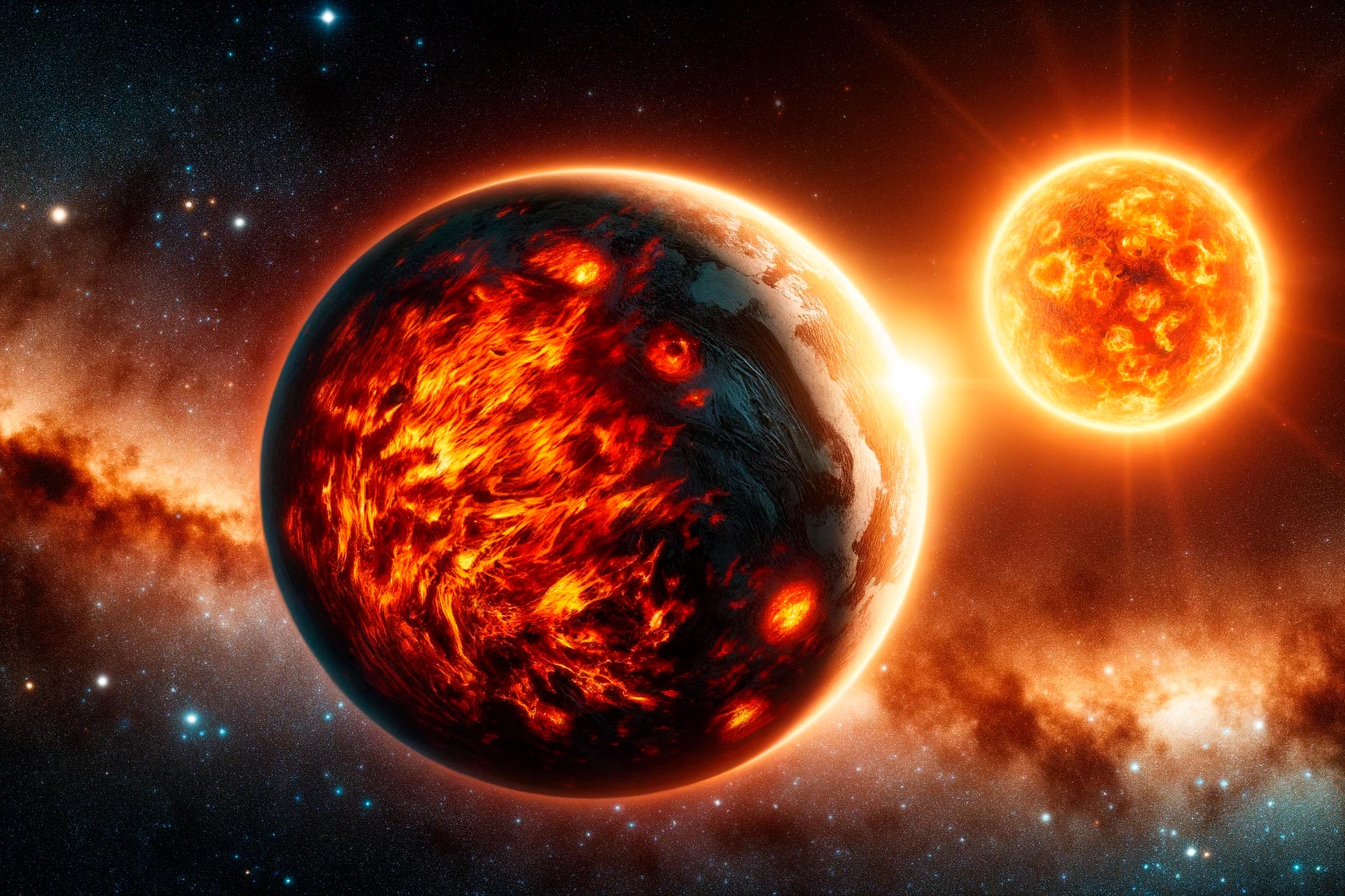
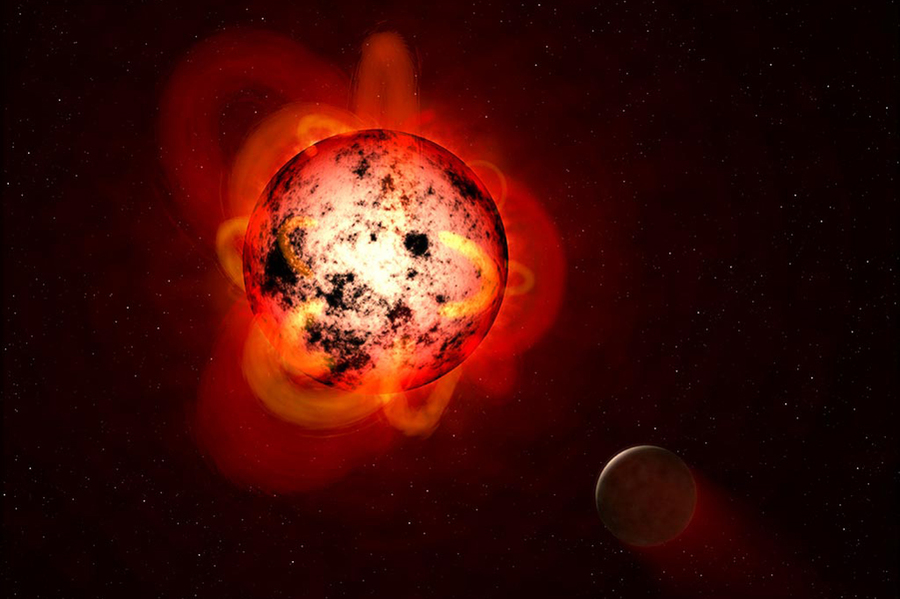
Astronomers have discovered a truly extraordinary exoplanet: an Earth-sized world with one hemisphere covered in molten lava and a year lasting just 4.2 days. This extreme planet challenges our understanding of planetary formation, geology, and the diversity of worlds beyond our solar system. Observations suggest it is tidally locked to its parent star, meaning one side constantly faces the star while the other remains in near-perpetual darkness.
The discovery provides a natural laboratory for studying extreme planetary environments, tidal heating, and atmospheric dynamics, offering insights that may reshape exoplanet science.
Discovery and Observation
The exoplanet, designated TOI-2339b, was identified using the Transiting Exoplanet Survey Satellite (TESS) and confirmed with follow-up observations from ground-based telescopes. Scientists noted periodic dimming of the host star every 4.2 days, corresponding to the planet’s extremely short orbital period.
Spectroscopic analysis revealed unusual thermal signatures: one hemisphere exhibited temperatures high enough to sustain molten lava, while the dark hemisphere remained far cooler. Infrared imaging confirmed the planet’s extreme temperature gradient, highlighting the stark contrast between its two faces.
Implications: TOI-2339b represents one of the most extreme terrestrial exoplanets discovered, providing a window into geological and atmospheric processes under extreme stellar irradiation.
Characteristics of TOI-2339b
-
Size and Mass: Roughly Earth-sized, with a radius 1.1 times that of Earth and a mass slightly higher, suggesting a dense rocky composition.
-
Orbital Period: A year lasting only 4.2 Earth days, placing it extremely close to its host star.
-
Tidally Locked: One hemisphere constantly faces the star (dayside), while the other remains in shadow (nightside).
-
Surface Conditions: The dayside features molten lava oceans and extreme volcanic activity, while the nightside experiences frigid temperatures.
-
Atmosphere: Likely thin and partially vaporized due to intense stellar radiation, with possible lava-generated clouds of mineral vapors.
Lava Hemisphere: Formation and Dynamics
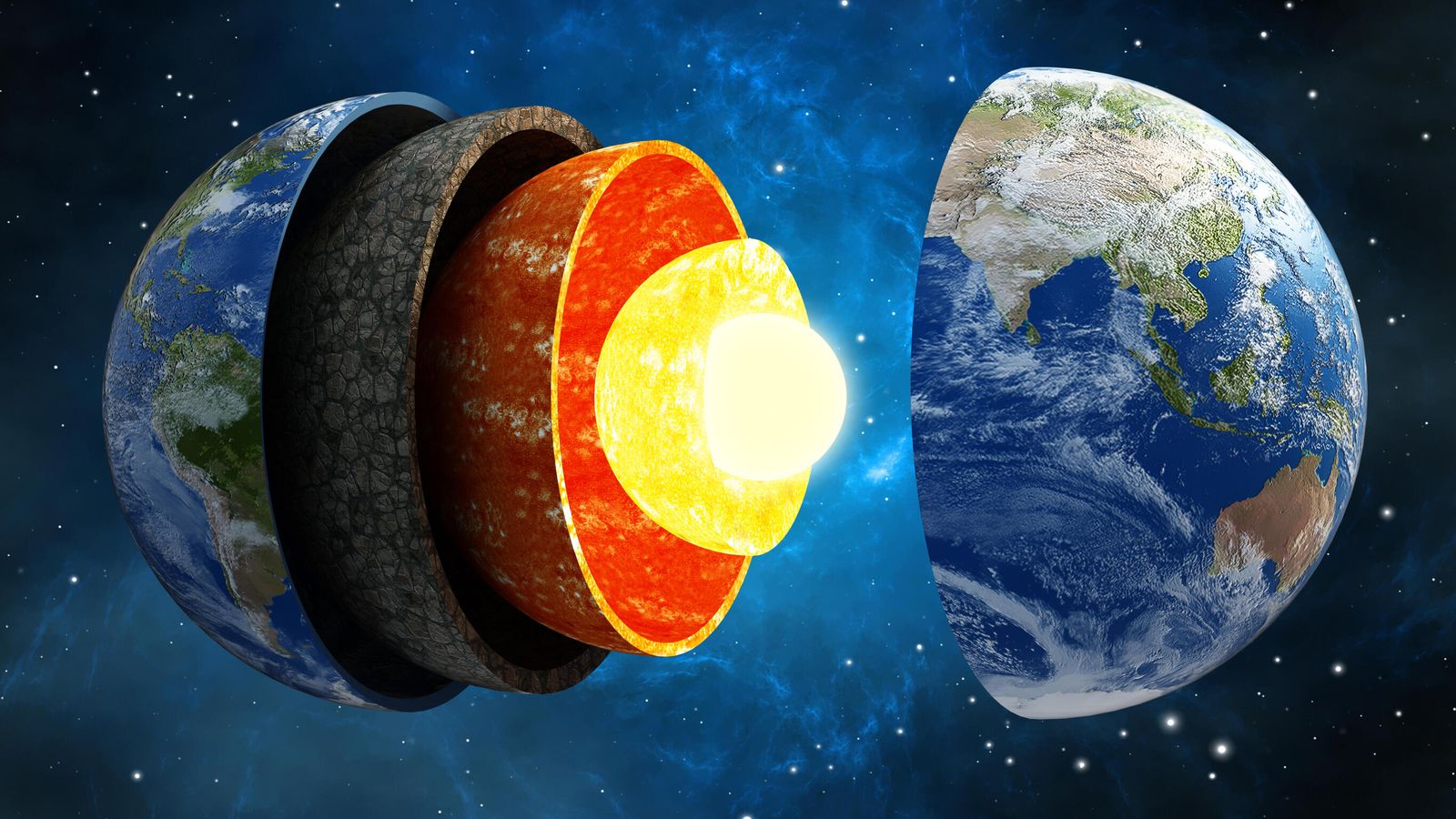
The lava hemisphere results from intense stellar irradiation combined with tidal heating caused by the planet’s close orbit. Continuous gravitational interaction with the host star generates internal friction, keeping the planet’s interior molten and driving surface volcanism.
Tidal locking ensures that the same side always faces the star, creating a permanent dayside with lava oceans and a nightside that is far cooler. Models suggest that the extreme heat causes the surface rock to vaporize partially, forming a transient mineral atmosphere that may condense on the nightside.
Implications: Studying TOI-2339b helps scientists understand the effects of tidal heating, extreme volcanism, and molten surface dynamics, which are critical for modeling the diversity of rocky exoplanets.
Extreme Orbital Dynamics
With a year lasting just 4.2 days, TOI-2339b orbits extremely close to its star, likely within 0.03 astronomical units (AU). At this distance, the planet experiences intense stellar radiation and strong gravitational forces.
This proximity causes:
-
Strong tidal forces: Which maintain tidal locking and enhance internal heating.
-
Rapid orbital motion: Completing more than 85 orbits per Earth year.
-
Atmospheric stripping potential: Stellar winds and radiation may gradually erode any atmosphere present.
These extreme orbital dynamics make TOI-2339b an invaluable case study for understanding the evolution of close-in terrestrial planets.
Observational Techniques Used
Researchers combined multiple observational methods to study TOI-2339b:
-
Transit Photometry: Detecting periodic dimming of the host star to confirm planetary presence.
-
Spectroscopy: Analyzing emitted and absorbed light to identify temperature gradients and surface composition.
-
Infrared Imaging: Revealing the temperature difference between the lava hemisphere and the cooler side.
-
Radial Velocity Measurements: Determining the planet’s mass and confirming its orbit.
The integration of these techniques allowed astronomers to reconstruct a detailed profile of this extreme exoplanet.
Implications for Planetary Science
TOI-2339b offers insights into several key areas:
-
Planet Formation: Its dense rocky composition and extreme proximity suggest formation close to the star or inward migration from a more distant orbit.
-
Tidal Heating Effects: Demonstrates how gravitational forces can influence geological activity and planetary evolution.
-
Atmospheric Dynamics: Highlights how extreme irradiation and molten surfaces affect potential atmospheres and vapor cycles.
-
Comparative Planetology: Serves as a natural laboratory for studying extreme conditions, complementing observations of lava worlds such as 55 Cancri e and KELT-9b.
Potential for Future Research
Astronomers plan several research directions for TOI-2339b:
-
Detailed Spectroscopy: To determine the chemical composition of lava oceans and vaporized minerals.
-
Thermal Mapping: Tracking heat distribution across the planet’s surface to understand heat transport.
-
Atmospheric Studies: Investigating potential mineral vapor clouds and their dynamics.
-
Comparative Studies: Analyzing similarities with other close-in terrestrial exoplanets to model planetary evolution under extreme conditions.
These studies will deepen understanding of extreme terrestrial exoplanets and inform models of planetary formation and evolution.
Broader Context: Lava Worlds in Exoplanet Research
TOI-2339b adds to a growing class of lava worlds, rocky planets with surfaces heated to the point of partial or complete melting. These planets, typically orbiting very close to their stars, provide key insights into:
-
Planetary composition under extreme heat
-
Tidal heating and internal geodynamics
-
Surface and atmospheric interactions in extreme environments
Studying such planets expands our understanding of planetary diversity and challenges assumptions based on solar system analogs.
Read Also: Keep your face towards the sunshine and shadows will fall behind you
Challenges in Observing Lava Worlds
Observing planets like TOI-2339b is challenging due to:
-
Extreme proximity to host stars: Making it difficult to separate planetary signals from stellar noise.
-
Transient surface phenomena: Lava flows and vapor clouds can change rapidly, complicating measurements.
-
Thin or absent atmospheres: Limiting the types of spectroscopy that can detect atmospheric signatures.
Despite these challenges, advances in space telescopes and infrared imaging have made detailed studies increasingly feasible.
What TOI-2339b Tells Us About Planetary Extremes
TOI-2339b exemplifies the incredible range of planetary environments in the galaxy. Its molten hemisphere, rapid orbit, and tidal heating offer clues about:
-
How planets survive close to their stars
-
The role of tidal forces in geological activity
-
Potential atmospheric processes under extreme conditions
-
The diversity of Earth-sized exoplanets beyond our solar system
By studying these extremes, scientists gain perspective on the conditions that shape terrestrial planets and the potential limits of habitability.
Conclusion: A New Frontier in Exoplanetary Science
The discovery of TOI-2339b, an Earth-sized planet with a lava hemisphere and a 4.2-day year, highlights the remarkable diversity of planets in our galaxy. Its extreme conditions provide a unique natural laboratory to study tidal heating, molten surfaces, atmospheric dynamics, and planetary evolution.
As astronomers continue to observe and analyze TOI-2339b, it will serve as a benchmark for understanding the processes that govern lava worlds and other extreme exoplanets. Discoveries like this underscore the vast array of planetary environments beyond our solar system and remind us that the cosmos is far more varied and fascinating than previously imagined.
In the coming years, further observations of TOI-2339b and similar exoplanets will likely reveal new surprises, expanding our knowledge of the mechanisms that shape planetary surfaces, atmospheres, and their interactions with host stars.
Watch Also: https://www.youtube.com/@TravelsofTheWorld24








Leave a Reply