
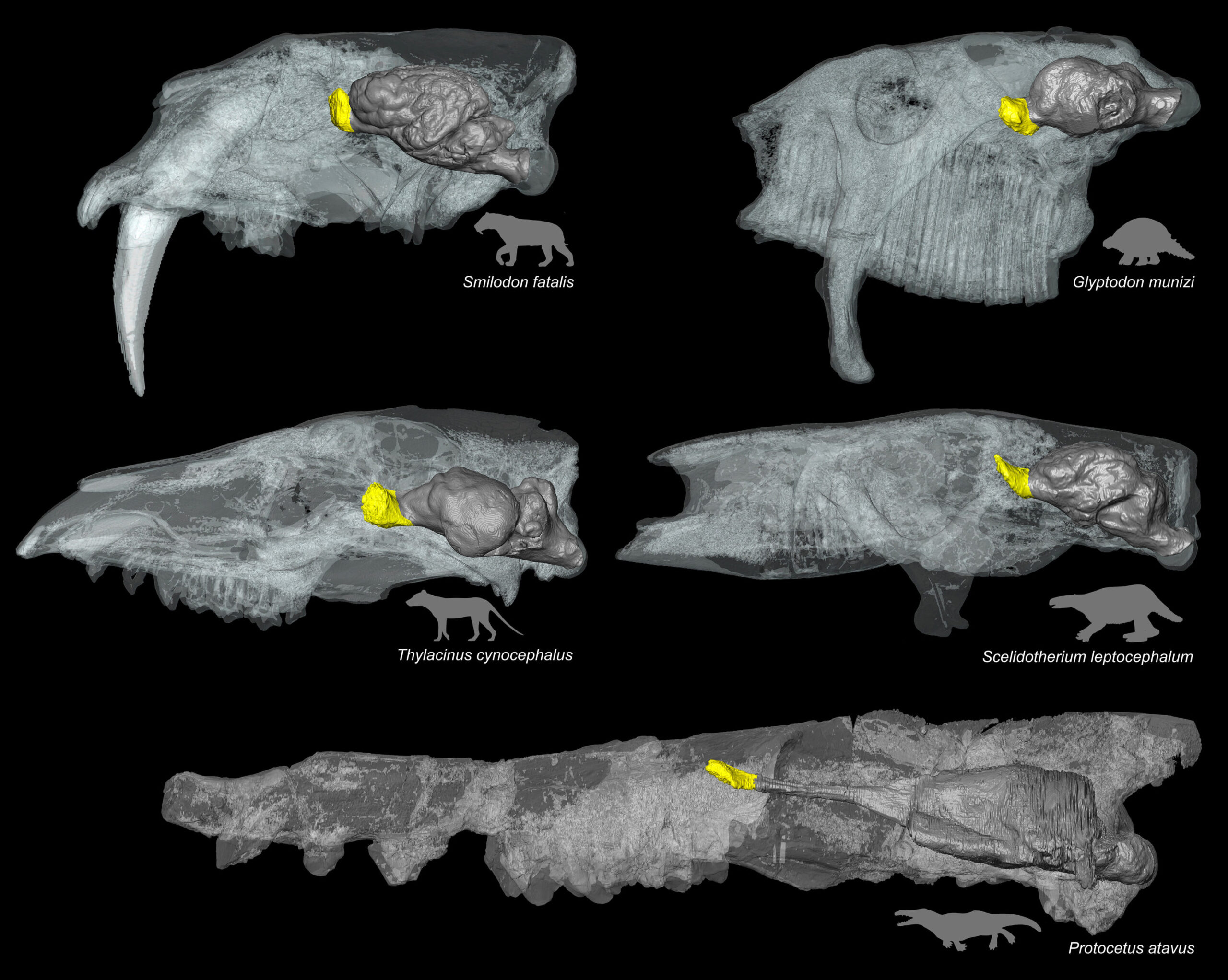
A recent study shows that many long‑extinct mammals — including early whales, sabre‑toothed cats, and marsupial predators — likely had a strong sense of smell. The key: their fossil skulls preserve the space once occupied by their olfactory bulbs — part of the brain responsible for processing smells. By analyzing that space, scientists can now infer how good their sense of smell was even tens of millions of years after they went extinct.
How Scientists Can “See” Smell from Fossils
Soft tissues such as brain matter usually decay and do not fossilize. However, the bones of the skull often remain intact, including the region that once enclosed the brain. In many mammals, the olfactory bulbs sit at the front of the brain — and the skull preserves a “mold” or internal cavity called an endocast that reflects the shape and volume the olfactory bulbs once occupied.
Researchers used advanced imaging (for example, CT scans) to create 3D reconstructions of the skull interior — for both living and extinct mammals. For living species, they compared the size of the olfactory-bulb cavity to the number of functional odor-receptor genes (the genes that encode the proteins that detect smells). They found a strong correlation: species with larger olfactory-bulb endocasts tend to have more smell‑receptor genes, and hence a better sense of smell.
Because this anatomical-genetic link holds in living mammals, the same principle can be applied to fossils — even when DNA is long gone. That means paleontologists now have a method to estimate olfactory capability in extinct species with some confidence, based purely on bone structure.
What This Revealed: Good Smell in Ancient Mammals
Applying this method to a variety of fossil specimens produced some intriguing results:
-
Some early whales from the Eocene (ancient relatives of modern cetaceans) had surprisingly well‑developed olfactory bulbs — suggesting they had a good sense of smell. This contrasts sharply with many modern whales and dolphins whose olfactory bulbs are much reduced.
-
Similarly, the infamous predatory mammal Smilodon (the sabre‑toothed tiger) was analyzed. The study suggests its sense of smell was not as powerful as a modern wolf’s, but possibly more oriented than previously assumed for such a predator.
-
Another extinct species, Thylacine — sometimes called the Tasmanian tiger — also showed evidence of a well-developed olfactory system. Its robust olfactory bulb endocast supports the idea that it relied heavily on smell in its lifestyle.
Thus, many ancient mammals appear to have had olfactory capacities as good as or even superior to those of many living species. This challenges some assumptions about sensory evolution and behaviour in extinct mammals.
Why This Matters — Evolution, Ecology, and Behavior
-
Sensory Evolution and Brain Development
Earlier studies already suggested that a strong sense of smell helped drive early mammalian brain evolution. For instance, fossils of some of the earliest known mammals — such as Morganucodon and Hadrocodium — show enlarged olfactory and tactile brain regions, implying that smell (and touch via fur) were among the first senses to sharpen in mammals.
The new method reinforces that idea, giving quantitative evidence across a wider array of extinct mammals. -
Reconstructing Lifestyle and Ecology
Smell is vital for many animal behaviours — finding food, tracking prey, detecting predators, navigating the environment, recognizing mates or kin, etc. With the ability to estimate olfactory capabilities in extinct species, scientists can now make informed inferences about how these animals lived: whether they hunted by scent, foraged for food, moved at night, or relied on smell more than vision or hearing.
For example: early whales with good smell may have lived partly at or near the surface/coast where smell mattered; thylacines or sabre-toothed predators may have relied on scent in hunting or scavenging — changing how we picture their behaviour. -
Sensory Trade-offs and Evolutionary Adaptation
The study reframes how we understand sensory changes over evolutionary time. As lineages move into new habitats — e.g. fully aquatic life (like whales), underground, or arboreal — sensory priorities shift. Sometimes, senses like smell get reduced while others (like echolocation, vision, hearing) get enhanced. The anatomy‑genetics approach gives a tool to track when or how these shifts happened.
For instance: the reduction of smell in modern whales may reflect adaptation to life in water, where smell is less useful than in air. -
Methodological Breakthrough
Perhaps the most important aspect: this method bridges brain anatomy and genetics. Even when DNA is irretrievably lost, the shape of the skull leaves a reliable clue. That opens up many possibilities: re-examining museum fossil collections, reconstructing senses of long-forgotten species, and building more accurate pictures of ancient ecosystems.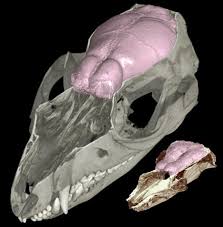
What This Doesn’t Tell Us — Limitations and Caution
-
The method estimates potential smell capability (based on olfactory bulb size and inferred number of receptor genes). It doesn’t tell us exactly what smells the animal could detect, or how well they could discriminate between odors.
-
Behaviour depends not only on smell — but on other senses, brain organization, environment, and lifestyle. A large olfactory bulb doesn’t guarantee a creature lived entirely by smell.
-
The reconstructions assume that the anatomical‑genetic correlation seen in living mammals holds for extinct ones. While that seems reasonable, extinct species may have had different olfactory systems or sensory specializations.
-
For species with highly modified lifestyles (e.g. shifting from land to water), smell may become less important; other senses might have taken over. So a reduced olfactory bulb in fossils does not always mean a “poor sense of smell” — it could reflect sensory trade-offs.
Broader Implications — Why It Changes Our View of Ancient Mammals
These findings help reshape how we view the lives of extinct mammals: not as vague, shadowy creatures, but as real animals with rich sensory lives — smelling, hunting, foraging, exploring, interacting. It underscores that smell was, and remains, a powerful sense for many mammals — not just a humdrum sense humans often take for granted.
The work also offers a model for how scientists can test sensory abilities across deep evolutionary time: connecting bones → brains → genes → behaviour. With more fossil skulls and better imaging, we may soon be able to reconstruct olfactory systems for many ancient mammals — giving us deeper insight into their ecology, evolution, and behaviour.
Ultimately, this research shows that fossils are not just bones: they are windows into lost worlds — complete with smells, scents, hunts, and survival stories.
Read Also: The Race to 300 mph: Will Hennessey or Koenigsegg Break the Speed Record in 2025?
Watch Also: https://www.youtube.com/@TravelsofTheWorld24








Leave a Reply